• Foreign spies are posing as consulting firms, think tanks, corporate recruiters, and more to exploit U.S. soldiers, Army civilians, and family members, the Army deputy chief of staff for intelligence said in a recent memo.

    “Especially in the context of the recent lapse in appropriations and government shutdown, our adversaries are looking online to identify individuals seeking new employment opportunities, expressing dissatisfaction or describing financial insecurity,” Lt. Gen. Anthony R. Hale wrote in a Nov. 13 message sent to more than a million soldiers and Army-related civilians.

    Current and former federal workers, especially those with security clearances, should be aware of these attempts, the message said. “If the offer seems flattering, urgent, exclusive or too good to be true, it probably is.”

    The Army publicized Hale's message in a Monday statement.

    His warning was issued after months of Defense Department changes that fired some civilian employees, induced thousands more to leave, and left many others shaken. The message went out just after the government reopened from a record-long shutdown on Nov. 12.

    In June 2024, a transmission provided by the Army indicated that it had observed such foreign intelligence activity for some time. It said adversaries use less-traditional social-messaging platforms like Reddit and Discord to pose seemingly innocuous questions to servicemembers that increase in sensitivity over time. 

    Requesters “may rely on opinion-based questions such as asking [Department of the Army] personnel for their opinion on topics such as Taiwan, Ukraine or Israel to gather information,” it said. The espionage efforts do not target only classified information and aim to access various forms of sensitive data like battle plans, contracts and research.

    Army members and their families may also be extended “disproportionate payment” offers, such as $1,000 for a two-page whitepaper or an all-expense paid trip to destinations like China, Hong Kong or Macao, the 2024 message said.

    A suspected Chinese intelligence operation has tried to recruit former U.S. federal employees and public policy experts through fake websites and job postings, Nextgov/FCW first reported in September. 

    Those recruitment efforts — which involved low-quality websites representing non-existent companies — appear to have picked up steam amid Department of Government Efficiency-fueled employee departures and terminations over the last several months.

    The FBI previously told Nextgov/FCW that it’s aware of foreign adversaries using employment sites and social media platforms to identify knowledgeable individuals to target for recruitment.

    “Often those targeted have security clearances and access to classified information. But our adversaries also are looking for experts in business and academia with technical expertise,” the bureau said.

    Chinese intelligence entities have deployed online efforts to recruit unwitting current and former federal employees, the National Counterintelligence and Security Center said in April. In March, CNN reported that foreign adversaries, including China and Russia, accelerated efforts to recruit disgruntled federal workers in national security roles.

    ]]>

    ¶¶¶¶¶

    ¶¶¶¶¶

    ¶¶¶¶¶

    ¶¶¶¶¶

    ¶¶¶¶¶

  • On the surface, the Superbox media streaming devices for sale at retailers like BestBuy and Walmart may seem like a steal: They offer unlimited access to more than 2,200 pay-per-view and streaming services like Netflix, ESPN and Hulu, all for a one-time fee of around $400. But security experts warn these TV boxes require intrusive software that forces the user’s network to relay Internet traffic for others, traffic that is often tied to cybercrime activity such as advertising fraud and account takeovers.
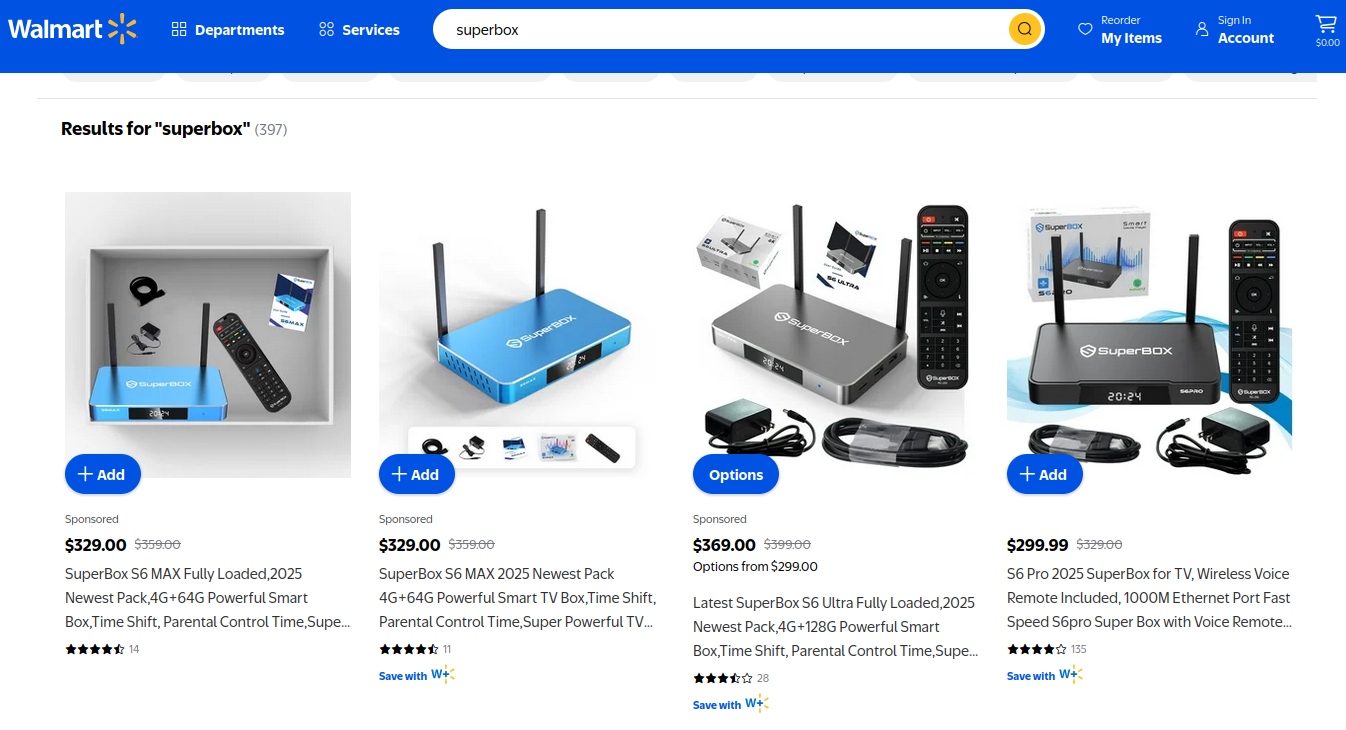
    Superbox media streaming boxes for sale on Walmart.com.

    Superbox bills itself as an affordable way for households to stream all of the television and movie content they could possibly want, without the hassle of monthly subscription fees — for a one-time payment of nearly $400.

    “Tired of confusing cable bills and hidden fees?,” Superbox’s website asks in a recent blog post titled, “Cheap Cable TV for Low Income: Watch TV, No Monthly Bills.”

    “Real cheap cable TV for low income solutions does exist,” the blog continues. “This guide breaks down the best alternatives to stop overpaying, from free over-the-air options to one-time purchase devices that eliminate monthly bills.”

    Superbox claims that watching a stream of movies, TV shows, and sporting events won’t violate U.S. copyright law.

    “SuperBox is just like any other Android TV box on the market, we can not control what software customers will use,” the company’s website maintains. “And you won’t encounter a law issue unless uploading, downloading, or broadcasting content to a large group.”

    A blog post from the Superbox website.

    There is nothing illegal about the sale or use of the Superbox itself, which can be used strictly as a way to stream content at providers where users already have a paid subscription. But that is not why people are shelling out $400 for these machines. The only way to watch those 2,200+ channels for free with a Superbox is to install several apps made for the device that enable them to stream this content.

    Superbox’s homepage includes a prominent message stating the company does “not sell access to or preinstall any apps that bypass paywalls or provide access to unauthorized content.” The company explains that they merely provide the hardware, while customers choose which apps to install.

    “We only sell the hardware device,” the notice states. “Customers must use official apps and licensed services; unauthorized use may violate copyright law.”

    Superbox is technically correct here, except for maybe the part about how customers must use official apps and licensed services: Before the Superbox can stream those thousands of channels, users must configure the device to update itself, and the first step involves ripping out Google’s official Play store and replacing it with something called the “App Store” or “Blue TV Store.”

    Superbox does this because the device does not use the official Google-certified Android TV system, and its apps will not load otherwise. Only after the Google Play store has been supplanted by this unofficial App Store do the various movie and video streaming apps that are built specifically for the Superbox appear available for download (again, outside of Google’s app ecosystem).

    Experts say while these Android streaming boxes generally do what they advertise — enabling buyers to stream video content that would normally require a paid subscription — the apps that enable the streaming also ensnare the user’s Internet connection in a distributed residential proxy network that uses the devices to relay traffic from others.

    Ashley is a senior solutions engineer at Censys, a cyber intelligence company that indexes Internet-connected devices, services and hosts. Ashley requested that only her first name be used in this story.

    In a recent video interview, Ashley showed off several Superbox models that Censys was studying in the malware lab — including one purchased off the shelf at BestBuy.

    “I’m sure a lot of people are thinking, ‘Hey, how bad could it be if it’s for sale at the big box stores?’” she said. “But the more I looked, things got weirder and weirder.”

    Ashley said she found the Superbox devices immediately contacted a server at the Chinese instant messaging service Tencent QQ, as well as a residential proxy service called Grass IO.

    GET GRASSED

    Also known as getgrass[.]io, Grass says it is “a decentralized network that allows users to earn rewards by sharing their unused Internet bandwidth with AI labs and other companies.”

    “Buyers seek unused internet bandwidth to access a more diverse range of IP addresses, which enables them to see certain websites from a retail perspective,” the Grass website explains. “By utilizing your unused internet bandwidth, they can conduct market research, or perform tasks like web scraping to train AI.” 

    Reached via Twitter/X, Grass founder Andrej Radonjic told KrebsOnSecurity he’d never heard of a Superbox, and that Grass has no affiliation with the device maker.

    “It looks like these boxes are distributing an unethical proxy network which people are using to try to take advantage of Grass,” Radonjic said. “The point of grass is to be an opt-in network. You download the grass app to monetize your unused bandwidth. There are tons of sketchy SDKs out there that hijack people’s bandwidth to help webscraping companies.”

    Radonjic said Grass has implemented “a robust system to identify network abusers,” and that if it discovers anyone trying to misuse or circumvent its terms of service, the company takes steps to stop it and prevent those users from earning points or rewards.

    Superbox’s parent company, Super Media Technology Company Ltd., lists its street address as a UPS store in Fountain Valley, Calif. The company did not respond to multiple inquiries.

    According to this teardown by behindmlm.com, a blog that covers multi-level marketing (MLM) schemes, Grass’s compensation plan is built around “grass points,” which are earned through the use of the Grass app and through app usage by recruited affiliates. Affiliates can earn 5,000 grass points for clocking 100 hours usage of Grass’s app, but they must progress through ten affiliate tiers or ranks before they can redeem their grass points (presumably for some type of cryptocurrency). The 10th or “Titan” tier requires affiliates to accumulate a whopping 50 million grass points, or recruit at least 221 more affiliates.

    Radonjic said Grass’s system has changed in recent months, and confirmed the company has a referral program where users can earn Grass Uptime Points by contributing their own bandwidth and/or by inviting other users to participate.

    “Users are not required to participate in the referral program to earn Grass Uptime Points or to receive Grass Tokens,” Radonjic said. “Grass is in the process of phasing out the referral program and has introduced an updated Grass Points model.”

    A review of the Terms and Conditions page for getgrass[.]io at the Wayback Machine shows Grass’s parent company has changed names at least five times in the course of its two-year existence. Searching the Wayback Machine on getgrass[.]io shows that in June 2023 Grass was owned by a company called Wynd Network. By March 2024, the owner was listed as Lower Tribeca Corp. in the Bahamas. By August 2024, Grass was controlled by a Half Space Labs Limited, and in November 2024 the company was owned by Grass OpCo (BVI) Ltd. Currently, the Grass website says its parent is just Grass OpCo Ltd (no BVI in the name).

    Radonjic acknowledged that Grass has undergone “a handful of corporate clean-ups over the last couple of years,” but described them as administrative changes that had no operational impact. “These reflect normal early-stage restructuring as the project moved from initial development…into the current structure under the Grass Foundation,” he said.

    UNBOXING

    Censys’s Ashley said the phone home to China’s Tencent QQ instant messaging service was the first red flag with the Superbox devices she examined. She also discovered the streaming boxes included powerful network analysis and remote access tools, such as Tcpdump and Netcat.

    “This thing DNS hijacked my router, did ARP poisoning to the point where things fall off the network so they can assume that IP, and attempted to bypass controls,” she said. “I have root on all of them now, and they actually have a folder called ‘secondstage.’ These devices also have Netcat and Tcpdump on them, and yet they are supposed to be streaming devices.”

    A quick online search shows various Superbox models and many similar Android streaming devices for sale at a wide range of top retail destinations, including Amazon, BestBuy, Newegg, and Walmart. Newegg.com, for example, currently lists more than three dozen Superbox models. In all cases, the products are sold by third-party merchants on these platforms, but in many instances the fulfillment comes from the e-commerce platform itself.

    “Newegg is pretty bad now with these devices,” Ashley said. “Ebay is the funniest, because they have Superbox in Spanish — the SuperCaja — which is very popular.”
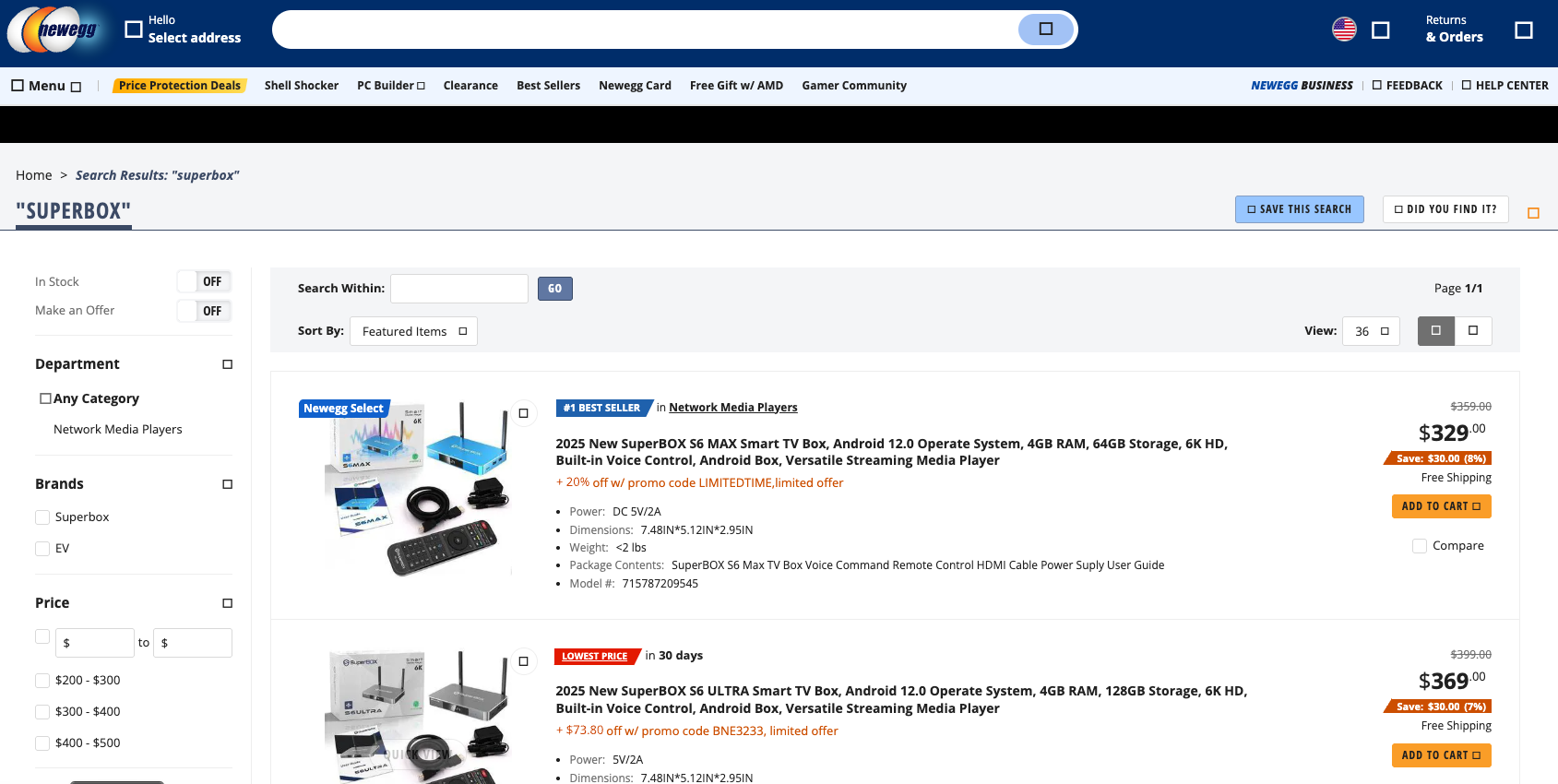
    Superbox devices for sale via Newegg.com.

    Ashley said Amazon recently cracked down on Android streaming devices branded as Superbox, but that those listings can still be found under the more generic title “modem and router combo” (which may be slightly closer to the truth about the device’s behavior).

    Superbox doesn’t advertise its products in the conventional sense. Rather, it seems to rely on lesser-known influencers on places like Youtube and TikTok to promote the devices. Meanwhile, Ashley said, Superbox pays those influencers 50 percent of the value of each device they sell.

    “It’s weird to me because influencer marketing usually caps compensation at 15 percent, and it means they don’t care about the money,” she said. “This is about building their network.”

    A TikTok influencer casually mentions and promotes Superbox while chatting with her followers over a glass of wine.

    BADBOX

    As plentiful as the Superbox is on e-commerce sites, it is just one brand in an ocean of no-name Android-based TV boxes available to consumers. While these devices generally do provide buyers with “free” streaming content, they also tend to include factory-installed malware or require the installation of third-party apps that engage the user’s Internet address in advertising fraud.

    In July 2025, Google filed a “John Doe” lawsuit (PDF) against 25 unidentified defendants dubbed the “BadBox 2.0 Enterprise,” which Google described as a botnet of over ten million Android streaming devices that engaged in advertising fraud. Google said the BADBOX 2.0 botnet, in addition to compromising multiple types of devices prior to purchase, can also infect devices by requiring the download of malicious apps from unofficial marketplaces.

    Some of the unofficial Android devices flagged by Google as part of the Badbox 2.0 botnet are still widely for sale at major e-commerce vendors. Image: Google.

    Several of the Android streaming devices flagged in Google’s lawsuit are still for sale on top U.S. retail sites. For example, searching for the “X88Pro 10” and the “T95” Android streaming boxes finds both continue to be peddled by Amazon sellers.

    Google’s lawsuit came on the heels of a June 2025 advisory from the Federal Bureau of Investigation (FBI), which warned that cyber criminals were gaining unauthorized access to home networks by either configuring the products with malicious software prior to the user’s purchase, or infecting the device as it downloads required applications that contain backdoors, usually during the set-up process.

    “Once these compromised IoT devices are connected to home networks, the infected devices are susceptible to becoming part of the BADBOX 2.0 botnet and residential proxy services known to be used for malicious activity,” the FBI said.

    The FBI said BADBOX 2.0 was discovered after the original BADBOX campaign was disrupted in 2024. The original BADBOX was identified in 2023, and primarily consisted of Android operating system devices that were compromised with backdoor malware prior to purchase.

    Riley Kilmer is founder of Spur, a company that tracks residential proxy networks. Kilmer said Badbox 2.0 was used as a distribution platform for IPidea, a China-based entity that is now the world’s largest residential proxy network.

    Kilmer and others say IPidea is merely a rebrand of 911S5 Proxy, a China-based proxy provider sanctioned last year by the U.S. Department of the Treasury for operating a botnet that helped criminals steal billions of dollars from financial institutions, credit card issuers, and federal lending programs (the U.S. Department of Justice also arrested the alleged owner of 911S5).

    How are most IPidea customers using the proxy service? According to the proxy detection service Synthient, six of the top ten destinations for IPidea proxies involved traffic that has been linked to either ad fraud or credential stuffing (account takeover attempts).

    Kilmer said companies like Grass are probably being truthful when they say that some of their customers are companies performing web scraping to train artificial intelligence efforts, because a great deal of content scraping which ultimately benefits AI companies is now leveraging these proxy networks to further obfuscate their aggressive data-slurping activity. By routing this unwelcome traffic through residential IP addresses, Kilmer said, content scraping firms can make it far trickier to filter out.

    “Web crawling and scraping has always been a thing, but AI made it like a commodity, data that had to be collected,” Kilmer told KrebsOnSecurity. “Everybody wanted to monetize their own data pots, and how they monetize that is different across the board.”

    SOME FRIENDLY ADVICE

    Products like Superbox are drawing increased interest from consumers as more popular network television shows and sportscasts migrate to subscription streaming services, and as people begin to realize they’re spending as much or more on streaming services than they previously paid for cable or satellite TV.

    These streaming devices from no-name technology vendors are another example of the maxim, “If something is free, you are the product,” meaning the company is making money by selling access to and/or information about its users and their data.

    Superbox owners might counter, “Free? I paid $400 for that device!” But remember: Just because you paid a lot for something doesn’t mean you are done paying for it, or that somehow you are the only one who might be worse off from the transaction.

    It may be that many Superbox customers don’t care if someone uses their Internet connection to tunnel traffic for ad fraud and account takeovers; for them, it beats paying for multiple streaming services each month. My guess, however, is that quite a few people who buy (or are gifted) these products have little understanding of the bargain they’re making when they plug them into an Internet router.

    Superbox performs some serious linguistic gymnastics to claim its products don’t violate copyright laws, and that its customers alone are responsible for understanding and observing any local laws on the matter. However, buyer beware: If you’re a resident of the United States, you should know that using these devices for unauthorized streaming violates the Digital Millennium Copyright Act (DMCA), and can incur legal action, fines, and potential warnings and/or suspension of service by your Internet service provider.

    According to the FBI, there are several signs to look for that may indicate a streaming device you own is malicious, including:

    -The presence of suspicious marketplaces where apps are downloaded.
    -Requiring Google Play Protect settings to be disabled.
    -Generic TV streaming devices advertised as unlocked or capable of accessing free content.
    -IoT devices advertised from unrecognizable brands.
    -Android devices that are not Play Protect certified.
    -Unexplained or suspicious Internet traffic.

    This explainer from the Electronic Frontier Foundation delves a bit deeper into each of the potential symptoms listed above.

    ¶¶¶¶¶

    ¶¶¶¶¶

    ¶¶¶¶¶

    ¶¶¶¶¶

    ¶¶¶¶¶

  • A new malware campaign targeting Brazilian users has emerged, using WhatsApp as its primary distribution channel to spread banking trojans and harvest sensitive information.

    This sophisticated attack leverages social engineering by exploiting the trust victims place in their existing contacts, making the malicious files appear legitimate.

    The campaign begins with phishing emails containing archived VBS scripts that employ advanced obfuscation techniques to evade detection by security software.

    Once the initial payload runs, it downloads and installs Python and the Selenium WebDriver components, enabling automated interaction with WhatsApp Web.

    The malware then injects malicious JavaScript code into the victim’s browser session, accessing WhatsApp’s internal APIs to enumerate contacts and distribute payloads.

    This approach allows attackers to spread the infection without requiring QR code authentication by hijacking existing logged-in sessions by copying browser cookies and local storage data.

    K7 Security Labs researchers identified this variant as part of the broader Water-Saci campaign, which has been actively targeting financial institutions across Brazil.

    The attack chain deploys both a Python-based distribution script and a banking trojan that monitors for active Windows related to Brazilian banks and cryptocurrency wallets.

    By combining automated messaging with memory-only payload execution, the malware remains undetected, mainly while compromising victim machines and their entire contact networks.

    The campaign also delivers an MSI installer that drops an AutoIt script alongside encrypted payload files. This secondary component establishes persistence through registry modifications and continuously monitors the victim’s active windows for banking-related keywords.

    Kill chain (Source - K7 Security Labs)
    Kill chain (Source – K7 Security Labs)

    When specific financial institutions or crypto wallet applications are detected, the malware decrypts and loads its banking trojan directly into memory, bypassing disk writes and making traditional file-based detection methods ineffective.

    Technical Breakdown of the Infection Mechanism

    The infection begins when victims receive phishing emails containing ZIP-archived VBS script files that use character encoding and XOR encryption to evade signature-based detection.

    The script employs a multi-layered obfuscation strategy, building strings character by character using Chr() functions and then applying XOR operations with specific values to decode the actual malicious commands.

    objyAQeaOCCI = objyAQeaOCCI & Chr(49)
    objyAQea0cCI = objyAQeaOCCI & Chr(55)
    objyAQea0cCI = objyAQeaOCCI & Chr(57)
    For Each varcBAIRFO In Split(strSwQRHTeBd, aOwTbJaE)
    objhiCebPk = (objhiCebPk (26 Xor 93)) Mod 256
    objhiCebPk = (objhiCebPk (150 Xor 104)) Mod 256

    Char and Xor (Source - K7 Security Labs)
    Char and Xor (Source – K7 Security Labs)

    After deobfuscation, the script downloads two components: an MSI file and another VBS file. The downloaded VBS file contains identical obfuscation patterns and drops a batch script that installs the Python, ChromeDriver, and Selenium packages.

    This automated setup creates the infrastructure needed for WhatsApp automation without requiring manual user intervention.

    The Python script, named whats.py, takes control of the victim’s WhatsApp Web session by copying browser profile data, including cookies, local storage, and IndexedDB files, to a temporary directory.

    Using Selenium’s user-data-dir argument, the script launches Chrome with these copied credentials, effectively bypassing the QR code authentication step that would usually protect WhatsApp Web access.

    arquivos_copiar = [
    “Cookies”, “Cookies-journal”,
    “Local Storage”, “Session Storage”,
    “IndexedDB”, “Service Worker”
    ]
    options.add_argument(f”–user-data-dir={perfil_temp}”)

    Sets up the user-data-dir (Source - K7 Security Labs)
    Sets up the user-data-dir (Source – K7 Security Labs)

    Once authenticated, the malware injects helper JavaScript from GitHub into the WhatsApp Web page context, enabling access to internal API functions like WPP.contact.list, WPP.chat.sendTextMessage, and WPP.chat.sendFileMessage.

    The script then harvests the victim’s contact list, filtering out groups, business accounts, and contacts with specific number patterns configured by the attackers.

    These harvested contacts are batched and systematically sent malicious ZIP files containing the next stage of the infection, perpetuating the campaign across victim networks while sending detailed logs back to the attacker’s PHP server.

    Follow us on Google NewsLinkedIn, and X to Get More Instant UpdatesSet CSN as a Preferred Source in Google.

    The post Hackers Leveraging WhatsApp That Silently Harvest Logs and Contact Details appeared first on Cyber Security News.

    ¶¶¶¶¶

    ¶¶¶¶¶

    ¶¶¶¶¶

    ¶¶¶¶¶

    ¶¶¶¶¶

  • Tel Aviv, Israel, November 24th, 2025, CyberNewsWire Blast is introducing a new operating model for cloud security with a first-of-its-kind Preemptive Cloud Defense Platform, replacing reactive response with continuous prevention. Blast Security, a cybersecurity startup founded by industry veterans from Solebit (acquired by Mimecast) and elite IDF units, today announced its launch from stealth and […]

    The post Elite Cyber Veterans Launch Blast Security with $10M to Turn Cloud Detection into Prevention appeared first on GBHackers Security | #1 Globally Trusted Cyber Security News Platform.

    ¶¶¶¶¶

    ¶¶¶¶¶

    ¶¶¶¶¶

    ¶¶¶¶¶

    ¶¶¶¶¶

  • Tel Aviv, Israel, November 24th, 2025, CyberNewsWire

    Blast is introducing a new operating model for cloud security with a first-of-its-kind Preemptive Cloud Defense Platform, replacing reactive response with continuous prevention.

    Blast Security, a cybersecurity startup founded by industry veterans from Solebit (acquired by Mimecast) and elite IDF units, today announced its launch from stealth and a $10 million seed round co-led by 10D and MizMaa Ventures.

    Blast is redefining how organizations eliminate cloud risks using preventive guardrails to ensure environments remain secure by design.

    The company is already working with numerous global enterprises to secure their production environments, preventing cloud risk by over 90% and significantly shrinking the blast radius.

    Enterprises operating at multi-cloud scale face relentless change and compounding complexity accelerated by the growth of AI.

    Blast’s Preemptive Cloud Defense Platform marks an inflection point for organizations shifting from reactive alert-chasing to proactive, continuously enforced prevention.

    It turns native cloud control into a preventive defense fabric, where every change is modelled, tested, and enforced safely. This approach ensures prevention never breaks production or slows innovation.

    “Cloud adoption and AI have multiplied complexity and risk faster than teams can keep up. The market is full of tools for detection and remediation, but the only reliable way to mitigate risk is to prevent it in the first place – and that’s what Blast is built to do,” said Boris Vaynberg, co-founder and CEO of Blast Security.

    “When Henry Ford introduced his automobile, many believed horses were good enough. It’s hard to see how a new approach can redefine the standard – until it becomes the standard. Our mission is to make prevention the new standard in cloud security and lead the market shift.”

    The lightbulb moment for Blast’s founding team – Boris Vaynberg, Ido Bukra, and Roi Panai – came when they were called to reserve duty to lead a national-level cloud security project.

    During this critical time, the team realized that security must match the cloud’s speed, scale, and complexity with prevention measures-built in.

    Blast’s founding team brings over a decade of collaborative experience – their first company, Solebit, was acquired by Mimecast in their largest acquisition.

    Blast’s engineers are cloud security veterans committed to developing game-changing, practical solutions that prevent risks before they arise and keep cloud environments inherently secure.

    “At Via, we see the shift from alert-chasing to prevention as a strategic program to strengthen our overall defense. Blast enables us to enforce preventive guardrails at scale – making our cloud environments more resilient with the same resources, less manual effort, and the trust to ensure zero disruption to the business,” said Oren Hogery, CISO, Via.

    “Blast’s founding team has a remarkable history of solving complex security challenges,” said Itay Rand, General Partner at 10D Capital.

    “Their preemptive approach to cloud security meets a growing critical need in the market, enabling organizations to prevent threats rather than merely reacting to them. We’re thrilled to back Blast as they set a new standard for truly proactive cloud defense.”

    To learn more about Blast’s Preemptive Cloud Defense Platform and its capabilities, users can visit blast.security

    About Blast Security

    Blast Security marks the end of reactive cloud security, replacing after-the-fact response with continuous prevention.

    Instead of reacting to threats and chasing alerts, Blast creates a living, preemptive defense fabric that continuously evolves with the enterprise cloud environment – eliminating alert fatigue, reducing operational friction, and shrinking the blast radius.

    The Blast founding team has worked together for more than a decade and has a proven track record of building scalable prevention products, including at Solebit (acquired by Mimecast).

    Headquartered in Tel Aviv, Blast is backed by leading investors and trusted by global organizations.

    Users can visit blast.security to learn more.

    Contact

    VP Markerting

    Dayana Nevo

    Blast Security

    dayanan@blast.security

    The post Elite Cyber Veterans Launch Blast Security with $10M to Turn Cloud Detection into Prevention appeared first on Cyber Security News.

    ¶¶¶¶¶

    ¶¶¶¶¶

    ¶¶¶¶¶

    ¶¶¶¶¶

    ¶¶¶¶¶

  • A proof-of-concept exploit has been publicly released for CVE-2025-9501, a critical, unauthenticated command-injection vulnerability affecting W3 Total Cache, one of WordPress’s most widely deployed caching plugins.

    With over 1 million active installations, the vulnerability poses a significant risk to countless websites worldwide.

    RCE Security discovers that the flaw exists in W3 Total Cache’s dynamic content parsing functionality, specifically in the _parse_dynamic_mfunc function within the PgCache_ContentGrabber class.

    The vulnerable code uses PHP’s eval() function to execute code derived from cached page content, creating a direct code injection vector.

    Page Cache is enabled in the plugin
    Page Cache is enabled in the plugin

    Unauthenticated Command Injection Discovered

    RCESecurity researchers analyzed WPScan’s initial advisory and developed a working exploit to validate the vulnerability’s severity.

    The vulnerability requires specific conditions to be exploitable. Attackers must know the W3TC_DYNAMIC_SECURITY constant value defined in the site’s wp-config.php file.

    Additionally, page caching must be enabled (core functionality but disabled by default), and website comments must be permitted for unauthenticated users.

    If these conditions align, attackers can inject arbitrary PHP code through specially crafted HTML comments in cached pages, achieving complete remote code execution.

    PropertyValue
    CVE IDCVE-2025-9501
    Vulnerability TypeUnauthenticated Command Injection / Remote Code Execution
    Affected PluginW3 Total Cache
    Affected VersionsVersions with vulnerable code in PgCache_ContentGrabber class
    Attack VectorCached page content with malicious mfunc comments
    ImpactRemote Code Execution, Complete Server Compromise
    StatusExploit PoC Released

    When the page cache processes a request, it invokes the vulnerable _parse_dynamic function, which searches cached content for specially formatted mfunc comment tags.

    If an attacker knows the W3TC_DYNAMIC_SECURITY value, they can inject malicious PHP code within these tags. The code then executes directly on the server, granting attackers shell-level access.

    A simple injection like <!– mfunc rcesec –>echo passthru($_GET[1337])<!– /mfunc rcesec –> enables command execution.

    While technically straightforward to exploit once preconditions are met, the vulnerability’s real-world impact depends on WordPress administrator practices.

    Sites using the W3TC_DYNAMIC_SECURITY feature with default values or weak secrets face heightened risk.

     comments are enabled for unauthenticated users
     Comments are enabled for unauthenticated users

    The combination of widespread plugin adoption and the ability to execute arbitrary code positions this as a critical threat.

    RCESecurity recommends that Website administrators using W3 Total Cache immediately review their security configurations, turn off the feature if unused, or apply available patches.

    The vulnerability underscores the importance of secure coding practices, particularly avoiding dynamic code evaluation functions like eval() in security-sensitive contexts.

    Website owners should immediately review W3 Total Cache configurations, update to patched versions when available, and consider disabling dynamic content caching if it is not actively used.

    Organizations running penetration tests should incorporate this vulnerability into their assessment protocols to identify exposed instances within their infrastructure.

    Follow us on Google News, LinkedIn, and X for daily cybersecurity updates. Contact us to feature your stories.

    The post PoC released for W3 Total Cache Vulnerability that Exposes 1+ Million Websites to RCE Attacks appeared first on Cyber Security News.

    ¶¶¶¶¶

    ¶¶¶¶¶

    ¶¶¶¶¶

    ¶¶¶¶¶

    ¶¶¶¶¶

  • President Trump’s plan for Ukraine’s future is falling flat on both sides of the Atlantic. His chief negotiator Steve Witkoff reportedly helped draft a 28-point plan with his Russian counterpart last month in Miami. No Ukrainians were present for those talks, according to Axios. But now Ukraine’s president is under pressure from Trump’s Army secretary to find a way forward—possibly as soon as this Thursday—using that plan as at least a start point to end Russia’s nearly four-year invasion and occupation of eastern Ukraine. 

    Latest: The 28-point plan is now a 19-point plan, according to the Financial Times, reporting Monday. However, “the most politically sensitive elements [are still] to be decided by the countries’ presidents,” FT’s Christopher Miller reports. According to one Ukrainian official, “Very few things are left from the original version.” 

    U.S. and Ukrainian officials met Sunday in Geneva to begin work on “an updated and refined peace framework,” according to a joint statement from the two countries. It’s not yet clear what’s been updated. So far, “Only one EU leader—Hungary’s Kremlin-friendly Prime Minister Viktor Orbán—has unconditionally backed Witkoff’s plan, which critics say makes disproportionate concessions to Russia,” Politico reported Sunday. Polish Prime Minister Donald Tusk shared his misgivings on Twitter Sunday, writing, “before we start our work, it would be good to know for sure who is the author of the plan and where was it created.” 

    Trump even walked back his support for the Witkoff document, telling reporters at the White House Saturday that it’s “not my final” offer. “We're trying to get it ended. One way or the other, we have to get it ended,” he said. 

    Cracks in the White House’s plan began emerging publicly in Europe early last week, as Axios and Politico reported when word of the 28-point plan emerged. Indeed, one European Union defense official told Politico on Wednesday, “Europeans have not been consulted on this…The Russians have clearly identified Witkoff as someone who is willing to promote their interests.” On Thursday, the EU’s foreign policy chief Kaja Kallas told reporters, “In this war, there is one aggressor and one victim. So far, we haven't heard of any concessions from Russia's side.”

    By Friday, those cracks had spread from Europe to Congress. Senate Armed Services Committee Chairman Roger Wicker, R-Miss., shared his serious misgivings in a public statement

    “This so-called ‘peace plan’ has real problems, and I am highly skeptical it will achieve peace,” Wicker said. “Ukraine should not be forced to give up its lands to one of the world’s most flagrant war criminals in Vladimir Putin…The size and disposition of Ukraine’s armed forces is a sovereign choice for its government and people. And any assurances provided to Putin should not reward his malign behavior or undermine the security of the United States or allies. In particular, any suggestion that we can pursue arms control with a serial liar and killer like Putin should be treated with great skepticism.”

    GOP Sens. Mitch McConnell and Lindsey Graham also said they opposed Trump’s plan. “While there are many good ideas in the proposed Russia-Ukraine peace plan, there are several areas that are very problematic and can be made better,” Graham wrote on social media Saturday. 

    McConnell: “If Administration officials are more concerned with appeasing Putin than securing real peace, then the President ought to find new advisors,” the former majority leader said in his own statement Friday. “Rewarding Russian butchery would be disastrous to America’s interests. And a capitulation like Biden’s abandonment of Afghanistan would be catastrophic to a legacy of peace through strength.”

    Historian reax: Anne Applebaum described it as a “Murky Plan That Ensures a Future War,” writing Saturday in The Atlantic.

    One lingering question from these White House ambitions in Ukraine: Why is the U.S. Army’s man-train-equip boss, Secretary Dan Driscoll, doing diplomacy? One user remarked on Reddit, “The secretary of the army delivering a peace plan that’s essentially, give up territory, reduce your military by half, and capitulate is not…the warrior spirit I expected from him.” 

    Related reading: 


    Around the Defense Department

    How the Army’s most tech-forward divisions are practicing for war. Defense One’s Jennifer Hlad reports from a two-week Joint Pacific Multinational Readiness Center exercise in Hawaii, where the 25th Infantry Division worked with every U.S. service branch plus seven partner nations to defend an archipelago and take back islands seized by the enemy.

    The exercise involved 75 tech-centered experiments. “We have old stuff, we have new stuff, and we’re fighting in a new way,” said Col. Dan Von Benken, the division’s artillery commander. Read on, here.

    Can partner nations help solve the Navy’s shipbuilding woes? Chief of Naval Operations Adm. Daryl Caudle thinks so; his first trip abroad as the Navy’s top officer took him to South Korea and Japan in search of assistance in expanding and accelerating his service’s ability to add warships. Hlad talked with him at Pearl Harbor, here.

    Additional reading:HII Delivers Virginia-Class Submarine Massachusetts (SSN 798) to U.S. Navy,” the firm announced Friday.  

    Commentary: More is needed to turn the Marine Corps' aspirations into reality. Three former commandants—retired generals Krulak, Hagee, and Conway—acknowledge Gen. Eric Smith’s calls for more amphibious warfare ships and the expected National Defense Strategy’s inward turn, but say the Force Design concept is still leading the service astray. Read that in Defense One, here.

    Trump 2.0

    Regime change disguised as drug war? Several months of satellite data suggests the Pentagon’s recent naval buildup around Latin America “is focused more on a pressure campaign against Venezuela than on the counternarcotics operation the Trump administration says it’s waging,” the New York Times reported Friday, with a big assist from Ollie Ballinger of the University College London’s Center for Advanced Spatial Analysis. 

    How so? The “busiest [cocaine] smuggling routes…are off the coast of neighboring Colombia.” But those are “several hundred miles” away from where U.S. Navy cruisers and destroyers “have consistently been sailing in an area 50 to 100 miles off Venezuelan shores,” Riley Mellen of the Times reports. What’s more, “smuggling routes in the Caribbean are dwarfed by those in the eastern Pacific, which has not seen a comparable influx of American military assets.”

    Expert reax: “The naval presence that we’re seeing here is aimed at Venezuela, and they can see it,” Mark Cancian of the Center for Strategic and International Studies told Mellen. Continue reading (gift link), here

    If the U.S. goes to war with Venezuela, it would be doing so without authorization from Congress, without casus belli, without any allies or international support, without an apparent plan for the country after Maduro is gone, and without any apparent preparation for stabilization or containing the fallout, noted Illinois international relations professor Nicholas Grossman, writing Monday on social media.

    Related: Trump and his aides “repeatedly steamrolled or sidestepped government lawyers” questioning the legality of using the military to kill alleged drug traffickers, several current and former officials told the Washington Post, reporting Saturday. 

    “The question is, is it legal just to kill the guy if he’s not threatening to kill you and you’re outside an armed conflict?” a former senior official said. “There are people who are simply uncomfortable with the president just declaring we’re at war with drug traffickers.”

    And lastly today: Trump’s recent call for political retribution indicates thatThe President Is Losing Control of Himself,” former Naval War College professor Tom Nichols argued Friday for The Atlantic

    Tipping point? “A group of Democratic legislators—all of them either military veterans or former national-security officials—may have helped to push the president over the edge,” Nichols writes for those who may have missed the headlines (like this one). “On Tuesday, they issued a video reminding members of the U.S. Armed Forces that their oath of service requires them to refuse illegal orders, and that their loyalty is owed not to any one president, but to the Constitution itself.” 

    “Normally, legislators don’t feel the need to make such an obvious declaration, but the president is using the military—including deploying troops to U.S. cities and ordering the killing of people on the high seas—in ways that almost certainly involve illegal orders,” Nichols warns. “This is a new and dire development in the ongoing American constitutional crisis. The voters, Congress, and, yes, the U.S. military must all now be more vigilant than at any time in our modern history,” he writes. Read the rest (gift link), here

    ICYMI: Sen. Jack Reed, D-R.I., also has issues with the president’s calls for political violence. “President Trump’s social media posts were inflammatory, irresponsible, and totally unacceptable,” Reed said in a statement Friday. “He continues to try to use intimidation and executive overreach to silence his critics. The Trump Administration systematically ousted judge advocates general (JAGs)—military lawyers—who are supposed to advise commanders on the rule of law, including whether presidential orders are legal.” 

    “This purge of independent JAG officers offering principled legal advice free from partisan influence has raised all kinds of legitimate legal and ethical concerns,” said Reed, the ranking member on the Armed Services Committee. “I would welcome the Secretary of Defense coming to Congress to testify about this matter if he has any issues with my colleagues restating the law and encouraging people to stand up for our Constitution. President Trump should know a thing or two about seditious acts because he himself pardoned many violent January 6th criminals who were convicted of seditious conspiracy.”

    ]]>

    ¶¶¶¶¶

    ¶¶¶¶¶

    ¶¶¶¶¶

    ¶¶¶¶¶

    ¶¶¶¶¶

  • A massive resurgence of the Sha1-Hulud supply chain malware has struck the open-source ecosystem, compromising over 800 npm packages and tens of thousands of GitHub repositories in a campaign the attackers have dubbed “The Second Coming.”

    This sophisticated wave targets high-profile dependencies from major organizations, including AsyncAPI, Postman, PostHog, Zapier, and ENS, affecting an estimated 132 million monthly downloads.

    The attack leverages the Bun runtime environment to bypass traditional detection methods and introduces a catastrophic fallback mechanism capable of wiping victim data.

    The most alarming evolution in this variant is its aggressive volatility. While the primary goal remains credential theft, the malware includes a destructive fail-safe that triggers if it cannot establish persistence or exfiltrate data.

    If the malware fails to authenticate to GitHub, create a repository, fetch a GitHub token, or locate an NPM token, it executes a wiper routine.

    Sha1-Hulud Supply Chain Attack

    This logic attempts to destroy the victim’s entire home directory by deleting every writable file owned by the current user. This shift indicates that if Sha1-Hulud cannot steal credentials or secure an exfiltration channel, it defaults to catastrophic data destruction to eliminate evidence or cause disruption.

    The attack chain first observed by Aikido Security begins with a file named setup_bun.js, which installs the Bun runtime to execute the core malicious payload contained in bun_environment.js. This method allows the malware to operate outside the standard Node.js execution path, often evading static analysis tools.

    Once active, the worm utilizes TruffleHog to scan the infected environment for API keys and tokens. Unlike previous versions that used hardcoded repository names, this iteration creates randomly named GitHub repositories to store stolen secrets.

    These repositories are identified by the description “Sha1-Hulud: The Second Coming,” with security researchers currently identifying approximately 26,300 exposed repositories.

    Idan Dartikman, co-founder and CTO of Koi Security, emphasized the escalation in tactics. “This wave is larger, spreads more quickly, and is more violent than the last,” Dartikman stated. “There’s also a big security change coming to NPM, and it is very possible that the threat actor worked fast to infect as many victims as possible before that.”

    The timing of this campaign appears calculated to precede npm’s scheduled revocation of classic tokens on December 9, 2025. The compromise has affected critical infrastructure software, including significant portions of the AsyncAPI and Postman ecosystems.

    Security teams are advised to immediately audit dependencies for the specific file indicators and rotate all credentials exposed in CI/CD environments.

    Victim OrganizationAffected Scope/Package ExamplesEstimated Impact
    AsyncAPI@asyncapi/cli,@asyncapi/generator,asyncapi-previewCritical development tools used for event-driven architectures.
    PostHog@posthog/cli,@posthog/node,posthog-jsAnalytics data ingestion and plugin infrastructure.
    Postman@postman/collection-fork,@postman/tunnel-agentAPI development and testing utilities.
    Zapier@zapier/zapier-sdk,zapier-platform-coreIntegration and automation SDKs.
    ENS Domains@ensdomains/ensjs,@ensdomains/thorinEthereum Name Service frontend and contract interactions.

    Follow us on Google News, LinkedIn, and X for daily cybersecurity updates. Contact us to feature your stories.

    The post Sha1-Hulud Supply Chain Attack: 800+ npm Packages and Thousands of GitHub Repos Compromised appeared first on Cyber Security News.

    ¶¶¶¶¶

    ¶¶¶¶¶

    ¶¶¶¶¶

    ¶¶¶¶¶

    ¶¶¶¶¶

  • India-aligned threat group Dropping Elephant has launched a sophisticated multi-stage cyberattack targeting Pakistan’s defense sector using a Python-based remote access trojan disguised within an MSBuild dropper.

    Idan Tarab has identified this advanced campaign that leverages fake defense-related phishing lures to compromise military research and development units and procurement facilities linked to Pakistan’s National Radio and Telecommunication Corporation.

    The attack begins innocuously with a phishing email containing a malicious ZIP archive. Once downloaded, the archive includes an MSBuild project file that serves as the initial dropper, along with a decoy PDF designed to appear legitimate.

    When executed, the dropper begins downloading multiple components to the Windows Tasks directory, establishing persistence via scheduled tasks with seemingly legitimate names such as KeyboardDrivers and MsEdgeDrivers.

    Security researcher Idan Tarab noted that Dropping Elephant employed sophisticated obfuscation techniques throughout the infection chain, using UTF-reverse encryption to reconstruct strings and dynamic API resolution to avoid detection by security tools.

    The group’s approach demonstrates significant technical maturity in weaponizing legitimate Windows utilities as part of their attack infrastructure.

    The Stealth Python Persistence Mechanism

    The operation’s centerpiece involves deploying a complete embedded Python runtime to the AppData directory, where a fake DLL file named python2_pycache_.dll actually contains marshalled Python bytecode rather than legitimate library code.

    This payload executes via pythonw.exe, which runs without displaying a window, providing deep stealth against potential defenders.

    The Python backdoor includes multiple modules, such as client, commands, remote_module, and base.py, enabling comprehensive system control and information gathering from compromised machines.

    The malware maintains command-and-control communication through domains including nexnxky.info, upxvion.info, and soptr.info.

    The identified code contains heavily obfuscated variable names and base64-encoded command structures, making manual analysis particularly challenging.

    The group employed specific file paths and task scheduler entries that mimic legitimate Windows operations, allowing the backdoor to blend seamlessly into regular system activity while remaining dormant until receiving commands from attacker-controlled infrastructure.

    This campaign underscores the persistent threat from advanced persistent threat groups targeting defense-critical infrastructure in South Asia.

    Organizations should implement enhanced monitoring for suspicious MSBuild executions and for unusual Python runtime deployments in system directories, and maintain strict controls over phishing defense mechanisms.

    Follow us on Google NewsLinkedIn, and X to Get More Instant UpdatesSet CSN as a Preferred Source in Google.

    The post Dropping Elephant Hacker Group Attacks Defense Sector Using Python Backdoor via MSBuild Dropper appeared first on Cyber Security News.

    ¶¶¶¶¶

    ¶¶¶¶¶

    ¶¶¶¶¶

    ¶¶¶¶¶

    ¶¶¶¶¶

  • Cybersecurity researchers have discovered five vulnerabilities in Fluent Bit, an open-source and lightweight telemetry agent, that could be chained to compromise and take over cloud infrastructures. The security defects “allow attackers to bypass authentication, perform path traversal, achieve remote code execution, cause denial-of-service conditions, and manipulate tags,” Oligo Security said in

    ¶¶¶¶¶

    ¶¶¶¶¶

    ¶¶¶¶¶

    ¶¶¶¶¶

    ¶¶¶¶¶