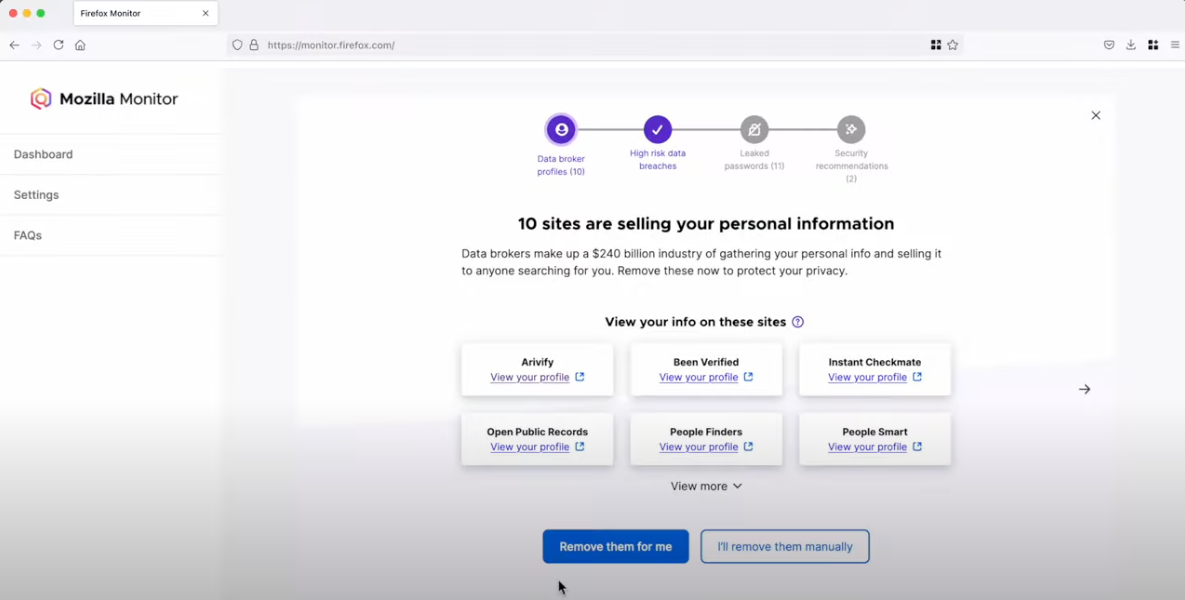
• In March 2024, Mozilla said it was winding down its collaboration with Onerep — an identity protection service offered with the Firefox web browser that promises to remove users from hundreds of people-search sites — after KrebsOnSecurity revealed Onerep’s founder had created dozens of people-search services and was continuing to operate at least one of them. Sixteen months later, however, Mozilla is still promoting Onerep. This week, Mozilla announced its partnership with Onerep will officially end next month.

    Mozilla Monitor. Image Mozilla Monitor Plus video on Youtube.

    In a statement published Tuesday, Mozilla said it will soon discontinue Monitor Plus, which offered data broker site scans and automated personal data removal from Onerep.

    “We will continue to offer our free Monitor data breach service, which is integrated into Firefox’s credential manager, and we are focused on integrating more of our privacy and security experiences in Firefox, including our VPN, for free,” the advisory reads.

    Mozilla said current Monitor Plus subscribers will retain full access through the wind-down period, which ends on Dec. 17, 2025. After that, those subscribers will automatically receive a prorated refund for the unused portion of their subscription.

    “We explored several options to keep Monitor Plus going, but our high standards for vendors, and the realities of the data broker ecosystem made it challenging to consistently deliver the level of value and reliability we expect for our users,” Mozilla statement reads.

    On March 14, 2024, KrebsOnSecurity published an investigation showing that Onerep’s Belarusian CEO and founder Dimitiri Shelest launched dozens of people-search services since 2010, including a still-active data broker called Nuwber that sells background reports on people. Shelest released a lengthy statement wherein he acknowledged maintaining an ownership stake in Nuwber, a data broker he founded in 2015 — around the same time he launched Onerep.

    ¶¶¶¶¶

    ¶¶¶¶¶

    ¶¶¶¶¶

    ¶¶¶¶¶

    ¶¶¶¶¶

  • Oligo Security has warned of ongoing attacks exploiting a two-year-old security flaw in the Ray open-source artificial intelligence (AI) framework to turn infected clusters with NVIDIA GPUs into a self-replicating cryptocurrency mining botnet. The activity, codenamed ShadowRay 2.0, is an evolution of a prior wave that was observed between September 2023 and March 2024. The attack, at its core,

    ¶¶¶¶¶

    ¶¶¶¶¶

    ¶¶¶¶¶

    ¶¶¶¶¶

    ¶¶¶¶¶

  • Cybersecurity researchers have warned of an actively expanding botnet dubbed Tsundere that’s targeting Windows users. Active since mid-2025, the threat is designed to execute arbitrary JavaScript code retrieved from a command-and-control (C2) server, Kaspersky researcher Lisandro Ubiedo said in an analysis published today. There are currently no details on how the botnet malware is propagated;

    ¶¶¶¶¶

    ¶¶¶¶¶

    ¶¶¶¶¶

    ¶¶¶¶¶

    ¶¶¶¶¶

  • Developing: The White House is trying again to convince Vladimir Putin to end his military invasion and occupation of Ukraine. According to the latest draft of a U.S.-proposed peace plan, Ukraine would cut its army in half and cede to Russia 20,000 square miles of its coal-rich Donbas region, which consists of the partially-occupied eastern Donetsk and Luhansk oblasts, the Financial Times reported Wednesday. 

    The Trump administration also wants Russian to be Ukraine’s official language, and it wants “Ukraine to abandon key categories of weaponry and would include the rollback of US military assistance that has been vital to its defence,” FT’s Chris Miller reported, citing people with knowledge of the U.S. document. 

    The 28-point plan was drafted by Trump's envoy Steve Witkoff and Russian special envoy Kirill Dmitriev after three days of meetings in Miami last month, Axios reported Wednesday. Ukrainian officials were kept out of that process. 

    Latest: Trump sent Army Secretary Dan Driscoll to Ukraine to pressure President Volodymyr Zelenskyy and military officials to accept the terms, Politico reported Tuesday. Driscoll is joined by Army chief Gen. Randy George, his top enlisted soldier Michael Weimer, as well as U.S. Army Europe and Africa commander Gen. Chris Donahue, the BBC reports from Kyiv. The U.S. delegation met Ukraine’s top military commander Oleksandr Syrskyi Wednesday evening. 

    European officials expressed alarm over the planned concessions from Ukraine, with European Commission Vice President Kaja Kallas telling reporters Thursday, “[F]or any plan to work, it needs Ukrainians and Europeans on board. In this war, there is one aggressor and one victim. So far, we haven't heard of any concessions from Russia's side,” she said.  

    “[P]eace cannot be a capitulation,” French Foreign Minister Jean-Noel Barrot said Thursday in Brussels. Another European Union defense official told Politico, “Europeans have not been consulted on this. But there’s a wing inside the White House who for some time have seen Europeans as ‘spoilers’ in the peace process, so in a way, it’s not surprising.” The official added, “The Russians have clearly identified Witkoff as someone who is willing to promote their interests.” 

    Worth noting: “A peace deal that requires Kyiv to hand over territory to Russia would not only be deeply unpopular with Ukrainians, it also would be illegal under Ukraine’s constitution,” the Associated Press reports. What’s more, President “Zelenskyy has repeatedly ruled out such a possibility.”

    Russian officials said there are no talks taking place. “Consultations are not currently underway. There are contacts, of course, but there is no process that could be called consultations,” Kremlin spokesman Dmitry Peskov said Thursday, Reuters reports. 

    But White House officials said they’ll get Ukraine and Russia to agree to some form of this new plan “as soon as this week,” Politico reported Wednesday. 

    Commentary: This new peace plan from Trump amounts to a “self-defeating reversal,” Tom Wright of Brookings argues, writing Thursday in The Atlantic. This is partly because “the plan emerged at a moment when Donald Trump’s Ukraine policy had finally found its footing after a very turbulent start.” 

    How so? “The United States was no longer spending money on Ukraine. Ukraine and the Europeans were close to putting together a $90 billion arms purchase, much of which would be produced in the United States and be a boon to the American defense industry,” says Wright. “The United States could continue arms sales while insisting on a peace settlement that allows for an independent and sovereign Ukraine—and Trump might have had a deal to end the war later in 2026 or in 2027. Instead, Witkoff may have convinced himself that he could reproduce the deal that ended the war in Gaza. [But] The circumstances there were fundamentally different.” (More on the Gaza ceasefire in the additional reading links below.)

    After all, “Russia has demanded these concessions for years, but the Trump administration, to its credit, has rejected them before now,” Wright points out. Continue reading (gift link), here

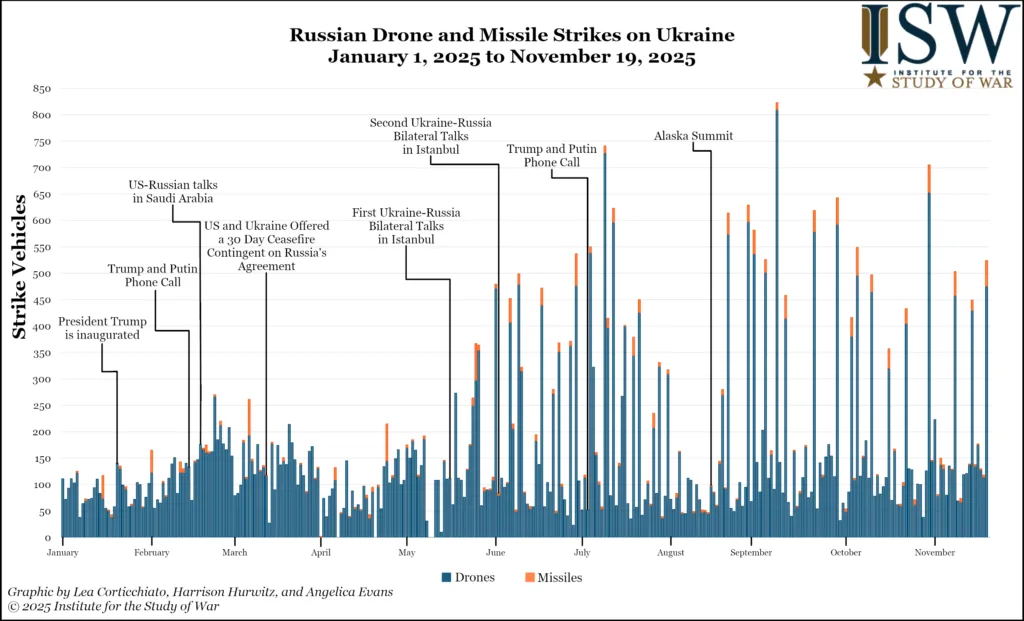
    Meanwhile, Russia is renewing its attacks on Ukraine’s energy grid, with an estimated 400,000 Ukrainians affected and outages in the capital city of Kyiv expected to last as long as 18 hours today, according to Ukrainian officials. 

    Panning out: See how Russian missile and drone attacks on Ukraine have risen sharply since May in a graph compiled by the Washington-based Institute for the Study of War, here

    Analyst reax: “Russia has sustained heavy losses in this war and risks greater long-term damage by extending the war, but Moscow can still inflict considerable damage on Ukraine,” Rob Lee of the Foreign Policy Research Institute wrote Wednesday on social media. “Russia has demonstrated a capacity to sustain heavy costs, and it is unclear when it might reach a breaking point. The strains of the war are growing for both sides, and Ukraine's foreign supporters should not become complacent. The situation can still deteriorate further,” he warned. 

    New: Ukraine used U.S. long-range ATACMS missiles to hit Russian territory for the first time during the Trump administration, the Wall Street Journal reported Wednesday, citing a Tuesday announcement by the Ukrainian military chief.

    Rewind: Kyiv fired short-range ATACMS in late 2023 and longer-ranged ones in 2024, The War Zone reminds us, but the Trump White House had restricted their use until September. TWZ also rounded up what’s publicly known about Ukraine’s inventory of these missiles, here.   

    In other U.S. weapons, you can watch a 15-second video of a Ukrainian F-16 chasing a Russian cruise missile on Telegram, here

    Developing: Iranian nuclear experts made more than one covert trip to Russia last year, with available evidence suggesting Iran is “seeking laser technology and expertise that could help them validate a nuclear weapon design without conducting a nuclear explosive test,” the Financial Times reported Wednesday. Just last month, the U.S. State Department sanctioned the front company that organized the trips to Russia, accusing them of “facilitat[ing] travel for Iranian nuclear experts to Russia to pursue sensitive dual-use technologies and expertise.”

    Additional reading: 


    Welcome to this Thursday edition of The D Brief, a newsletter dedicated to developments affecting the future of U.S. national security, brought to you by Ben Watson and Bradley Peniston. It’s more important than ever to stay informed, so thank you for reading. Share your tips and feedback here. And if you’re not already subscribed, you can do that here. On this day in 1985, Microsoft released Windows 1.0.

    Around the Defense Department

    Military aircraft crashes skyrocketed from 2020 to 2024, new data shows. The number of Class A mishaps—the deadliest and costliest category—per 100,000 flight hours rose from 1.3 in fiscal 2020 to 2.02 in fiscal 2024, according to data provided to Sen. Elizabeth Warren, D-Mass. Last year saw a four-year high for every service except the Navy.

    The Pentagon data included the Class A mishap rates of its 10 most-used aircraft. The list was topped by the H-60 helicopter, which was involved in 23 total incidents per four years worth of flight hours.

    AEI’s Mackenzie Eaglen says past operations and maintenance spending failed to keep up with inflation and the pace of use. “Shockingly, military aviation units in separate branches in the armed services are currently cannibalizing aircraft parts to get planes flying,” Eaglen said. “The decade-long budget control act, followed by sequestration, followed by budgets that did not keep pace with generational record-high inflation mean there is a lot of time, work, and money needed to reverse these trends.” Defense One’s Thomas Novelly has more, here.

    Additional reading: 

    Trump 2.0

    Developing: Trump has reportedly authorized CIA covert action inside Venezuela, the New York Times reported Tuesday, noting those operations “could be meant to prepare a battlefield for further action.”

    At the same time, White House officials have “opened up back-channel negotiations” with Venezuelan dictator Nicolas Maduro, who has allegedly “signaled a willingness to offer access to his country’s oil wealth to American energy companies,” the Times reports. 

    The way forward? There appear to be at least three options on the table, including Trump forging some kind of “diplomatic deal to gain more access to the Venezuela oil resources for American companies,” or Maduro could “voluntarily give up power,” or military action to implement regime change in Caracas. Read more (gift link), here

    Trump issues call to punish lawmakers for making video. In a series of social media posts Thursday morning, the U.S. president called for the arrest of Democratic lawmakers who posted a video on Tuesday urging members of the military to refuse illegal orders. The chief executive, who is charged with upholding U.S. law, called the video “SEDITIOUS BEHAVIOR, punishable by DEATH!” He also retweeted a call to “HANG THEM.” Kyle Cheney of Politico has more.

    Elsewhere stateside, the Border Patrol is now monitoring U.S. drivers and detaining folks with “suspicious” travel patterns, AP reported Thursday. 

    How it works: “A network of cameras scans and records vehicle license plate information, and an algorithm flags vehicles deemed suspicious based on where they came from, where they were going and which route they took. Federal agents in turn may then flag local law enforcement.” That system “Started about a decade ago to fight illegal border-related activities and the trafficking of both drugs and people, [but] it has expanded over the past five years,” AP writes. 

    A key component of this surveillance network: License plate readers. If you’ve served on a grand jury recently, it’s possible you’ve heard about the near-ubiquity of these devices, which can be installed almost anywhere—from intersections to Walmart parking lots. “Readers are often disguised along highways in traffic safety equipment like drums and barrels,” AP reports. 

    Background: “The Border Patrol has for years hidden details of its license plate reader program, trying to keep any mention of the program out of court documents and police reports…even going so far as to propose dropping charges rather than risk revealing any details about the placement and use of their covert license plate readers.” Continue reading, here

    ]]>

    ¶¶¶¶¶

    ¶¶¶¶¶

    ¶¶¶¶¶

    ¶¶¶¶¶

    ¶¶¶¶¶

  • A critical remote code execution flaw in Microsoft’s Windows Graphics Component allows attackers to seize control of systems using specially crafted JPEG images.

    With a CVSS score of 9.8, this vulnerability poses a severe threat to Windows users worldwide, as it requires no user interaction for exploitation.

    Discovered in May 2025 and patched by Microsoft on August 12, 2025, the issue stems from an untrusted pointer dereference in the windowscodecs.dll library, affecting core image processing functions.​

    Attackers can embed the malicious JPEG in everyday files like Microsoft Office documents, enabling silent compromise when the file is opened or previewed.

    This flaw highlights ongoing risks in legacy graphics handling, where seemingly innocuous image decoding can result in a complete system takeover. As Windows powers billions of devices, unpatched systems remain highly exposed to phishing campaigns or drive-by downloads.​

    Zscaler ThreatLabz identified the vulnerability through targeted fuzzing of the Windows Imaging Component, focusing on JPEG encoding and decoding paths in windowscodecs.dll.

    The entry point for exploitation lies in the GpReadOnlyMemoryStream::InitFile function, where manipulated buffer sizes allow attackers to control memory snapshots during file mapping.

    Fuzzing revealed a crash triggered by dereferencing an uninitialized pointer at jpeg_finish_compress+0xcc, exposing user-controllable data via heap spraying.​

    Stack traces from WinDbg analysis pointed to key functions like CJpegTurboFrameEncode::HrWriteSource and CFrameEncodeBase::WriteSource, confirming the flaw in JPEG metadata encoding processes.

    This uninitialized resource issue enables arbitrary code execution without privileges, making it exploitable over networks. Microsoft confirmed the vulnerability affects automatic image rendering in applications reliant on the Graphics Component.​

    Affected Versions and Patching

    The vulnerability impacts recent Windows releases, particularly those using vulnerable builds of windowscodecs.dll. Organizations must prioritize updates to mitigate risks, as exploitation could chain with other attacks for lateral movement in networks.

    ProductImpacted VersionPatched Version
    Windows Server 202510.0.26100.485110.0.26100.4946
    Windows 11 Version 24H2 (x64)10.0.26100.485110.0.26100.4946
    Windows 11 Version 24H2 (ARM64)10.0.26100.485110.0.26100.4946
    Windows Server 2025 (Core)10.0.26100.485110.0.26100.4946

    Exploitation Mechanics and Proof-of-Concept

    Exploiting CVE-2025-50165 involves crafting a JPEG that triggers the pointer dereference during decoding, often via embedded files in Office or third-party apps.

    For 64-bit systems, attackers bypass Control Flow Guard using Return-Oriented Programming (ROP) chains in sprayed heap chunks of size 0x3ef7. This pivots execution by creating read-write-execute memory with VirtualAlloc and loading shellcode for persistent access.​

    Windows Graphics Vulnerability Exploit

    Zscaler’s proof-of-concept demonstrates heap manipulation through an example app that allocates, frees, and processes Base64-encoded JPEGs, achieving RIP control.

    While no in-the-wild exploits have been reported, the low complexity and wide network reach make it a prime target for ransomware or espionage. CFG is disabled by default in 32-bit versions, easing attacks on older setups.​

    Users should immediately apply the August 2025 Patch Tuesday updates via Windows Update, targeting high-value assets first. Disable automatic image previews in email clients and enforce sandboxing for untrusted files. Zscaler has implemented cloud-based protections to block exploit attempts.​

    This incident underscores the perils of unpatched graphics libraries in enterprise environments, where JPEGs are ubiquitous in workflows.

    As threat actors evolve tactics, timely patching remains the strongest defense against such pixel-perfect poisons. With no observed active exploitation yet, proactive measures can prevent widespread damage.​

    Follow us on Google News, LinkedIn, and X for daily cybersecurity updates. Contact us to feature your stories.

    The post Critical Windows Graphics Vulnerability Lets Hackers Seize Control with a Single Image appeared first on Cyber Security News.

    ¶¶¶¶¶

    ¶¶¶¶¶

    ¶¶¶¶¶

    ¶¶¶¶¶

    ¶¶¶¶¶

  • Tsundere represents a significant shift in botnet tactics, leveraging the power of legitimate Node.js packages and blockchain technology to distribute malware across multiple operating systems.

    First identified around mid-2025 by Kaspersky GReAT researchers, this botnet demonstrates the evolving sophistication of supply chain attacks.

    The threat originates from activity first observed in October 2024, where attackers created 287 malicious npm packages using typosquatting—mimicking the names of popular libraries like Puppeteer and Bignum.js to deceive developers into installation.

    The infection vector has evolved considerably since then. Tsundere spreads through multiple pathways, including Remote Monitoring and Management tools and disguised game installers that capitalize on piracy communities.

    Samples discovered in the wild bear names like “valorant,” “cs2,” and “r6x,” specifically targeting first-person shooter enthusiasts.

    Smart contract containing the Tsundere botnet WebSocket C2 (Source - Securelist)
    Smart contract containing the Tsundere botnet WebSocket C2 (Source – Securelist)

    This approach proves highly effective at evading traditional security awareness since users expect these applications anyway.

    The botnet particularly threatens Windows users, though the initial campaign exposed systems across Windows, Linux, and macOS platforms when it operated through npm package deployment.

    The infrastructure behind Tsundere reveals a sophisticated understanding of modern attack methods. Rather than relying on traditional centralized command-and-control infrastructure, the botnet utilizes Ethereum blockchain smart contracts to store and retrieve C2 addresses.

    Tsundere communication process with the C2 via WebSockets (Source - Securelist)
    Tsundere communication process with the C2 via WebSockets (Source – Securelist)

    This approach adds resilience by making servers difficult to take down through conventional means. The threat actor, identified as koneko—a Russian-speaking operative—operates a professional marketplace where other cybercriminals can purchase botnet services or deploy their own functionality.

    Securelist security analysts identified the malware after discovering connections between the current campaign and earlier supply chain attacks.

    Their investigation revealed that the threat actor has since resurfaced with enhanced capabilities, launching Tsundere as an evolution of previous malware efforts.

    Tsundere botnet panel login (Source - Securelist)
    Tsundere botnet panel login (Source – Securelist)

    The panel supports both MSI installer and PowerShell script delivery mechanisms, giving attackers flexibility in deployment strategies across different network environments and defenses.

    How Tsundere Maintains Persistence Through Node.js Abuse

    The infection mechanism begins when an MSI installer or PowerShell script executes on the victim’s system, dropping legitimate Node.js runtime files into AppData alongside malicious JavaScript.

    The setup uses a hidden PowerShell command that spawns a Node.js process executing obfuscated loader code.

    This loader script decrypts the main bot using AES-256-CBC encryption before establishing the botnet environment. The bot automatically installs three critical npm packages: ws for WebSocket communication, ethers for Ethereum blockchain interaction, and pm2 for process persistence.

    The pm2 package plays a crucial role in maintaining presence on compromised machines. It creates registry entries that ensure the bot restarts automatically whenever a user logs in, achieving effective persistence.

    The bot then queries Ethereum blockchain nodes through public RPC providers, retrieving the current C2 server address from a smart contract variable.

    This clever approach means defenders cannot simply block a known IP address—the attackers rotate C2 infrastructure at will through blockchain transactions, rendering traditional IP-based blocking ineffective.

    Once connected, the bot establishes encrypted communication and awaits commands from operators, which arrive as dynamic JavaScript code for execution.

    Follow us on Google NewsLinkedIn, and X to Get More Instant UpdatesSet CSN as a Preferred Source in Google.

    The post Tsundere Botnet Abusing Popular Node.js and Cryptocurrency Packages to Attack Windows, Linux, and macOS Users appeared first on Cyber Security News.

    ¶¶¶¶¶

    ¶¶¶¶¶

    ¶¶¶¶¶

    ¶¶¶¶¶

    ¶¶¶¶¶

  • A new banking malware called Sturnus has emerged as a significant threat to mobile users across Europe.

    Security researchers have discovered that this sophisticated Android trojan can capture encrypted messages from popular messaging apps like WhatsApp, Telegram, and Signal by accessing content directly from the device screen after decryption.

    The malware’s ability to monitor these communications marks a serious advancement in mobile banking threats, combining credential theft with extensive remote access capabilities.

    The malware operates by harvesting banking credentials through convincing fake login screens that perfectly replicate legitimate banking applications.

    What makes Sturnus particularly dangerous is its capacity to provide attackers with full device takeover, allowing them to observe all user activity without physical interaction.

    Attackers can inject text messages, intercept communications, and even black out the device screen while conducting fraudulent transactions in the background, leaving victims completely unaware of the theft occurring on their compromised devices.

    Threat Fabric security analysts identified Sturnus as a privately operated trojan currently in its early testing phase, with targeted campaigns already configured against financial institutions across Southern and Central Europe.

    Although the malware remains in limited deployment, researchers emphasize that Sturnus is fully functional and more advanced than several established malware families in certain aspects, particularly regarding its communication protocol and device support capabilities.

    Early stages (Source - Threat Fabric)
    Early stages (Source – Threat Fabric)

    This combination of sophisticated features and targeted geographic focus suggests attackers are refining their tools before launching broader operations.

    The current threat landscape indicates that Sturnus.A operates with region-specific targeting, using tailored overlay templates designed for Southern and Central European victims.

    The malware’s operators demonstrate clear focus on compromising secure messaging platforms, testing the trojan’s ability to capture sensitive communications across different environments.

    The relatively few samples detected so far, combined with short intermittent campaigns rather than sustained large-scale activity, indicate the operation remains in evaluation and tuning phases.

    Understanding the Communication Protocol

    The malware’s complex communication structure inspired its name, drawing parallels to the Sturnus vulgaris bird, whose rapid and irregular chatter jumps between whistles, clicks, and imitations.

    Sturnus mirrors this chaotic pattern through its layered mix of plaintext, RSA, and AES communications that switch unpredictably between simple and complex messages.

    Capabilities (Source - Threat Fabric)
    Capabilities (Source – Threat Fabric)

    The malware establishes a connection with its command-and-control server using both WebSocket (WSS) and HTTP channels, transmitting a combination of encrypted and plaintext data primarily over WebSocket connections.

    The technical handshake begins with an HTTP POST request where the malware registers the device using a placeholder payload. The server responds with a UUID client identifier and an RSA public key.

    The malware then generates a 256-bit AES key locally, encrypts it using RSA/ECB/OAEPWithSHA-1AndMGF1Padding, and transmits the encrypted key back while storing the plaintext AES key on the device in Base64 format.

    Once key exchange completes, all subsequent communication receives protection through AES/CBC/PKCS5Padding with a 256-bit encryption key.

    The trojan generates fresh 16-byte initialization vectors for each message, prepends them to encrypted payloads, and wraps results in custom binary protocols containing message type headers, message length data, and client UUIDs.

    This sophisticated encryption scheme demonstrates the developers’ expertise in secure communications while maintaining malicious functionality.

    Follow us on Google NewsLinkedIn, and X to Get More Instant UpdatesSet CSN as a Preferred Source in Google.

    The post Sturnus Banking Malware Steals Communications from Signal and WhatsApp, Gaining Full Control of The Device appeared first on Cyber Security News.

    ¶¶¶¶¶

    ¶¶¶¶¶

    ¶¶¶¶¶

    ¶¶¶¶¶

    ¶¶¶¶¶

  • The U.S. Attorney’s Office, Southern District of New York, has announced the sentencing of Keonne Rodriguez and William Lonergan Hill, co-founders of Samourai Wallet, a cryptocurrency mixing application designed specifically to hide illegal financial transactions.

    Rodriguez, who served as the Chief Executive Officer, received a five-year prison sentence on November 6, 2025, while Hill, the Chief Technology Officer, was sentenced to four years on November 19, 2025.

    Their criminal enterprise facilitated the laundering of over $237 million in illicit funds through their mobile application platform.

    Starting around 2015, Rodriguez and Hill developed Samourai with the explicit purpose of concealing criminal proceeds.

    The application’s architecture centered on two core services built specifically to obstruct law enforcement investigations and prevent financial tracing.

    Over 80,000 Bitcoin, valued at more than $2 billion at the time, flowed through their services, generating approximately $6 million in fees for the operators.

    The U.S. Attorney’s Office, Southern District of New York security analysts identified that the criminal proceeds originated from multiple sources including drug trafficking, darknet marketplaces, cyber-intrusions, frauds, sanctioned jurisdictions, murder-for-hire schemes, and child pornography operations.

    How Samourai’s Technical Infrastructure Enabled Money Laundering

    The mixing service functioned through two primary obfuscation mechanisms. The first, known as “Whirlpool,” coordinated Bitcoin exchanges among user groups, effectively scrambling the blockchain record and making fund origins virtually untraceable to law enforcement and cryptocurrency exchanges.

    The second service, called “Ricochet,” inserted unnecessary intermediate transactions referred to as “hops” between sending and receiving addresses, significantly complicating the ability of monitoring entities to establish connections between transfers and criminal activities.

    Beyond the technical infrastructure, Rodriguez and Hill actively promoted their service to criminal communities.

    Hill marketed Samourai on Dread, a darknet forum, explicitly recommending Whirlpool as the optimal method to “clean dirty BTC.”

    Similarly, Rodriguez personally encouraged social media platform hackers via Twitter to route their stolen proceeds into Samourai’s Whirlpool service in July 2020, demonstrating direct knowledge and intentional facilitation of criminal activity.

    The sentencing reflects the serious consequences of operating money laundering services, regardless of the technology employed, signaling law enforcement’s commitment to pursuing cryptocurrency-based financial crime.

    Follow us on Google NewsLinkedIn, and X to Get More Instant UpdatesSet CSN as a Preferred Source in Google.

    The post Samourai Wallet Cryptocurrency Mixing Founders Jailed for Laundering Over $237 Million appeared first on Cyber Security News.

    ¶¶¶¶¶

    ¶¶¶¶¶

    ¶¶¶¶¶

    ¶¶¶¶¶

    ¶¶¶¶¶

  • A Russian-speaking threat actor attributed to the username “koneko” has resurfaced with a sophisticated new botnet named Tsundere, discovered by Kaspersky GReAT around mid-2025. This marks a significant evolution from a previous supply chain campaign that targeted Node.js developers in October 2024, revealing disturbing parallels in methodology and infrastructure. Using typosquatting techniques registering package names […]

    The post Tsundere Botnet Targets Windows, Linux & macOS via Node.js Packages appeared first on GBHackers Security | #1 Globally Trusted Cyber Security News Platform.

    ¶¶¶¶¶

    ¶¶¶¶¶

    ¶¶¶¶¶

    ¶¶¶¶¶

    ¶¶¶¶¶

  • A new wave of ransomware attacks is targeting cloud storage environments, specifically focusing on Amazon Simple Storage Service (S3) buckets that contain critical business data.

    Unlike traditional ransomware that encrypts files using malicious software, these attacks exploit weak access controls and configuration mistakes in cloud environments to lock organizations out of their own data.

    As more businesses move their operations to the cloud, attackers are adapting their methods, shifting away from on-premises systems to cloud-based resources where valuable information is stored.

    These attacks can result in complete data loss, operational disruptions, and significant financial damage if organizations lack proper backup and recovery systems.

    The threat actors behind these campaigns gain unauthorized access through stolen credentials, leaked access keys found in public code repositories, or compromised AWS accounts with excessive permissions.

    Once inside, they identify vulnerable S3 buckets by checking for specific weaknesses such as disabled versioning, missing object lock protection, and improper write permissions.

    The attackers then proceed to encrypt data using various encryption techniques, delete original files, or exfiltrate sensitive information before demanding ransom payments.

    What makes these attacks particularly dangerous is their ability to use native cloud features to conduct malicious activities while remaining hidden from traditional security monitoring tools.

    Trend Micro security researchers identified five distinct ransomware variants that specifically target S3 storage environments, each using different attack methods to achieve data encryption or deletion.

    These variants range from using customer-managed encryption keys with scheduled deletion timelines to leveraging server-side encryption with customer-provided keys that AWS cannot recover.

    The researchers documented both observed attack techniques used in real-world incidents and potential future attack vectors that organizations should prepare to defend against.

    Their analysis provides detailed technical breakdowns of how each variant operates and what security measures can prevent these attacks.

    Attack Mechanism and Technical Execution

    The Server-Side Encryption with Customer-Provided Keys (SSE-C) variant represents one of the most dangerous attack methods because it creates permanently unrecoverable encrypted data.

    In this approach, threat actors first gain write-level access to victim S3 buckets through compromised credentials or leaked IAM roles from public GitHub repositories.

    After identifying target buckets without proper protections, attackers initiate encryption by providing a locally stored AES-256 encryption key through specific HTTP request headers or AWS command-line tools.

    The critical aspect of this technique is that AWS uses the attacker’s encryption key to secure the data but never stores the actual key in its systems.

    AWS only logs a Hash-based Message Authentication Code (HMAC) of the encryption key in CloudTrail logs, which cannot be reversed or used to decrypt the protected data.

    This means neither the victim organization nor AWS support teams can recover the encrypted information once the attacker completes the encryption process.

    After encrypting all target files, the attackers deposit ransom notes in the affected buckets, typically naming them “ransom-note.txt” or similar variations, which contain instructions for payment and communication.

    Variant 1 attack flow (Source - Trend Micro)
    Variant 1 attack flow (Source – Trend Micro)

    The entire attack can be executed rapidly, and because the encryption key exists only on the attacker’s systems, victims face a permanent lockout unless they pay the ransom or have separate backup copies stored securely.

    Configuration settings (Source - Trend Micro)
    Configuration settings (Source – Trend Micro)

    Organizations can protect against this variant by implementing specific policy controls that block SSE-C encryption requests at the bucket level or through organization-wide resource control policies.

    Security teams should monitor CloudTrail logs for unusual SSE-C encryption activities and enforce policies that deny PutObject requests containing customer-provided encryption algorithm headers, effectively eliminating this attack vector from their cloud environments.

    Follow us on Google NewsLinkedIn, and X to Get More Instant UpdatesSet CSN as a Preferred Source in Google.

    The post New Ransomware Variants Targeting Amazon S3 Services Leveraging Misconfigurations and Access Controls appeared first on Cyber Security News.

    ¶¶¶¶¶

    ¶¶¶¶¶

    ¶¶¶¶¶

    ¶¶¶¶¶

    ¶¶¶¶¶