• Pentagon data shows that deadly and costly military aircraft mishaps skyrocketed 55 percent over the past four years, alarming lawmakers, defense analysts, and aviation safety experts.

    The number of Class A mishaps—the deadliest and costliest category—per 100,000 flight hours rose from 1.3 in fiscal 2020 to 2.02 in fiscal 2024, according to data provided to Sen. Elizabeth Warren, D-Mass. Defense One reviewed the data, which Warren received in January after requesting it last year.

    “This loss of life due to mishaps poses an unacceptable risk to service members, their families, and military readiness,” Warren said in a Wednesday news release.

    Across 4,280 total mishaps between full budget years 2020 through 2023 and part of 2024, those incidents led to 90 deaths, just shy of 90 aircraft destroyed, and upwards of $9 billion in damages, the data showed.
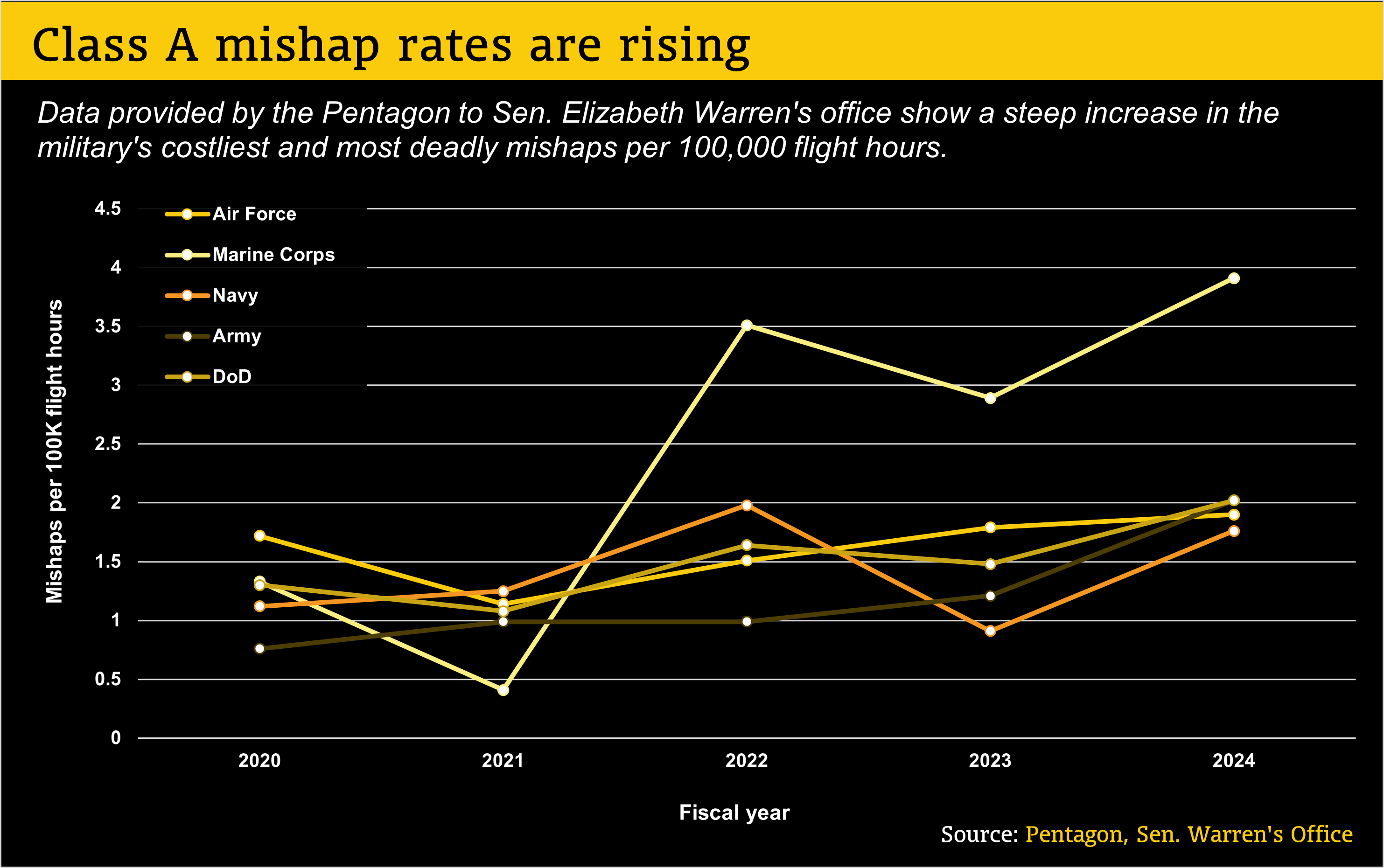
    mishaps

    Warren’s office said the rise in deadly mishaps supports a push to include provisions in this year’s defense policy bill asking the Pentagon to share summaries of internal military safety reports for the last three years with Congress. 

    Safety advocates and defense experts said the alarming trends are accompanied by declining transparency, increased operations, and stagnating budgets.

    Each service except the Navy saw the rate of Class A mishaps per 100,000 flight hours hit a four-year high in 2024. In the Marines, the rate nearly doubled from 1.33 to 3.91. The Army’s rate rose from 0.76 to 2.02; the Air Force’s edged up from 1.72 to 1.9; and the Navy’s went from 1.12 and 1.76 after peaking at 1.98 in 2022.

    A Pentagon official, responding to those figures being released by Warren’s office, said in an emailed statement that the Defense Department's safety oversight council regularly reviews incidents to “reduce safety risks” to the services.

    "We underscore the importance of safety and readiness at every level of the Department, ensuring that we invest in and adopt leading safety practices and foster a strong culture of safety throughout the organization,” the official said.

    The Pentagon data included the Class A mishap rates of its 10 most-used aircraft. The list was topped by the H-60 helicopter, which was involved in 23 total incidents per four years worth of flight hours. It was followed by the F-18 fighter jet and C-17 transport plane, both with 21 total incidents per four years worth of flight hours. 

    More than one-fifth of the 90 deaths mentioned in the Pentagon report occurred  in variants of the V-22 Osprey, which has seen four crashes resulting in 20 servicemember deaths since 2022. One widow who lost a loved one in a 2022 crash said the alarming trend of deadly incidents is made worse by a lack of transparency. Many survivors are still waiting on findings in Naval Air Systems Command and Government Accountability investigations probing the tiltrotor aircraft. 

    “The trends we’re seeing remain incredibly concerning, and answers aren’t only owed to the families whose loved ones are represented in these numbers. They’re owed to the service members still flying in these aircraft and to their loved ones,” the widow said. “We deserve complete answers and real accountability. We still don’t have either.

    Some services, such as the Air Force, have taken public-facing measures addressing the alarming rise in deadly mishaps. Before he retired as Air Force chief of staff earlier this year, then-Gen. David Allvin announced a safety and standards campaign in January, stating in a video the service lost 47 airmen and $1.5 billion in weapons due to preventable incidents. His replacement, Gen. David Wilsbach, told Congress during his confirmation hearing, and airmen in a letter this month, that his priority is to fix aging aircraft and increase readiness.

    J.F. Joseph, a retired Marine Corps pilot who is an aviation consultant and expert witness, said reversing the trends will require pilots to get enough flight hours. That involves consistently funding and staffing maintenance efforts so aviators can get more experience. 

    “The aircraft have to be supported by the maintainers and they have to have the parts, the components, to maintain those aircraft properly,” Joseph said. “If you don’t staff these aircraft squadrons properly with maintainers, even if you have the parts sitting on the shelf, you can’t fix the airplanes. The cost of doing aviation safely is expensive, it simply is. It’s even more expensive when you’re doing it properly, but it’s a lot more expensive when you’re not.”

    This year alone, the Navy lost four F/A-18Fs, according to Warren’s office, and the deadliest mishap in recent aviation history took place near Washington, D.C., in January when an Army Black Hawk helicopter collided in midair with a commercial airliner, killing all 67 aboard the two aircraft.

    Mackenzie Eaglen, a senior fellow at the American Enterprise Institute, said prior administrations’ defense budgets “did not keep pace with inflation while the military op-tempo was high,” adding that several services have had to take drastic measures to keep aircraft usable–such as the Air Force resurrecting retired B-1 Lancer bombers and returning them to service.

    “Shockingly, military aviation units in separate branches in the armed services are currently cannibalizing aircraft parts to get planes flying,” Eaglen said. “The decade-long budget control act, followed by sequestration, followed by budgets that did not keep pace with generational record-high inflation mean there is a lot of time, work, and money needed to reverse these trends.”

    In a Tuesday letter to Defense Secretary Pete Hegseth, Warren’s office is now asking for Class A-mishap data for the rest of 2024 and 2025 as well as broader information on “mishaps, fatalities, destroyed aircraft, and estimated costs across each service for each aircraft” in the past five years. The senator asked for the Pentagon to provide the information no later than Dec. 2. 

    “In the face of increasing rates of costly and deadly aviation mishaps, it is critical that Congress and DoD take all necessary action to address this problem,” Warren wrote.

    ]]>

    ¶¶¶¶¶

    ¶¶¶¶¶

    ¶¶¶¶¶

    ¶¶¶¶¶

    ¶¶¶¶¶

  • The Navy is finally in a place where it can start picking winners in its pursuit of maritime—specifically underwater—drones, but the ability to produce them en masse should be a prime consideration when awarding contracts, according to one lawmaker. 

    “I think they're making some good progress. I remember going to Newport…and seeing all kinds of great research projects. But when I asked, ‘When's the down-select going to happen?’ People look at me like…’We're just having fun experimenting with these platforms,’” Rep. Rob Wittman, R-Va., vice chairman of the House Armed Services Committee, said Tuesday during Defense One’s State of Defense Business event. “I think the Navy has finally gotten to that place. The key is not just, now, down-selecting, but how do you go to scale quickly with those operations?” 

    The congressman used an example of one company that built a 150-foot autonomous surface vessel in about six months to show how it can be done. 

    Saronic, a drone-boat startup based in Austin, Texas, announced during a panel at a General Catalyst Institute event Monday that it’s on track to complete its build of its Marauder vessel, which has a 3,500 nautical mile range, by December. Wittman was also a speaker at the event. 

    “So we acquired a shipyard in Franklin, Louisiana…the shipyard was closing down. So one of the things we think about is…how do we bring brand new capacity online in this country in a way that wouldn’t exist otherwise,” CEO and co-founder Dino Mavrookas said. “We laid our first weld on June 24 of this year, and that ship is going to be in the water by the end of the year.”

    Saronic has already started building its second Marauder, side-by-side with the first one, and is “already seeing production efficiency gains,” Mavrookas said. 

    Saronic isn’t the only defense tech company focused on producing sea drones in large quantities. Anduril recently announced plans to build an autonomous surface vessel prototype in South Korea with HD Hyundai Heavy Industries, before producing them at their shipyard in Seattle, Wash. HavocAI also announced plans to build a 100-foot drone boat this year. 

    The concept of building robot boats in months, instead of years, should translate to underwater vessels too, Wittman said on Tuesday. 

    “That’s the kind of pace we need,” he said. “How do we make sure that we are not only awarding contracts, but awarding contracts at scale and with timeliness—and that is performing and delivering those platforms within very strict time frames?”

    ]]>

    ¶¶¶¶¶

    ¶¶¶¶¶

    ¶¶¶¶¶

    ¶¶¶¶¶

    ¶¶¶¶¶

  • Among the changes that Defense Secretary Pete Hegseth laid out in his Nov. 7 address to industry is the idea that the Pentagon will be more willing to buy a system that provides “the 85% solution” now and the full solution later. On Tuesday, a panel of industry executives talked at a Defense One event about what that might take and what it might mean. 

    “It starts with how much acquisition risk are [they] willing to take to decrease operational risk,” said Steve Harris, vice president of defense and intelligence at the Professional Services Council, a GovCon trade association. “It is a culture change for the department writ large, and eventually, I think probably the government, in terms of what the tolerance is going to be for acquisition risk, and that’s going to be something that has to be a major culture change.”

    Hegseth said the extra testing and development needed to get to the 100% solution was often “unachievable.” 

    In fact, it can add one to two years, said Margaret Boatner, vice president for national-security policy at the Aerospace Industries Association trade group. 

    “We have to be willing to make some of those performance tradeoffs to meet 85% of the requirement, and move out with more speed than waiting the additional two years to get to 100%, and then moving out,” she said.

    Christian Gutierrez lives and works in that world of moving faster as a vice president at Shield AI, one of the handful of defense technology startups whose touted valuations exceed $1 billion. He oversees engineering for Hivemind, Shield AI’s flagship product for enabling unmanned aircraft to operate autonomously.

    As Gutierrez put it, his world is all about providing customers with a minimum viable product—the most basic version of a new product with just enough features to be usable by early customers, who then provide feedback for future development and iteration.

    He said companies like Shield AI always work to balance cost, schedule, budget and technical risks in product development and delivery.

    “Really, what we're talking about is a schedule risk. Speed is the name of the game right now. We have pacing threats, we have adversaries moving at speeds that we just haven't seen before,” Gutierrez said. Now it’s a matter of how you incentivize speed, how you lower the barrier to entry, and we're seeing that with this administration and the new policies.”

    ]]>

    ¶¶¶¶¶

    ¶¶¶¶¶

    ¶¶¶¶¶

    ¶¶¶¶¶

    ¶¶¶¶¶

  • Your SOC generates thousands of alerts daily. Many of them are low-priority, repetitive, or false positives. On paper, this looks like a technical problem. In reality, it’s a business problem. 

    Every Alert Costs 

    When analysts are buried under thousands of notifications, they spend more time triaging noise than responding to real incidents. The result: slower reaction times, missed threats, staff burnout, and ballooning operational costs. 

    Every wasted minute translates into a weaker security posture, potential financial loss, and reduced return on your security investments. Alert overload doesn’t just impact your SOC. 

    It slows down your entire organization’s ability to respond, recover, and produce revenue.  

    What Doesn’t Work 

    Organizations often try to tackle alert overload by: 

    • Hiring more analysts — which increases headcount costs but doesn’t reduce the noise. 
    • Relying on strict filtering rules — which risks missing critical alerts. 
    • Adding more tools — which only multiplies data sources and dashboards. 
    • Automating without context — which accelerates the wrong decisions. 

    These approaches attack the symptoms, not the cause: the lack of context around alerts. Without understanding what triggered an alert and how relevant it is, teams will always be stuck firefighting instead of investigating. 

    What Works: Context Powered by Threat Intelligence 

    The sustainable way to overcome alert overload is to improve alert quality through contextual threat intelligence

    When analysts can instantly enrich alerts with reliable, up-to-date data on IOCs, malware families, and infrastructure, they can prioritize faster and make confident decisions. 

    This is where ANY.RUN’s Threat Intelligence Lookup comes in — a solution designed to balance the speed of investigation with data completeness, freshness, and accuracy. 

    It helps teams quickly understand whether an alert is linked to a known threat, how serious it is, and whether it requires escalation. The outcome: fewer false positives, faster triage, and more efficient use of human and financial resources. 

    TI Lookup: click the search bar to choose parameters 

    Threat Intelligence Lookup delivers instant context for IOCs, domains, IPs, hashes, and other artifacts. The data is sourced from 15,000+ SOC environments and millions of malware analysis sessions in ANY.RUN’s Interactive Sandbox, constantly refreshed to reflect real-time global threat activity. 

    Benefits for analysts: 

    • Immediate access to verified IOC data — no need to switch between platforms. 
    • Clear visual indicators of threat relevance and relationships. 
    • Faster, more accurate triage decisions. 

    Benefits for business: 

    • Lower operational costs by reducing wasted analyst hours. 
    • Improved detection-to-response ratio, strengthening security ROI. 
    • More predictable and measurable SOC performance. 
    Try TI Lookup and discover how faster triage turns into measurable cost savings -> Contact ANY.RUN to get 50 trial lookups 

    How It Works 

    Here is an example of how security teams use TI Lookup to streamline their alert workflows and decision-making. 

    Suppose analysts receive an alert on a suspicious domain. TI Lookup provides an instant verdict on the potential indicator along with contextual data:  

    domainName:”databap.mom” 

    Domain search results: malicious label, linked IOCs, sandbox analyses 

    A quick lookup later, your team understands:  

    • The domain is a malicious activity indicator; 
    • It is associated with the dangerous Lumma stealer; 
    • Lumma now targets US and Europe;  
    • It has been detected in recent campaigns; 
    • It helps to harvest additional IOCs; 
    • There are malware sample sandbox analyses featuring this domain that allow to understand the threat’s behavior and TTPs.  

    From Overload to Efficiency and Profitability 

    When your SOC operates with context-rich data, the entire detection and response cycle accelerates. Analysts stop wasting time on noise. Decision-making becomes data-driven, not reactive. 

    That directly translates to measurable business value: 

    • Reduced mean time to detect (MTTD) and respond (MTTR). 
    • Better analyst productivity without expanding the team. 
    • Tangible cost savings from automation that works with — not against — human intelligence. 

    In short, eliminating alert overload isn’t just about comfort for the SOC team. It’s a strategic financial decision that strengthens resilience, reduces risk exposure, and safeguards your bottom line. 

    Conclusion 

    Alert overload can’t be solved by more people or more tools — only by smarter data.

    By empowering your SOC with contextual threat intelligence from ANY.RUN’s Threat Intelligence Lookup, you transform chaos into clarity, alerts into insights, and effort into measurable value. 

    Accelerate response, control costs, and maximize your team’s performance with TI Lookup. --> Start your trial today.  

    The post How to Solve Alert Overload in Your SOC  appeared first on Cyber Security News.

    ¶¶¶¶¶

    ¶¶¶¶¶

    ¶¶¶¶¶

    ¶¶¶¶¶

    ¶¶¶¶¶

  • Tel Aviv, Israel, November 19th, 2025, CyberNewsWire

    Seraphic, the leader in enterprise browser security (SEB) and AI enablement, today announced native protection for Electron-based applications such as ChatGPT desktop, Teams, Slack, and more, becoming the first and only browser security platform to introduce this capability.  

    AI runs in the browser: SaaS applications, AI copilots, agentic browsers, and Electron apps all execute within a JavaScript-driven environment.

    Since Seraphic’s tech lives within the JavaScript Engine, the Seraphic platform is designed to serve the AI revolution and operate as the control point for securing any AI-powered browser such as Atlas, Comet, Leo, Dia, Genspark, and more, and any additional AI tool that interacts with the browser.

    The Seraphic Browser Security Platform offers inline DLP, safe browsing, remote connectivity and real-time visibility across all devices, whether managed or unmanaged. 

    “Existing solutions such as SASE, RBI, VDI, and even newer approaches like dedicated browsers or extension-based security tools struggle to support emerging technologies like AI and the Electron framework due to architectural limitations. Seraphic was built differently. Our design is inherently flexible because we operate at the core of the browser, not around it. As a result, when AI exploded, these capabilities emerged naturally and effortlessly for us,” said Ilan Yeshua, CEO & Co-Founder of Seraphic. 

    Seraphic’s Electron app protection ties directly into its expanding AI Security features designed to protect enterprises as generative AI and LLM-based tools become central to daily workflows.

    Seraphic’s GenAI dashboard turns AI oversight from reactive to proactive, enabling organizations to adopt AI with confidence and protect against AI-driven threats. All this is achieved without making infrastructure changes and with no user friction. 

    With Seraphic’s GenAI dashboard, enterprises get: 

    • Complete AI Activity Visibility: Real-time monitoring of all AI interactions, including prompts, uploads, downloads, and agentic behavior. 
    • Shadow AI Detection: Identifies unauthorized or high-risk AI tools and enforces granular access and usage guardrails. 
    • Inline AI Data Protection (DLP): Inspects prompts, pasted text, file uploads, and cross-tab activity before data leaves the device; blocks, masks, or watermarks sensitive content. 
    • Protection for AI & Agentic Browsers: Native enforcement for ChatGPT Atlas, Dia, Genspark, Comet, and other agentic tools, preventing token misuse, unauthorized automation, and AI-driven threats. 
    • Electron Application Protection: First-of-its-kind coverage for Electron apps. 

    “Seraphic gives organizations a single, lightweight control point that follows the user everywhere, securing any device, any browser, and now any Electron app without disrupting productivity or forcing architectural changes. By extending our enterprise browser security to Electron environments, we enable security teams to safely embrace AI, with the visibility and fine‑grained controls they need to keep sensitive data, identities, and intellectual property protected,” said Alon Levin, VP Product Management at Seraphic. 

    In addition to its enterprise solution, Seraphic supports the wider security community through BrowserTotal, a free platform where users can educate themselves on AI threats like Prompt Injection and analyze LLMs for safety, empowering organizations and individuals to proactively mitigate risks as AI technologies evolve. 

    More information related to Seraphic’s Electron app protection can be found here.

    About Seraphic 

    Seraphic transforms any traditional or AI browser into a secure enterprise browser, delivering real-time protection against phishing, data loss, and credential theft on both managed and unmanaged devices.

    Backed by CrowdStrike’s Falcon Fund, recognized with the Frost & Sullivan Global Zero Trust Enabling Technology Leadership Award, and trusted by Fortune 500 enterprises, Seraphic provides the browser-layer security foundation for modern, cloud-driven businesses. 

    Users can learn more at seraphicsecurity.com

    Contact

    Head of Communications

    Eric Wolkstein

    Seraphic

    ericw@seraphicsecurity.com

    The post Seraphic Becomes the First and Only Secure Enterprise Browser Solution to Protect Electron-Based Applications appeared first on Cyber Security News.

    ¶¶¶¶¶

    ¶¶¶¶¶

    ¶¶¶¶¶

    ¶¶¶¶¶

    ¶¶¶¶¶

  • Tel Aviv, Israel, November 19th, 2025, CyberNewsWire Seraphic, the leader in enterprise browser security (SEB) and AI enablement, today announced native protection for Electron-based applications such as ChatGPT desktop, Teams, Slack, and more, becoming the first and only browser security platform to introduce this capability.   AI runs in the browser: SaaS applications, AI copilots, agentic […]

    The post Seraphic Becomes the First and Only Secure Enterprise Browser Solution to Protect Electron-Based Applications appeared first on GBHackers Security | #1 Globally Trusted Cyber Security News Platform.

    ¶¶¶¶¶

    ¶¶¶¶¶

    ¶¶¶¶¶

    ¶¶¶¶¶

    ¶¶¶¶¶

  • Hackers have begun actively exploiting a critical remote code execution (RCE) vulnerability in the popular file archiver 7-Zip, putting millions of users at risk of malware infection and system compromise.

    The flaw, tracked as CVE-2025-11001, stems from improper handling of symbolic links in ZIP archives, allowing attackers to traverse directories and execute arbitrary code on vulnerable systems.

    First disclosed in October 2025, this vulnerability has a CVSS v3 score of 7.0, highlighting its high severity due to the potential for widespread exploitation without requiring elevated privileges.​

    7-Zip RCE Vulnerability Exploited

    CVE-2025-11001 arises during the parsing of ZIP files containing crafted symbolic links, which trick 7-Zip into writing files outside the intended extraction directory.

    This directory traversal can enable attackers to overwrite critical system files or inject malicious payloads, leading to full code execution in the context of the user or service account running the application.

    Security researchers at Trend Micro’s Zero Day Initiative (ZDI) detailed how an attacker could leverage this to escape sandboxed environments, making it particularly dangerous for automated file processing in enterprise settings.​

    The vulnerability was discovered by Ryota Shiga of GMO Flatt Security Inc., in collaboration with their AI-powered AppSec Auditor tool, and reported promptly to the 7-Zip developers.

    A proof-of-concept (PoC) exploit has since been publicly released, demonstrating how a malicious ZIP file can abuse symbolic link handling to facilitate arbitrary file writes and, in certain scenarios, direct RCE.

    This PoC has lowered the barrier for threat actors, accelerating real-world attacks observed in the wild. Notably, exploitation requires minimal user interaction; simply opening or extracting a booby-trapped archive suffices, a common vector in phishing campaigns and drive-by downloads.​

    This issue is not isolated; 7-Zip version 25.00, released in July 2025, also patches a related flaw, CVE-2025-11002, which shares the same symbolic link mishandling root cause and carries an identical CVSS score of 7.0.

    Both vulnerabilities were introduced in version 21.02, affecting all prior releases of the open-source tool used by over 100 million Windows users worldwide for compression tasks. Early indicators suggest attackers are targeting unpatched systems in sectors like healthcare and finance, where file handling is routine.​

    The U.K.’s NHS England Digital issued an urgent advisory on November 18, 2025, confirming active exploitation of CVE-2025-11001, urging immediate updates to mitigate risks.

    Threat actors could use this RCE to deploy ransomware, steal sensitive data, or establish persistent backdoors, amplifying the danger in supply chain attacks where compromised archives spread via email or shared drives.

    Organizations relying on 7-Zip for bulk file operations face elevated threats, as automated extractions could silently propagate malware across networks.​

    To counter this threat, users and organizations must update 7-Zip to version 25.00 or later, available from the official website, which enforces stricter path canonicalization to block traversal attempts.

    The patch prevents symbolic links from escaping extraction boundaries, neutralizing both CVE-2025-11001 and CVE-2025-11002. Affected platforms include all Windows versions running 7-Zip prior to 25.00, with no reported impacts on Linux or macOS ports yet.​

    Follow us on Google News, LinkedIn, and X for daily cybersecurity updates. Contact us to feature your stories.

    The post Hackers Actively Exploiting 7-Zip RCE Vulnerability in the Wild appeared first on Cyber Security News.

    ¶¶¶¶¶

    ¶¶¶¶¶

    ¶¶¶¶¶

    ¶¶¶¶¶

    ¶¶¶¶¶

  • Microsoft is bringing native Sysmon functionality directly into Windows, eliminating the need for manual deployment and separate downloads.

    Starting next year, Windows 11 and Windows Server 2025 will include System Monitor (Sysmon) capabilities, transforming how security teams detect threats and investigate incidents.

    For years, Sysmon has been the go-to tool for IT administrators, security professionals, and threat hunters seeking deep visibility into Windows systems.

    However, deploying and maintaining it across thousands of endpoints has been cumbersome, requiring manual downloads, consistent updates, and operational overhead that introduces security risks when updates lag.

    The native integration solves these critical pain points. Security teams gain instant threat visibility with the same rich functionality, custom configuration files, and automated compliance through standard Windows Update.

    FeatureDescription
    Process MonitoringTracks process creation events and command-line activity
    Network Connection TrackingMonitors outbound communications and unusual connections
    Credential Access DetectionExposes process access attempts to LSASS memory
    File System MonitoringDetects file creation in suspicious directories
    Process Tampering DetectionIdentifies process hollowing and herpaderping techniques
    WMI Persistence TrackingCaptures WMI events and persistence mechanisms
    Custom Configuration SupportAllows custom configuration files to filter events
    Native Event LoggingWrites events to Windows Event Logs
    Automated UpdatesReceives monthly updates through Windows Update
    Official SupportMicrosoft provides dedicated customer service

    Most importantly, organizations now receive official customer service support, eliminating the risks associated with unsupported production environments.

    Sysmon in Windows delivers granular diagnostic data that powers advanced threat detection and technical investigation.

    Security applications can access these events through Windows Event Logs (Applications and Services Logs / Microsoft/Windows/Sysmon/Operational) or feed directly into SIEM systems.

    Key detection events include process creation monitoring to identify suspicious command-line activity. Network connection tracking to flag Command and Control (C2) traffic, and process access detection to expose credential dumping attempts.

    The tool also identifies file creation in suspicious locations, detects tampering techniques such as process hollowing, and captures WMI persistence mechanisms.

    Enabling Sysmon functionality is straightforward. Administrators can activate it using the Turn Windows Features On/Off feature, then install it with a single command: sysmon -i.

    This command installs the driver, starts the service immediately, and applies the default configuration, with no separate tooling required.

    Microsoft plans to expand capabilities further, including enterprise-scale management and AI-powered inferencing.

    Imagine automatically detecting credential theft or lateral movement patterns with edge AI, dramatically reducing dwell time and improving organizational resilience.

    This native integration represents a significant shift in how Windows handles security monitoring, combining OS-level signals with automated updates to build more resilient, secure-by-design systems.

    Follow us on Google News, LinkedIn, and X for daily cybersecurity updates. Contact us to feature your stories.

    The post Sysmon – Go-to Tool for IT Admins, Security Pros, and Threat Hunters Coming to Windows appeared first on Cyber Security News.

    ¶¶¶¶¶

    ¶¶¶¶¶

    ¶¶¶¶¶

    ¶¶¶¶¶

    ¶¶¶¶¶

  • The House is getting close to voting on its version of the 2026 National Defense Authorization Act, several lawmakers said Tuesday, six weeks after the fiscal year began. “It should be on the floor the beginning of the second week of December,” Rep. Rob Wittman, R-Va., told one of your D Brief-ers at our Acquisition Summit on Tuesday. Meanwhile, House Armed Services Committee chair Rep. Mike Rogers, R-Ala., told Roll Call to expect a vote the week after Thanksgiving.

    Wittman: “I think we are just about finished with all the issues involving HASC and SASC. The other issues remaining to be resolved are issues having to do with other committee jurisdictions, and those mostly are relegated to the Senate bill, so they're trying to work through those particular issues. I think that those will hopefully be done by the end of the week, and then the bill will be in its final form.” 

    Meanwhile: the SASC chair has canceled confirmation votes for Alexander Velez-Green, tapped to be the Pentagon’s deputy policy chief, and Austin Dahmer, the nominee to be assistant defense secretary for strategy, plans and capabilities. Politico: “The rare move by Armed Services Chair Roger Wicker (R-Miss.) to delay the votes is a hard flex from traditional Republicans in the committee’s public fight with the nominees’ boss, Pentagon policy chief Elbridge Colby. Republican defense hawks have slammed Colby for icing Congress out of key strategic decisions.”

    Conflicting accounts: The pause might also reflect Velez-Green’s and Dahmer’s performances during their confirmation hearings earlier this month, when they gave differing versions of how the U.S. came to pause arms shipments to Ukraine earlier this year. 

    Update: Following a judge’s order sending 200 Oregon National Guard troops home, those soldiers now must travel to Fort Hood in Texas just to “demobilize,” the Oregonian reported Tuesday. The process involves “medical and mental health screenings and administrative duties like dealing with their pay,” a Guard spokesman told the newspaper. 

    What’s going on: Because they were federalized by President Trump, those soldiers have no formal place in Oregon to demobilize, “so troops will travel out of state like they would when returning from an international deployment,” and “The federal government picks up that tab,” the spokesman explained. 

    Can quantum sensing turn magnetic navigation into a replacement for GPS? Well, not yet—but a new Pentagon contract indicates that one company might be on the right track to overcome one of the main barriers: how to know whether your quantum nav device is working. Defense One’s Patrick Tucker explains, here.

    Additional reading: 


    Welcome to this Wednesday edition of The D Brief, a newsletter dedicated to developments affecting the future of U.S. national security, brought to you by Ben Watson and Bradley Peniston. It’s more important than ever to stay informed, so thank you for reading. Share your tips and feedback here. And if you’re not already subscribed, you can do that here. On this day in 1863, President Abraham Lincoln delivered the Gettysburg Address

    Trump 2.0

    The U.S. has designated more terrorist groups this calendar year than it did in the last 10 years combined, Patty Nieberg and Jeff Schogol of Task & Purpose reported Tuesday as the White House escalates its war against drug cartels. 

    From 2014 to 2024, 18 groups earned the U.S. designation. Just since January, 19 groups have been added, including eight drug cartels.

    Why bring it up: “[P]olitically, this administration has used these designations to pave the way for military action,” said Brian Finucane, a former State Department lawyer. 

    But designating cartels as terrorists marks a significant break from precedent in that “[Drug cartels are] trying to sell Americans an illegal product, but they’re not targeting Americans with violence. They’re not crashing airplanes into buildings and therefore using the tools of counterterrorism are completely inappropriate,” Finacune said. “Obviously, drug overdoses, drug abuse in this country is a terrible problem, but it’s a public health problem. It’s not a military problem,” he added. Continue reading, here

    Analysis: Trump says Venezuela’s Nicolas Maduro leads a drug cartel called Cartel de los Soles. But “Cartel de los Soles” is not an actual group; it’s “a figure of speech in Venezuela, dating back to the 1990s, for Venezuelan military officials corrupted by drug money,” Charlie Savage of the New York Times reports, citing regional specialists, think tankers, and former Drug Enforcement Administration officials. 

    Related reading: Can Venezuela Count on Any Allies to Help if the U.S. Attacks?” the Times reported separately on Tuesday. 

    Developing: A U.S. contractor is reportedly recruiting LinkedIn users to “physically track immigrants for ICE” at a cost of about $300 each, 404 Media reported Tuesday. 

    And in Minnesota, an ICE agent was among 16 men arrested in a sex trafficking sting, CBS News reported Tuesday. “When he was arrested, he said, ‘I'm ICE, boys,’” Bloomington Police Chief Booker Hodges said at a press conference Tuesday. “Well, unfortunately for him, we locked him up.”

    As ICE enforcement expands from Charlotte to other cities in North Carolina, New Orleans and New York may be next, CNN and The Hill reported Wednesday morning. 

    Additional reading: 

    Ukraine

    After two failed summits with Russia’s leader, the Trump administration is reportedly drafting a new, “28-point plan” to end Vladimir Putin’s Ukraine invasion, Axios reported late Tuesday. “The plan's 28 points fall into four general buckets, sources tell Axios: peace in Ukraine, security guarantees, security in Europe, and future U.S. relations with Russia and Ukraine. It's unclear how the plan approaches contentious issues such as territorial control in eastern Ukraine—where Russian forces have been inching forward, but still control far less land than the Kremlin has demanded.”

    The effort is being led by Trump envoy Steve Witkoff, who discussed it extensively with Russian envoy Kirill Dmitriev, who runs Russia's sovereign wealth fund, visited Miami on Oct. 24-26, a U.S. official said. “Dmitriev expressed optimism about the deal's chances of success because, unlike past efforts, ‘we feel the Russian position is really being heard’,” Axios wrote, here.

    U.S. Army leaders in Kyiv: As part of the effort, Army Secretary Dan Driscoll and Chief of Staff Gen. Randy George are in Ukraine this morning, the Wall Street Journal first reported. They are “on a fact finding mission to meet with Ukrainian officials and discuss efforts to end the war,” Army Spokesperson Col. Dave Butler told CNN in a statement.

    European defense stocks fell 3% on the news, Reuters reported on Wednesday afternoon Berlin time.  

    Another likely Russian drone entered NATO airspace, this time over Romania, ABC News reports. 

    That took place during overnight Russian attacks on Ukraine that killed at least 25 people and wounded more than 70 others

    Developing: The U.S. is on the verge of selling Ukraine an upgrade package (not new launchers) for Patriot air defense systems totalling about $105 million. The Pentagon’s Defense Security Cooperation Agency has a few more details, here.  

    And lastly, in commentary: Don’t leave Lithuania, Luke Coffey of the Hudson Institute argues, writing Tuesday for Defense One. The Pentagon’s Global Posture Review is months behind schedule, but several senior officials are signaling their desire to reduce U.S. troop deployments around the globe. Coffey argues that the Baltic country is too geographically vulnerable and strategically important to reduce the rotational deployment of U.S. forces there.

    ]]>

    ¶¶¶¶¶

    ¶¶¶¶¶

    ¶¶¶¶¶

    ¶¶¶¶¶

    ¶¶¶¶¶

  • A recently disclosed security flaw impacting 7-Zip has come under active exploitation in the wild, according to an advisory issued by the U.K. NHS England Digital on Tuesday. The vulnerability in question is CVE-2025-11001 (CVSS score: 7.0), which allows remote attackers to execute arbitrary code. It has been addressed in 7-Zip version 25.00 released in July 2025. “The specific flaw exists

    ¶¶¶¶¶

    ¶¶¶¶¶

    ¶¶¶¶¶

    ¶¶¶¶¶

    ¶¶¶¶¶