• Over the weekend, President Donald Trump tried repeatedly to send the U.S. military into two more American cities—including to Portland, Oregon, “in direct contravention” of a judge’s order on Saturday—and against the wishes or requests of both states’ elected governors. 

    The state of Oregon sued the White House last week over Trump’s decision to send 200 Oregon National Guard troops to Portland following the president’s claim that the city is “ravaged” by war, with “ICE Facilities under siege from attack by Antifa, and other domestic terrorists.” The troops were scheduled to begin arriving in Portland early this week, prompting U.S. District Judge Karin Immergut to issue a ruling on the lawsuit Saturday. 

    “The President’s determination was simply untethered to the facts,” wrote Immergut, who was appointed by Trump. “There is not a legal basis to bring federalized National Guard members into Oregon,” she told the administration’s lawyers, stressing, “You have to have a colorable claim that Oregon conditions require it, but you don’t.”

    “This historical tradition boils down to a simple proposition: this is a nation of Constitutional law, not martial law,” Immergut said in her ruling. She added, “Defendants have made a range of arguments that, if accepted, risk blurring the line between civil and military federal power—to the detriment of this nation.”

    So on Sunday, Pentagon chief Pete Hegseth ordered 300 California National Guard troops to Oregon, which prompted California to join Oregon’s lawsuit against the administration’s alleged abuse of power. Hegseth’s decision to use California troops in this instance “is the legal equivalent of a child kicking a sibling after his mother says ‘violence is never acceptable, so I order you to stop hitting your brother,’” observed Liza Goitein of the Brennan Center for Justice. “If any other litigant pulled a stunt like this, they (and their lawyers) might well be facing sanctions.” 

    After an emergency hearing later Sunday, Immergut again froze the deployment of National Guard troops to Oregon for two weeks, and extended her freeze to cover all 50 states.

    Then Sunday evening, Trump ordered the Texas National Guard to “Illinois, Oregon, and other [unspecified] locations throughout the United States,” for 60 days (PDF), including “up to 400 members of the Texas National Guard for deployment in Portland, Chicago, and elsewhere, under Title 10, section 12406.” That is the same legal justification the White House used in June to order troops to protect immigration-enforcement officers in California. 

    Notable: Last month, District Judge Charles Breyer ruled that the June order violated the Posse Comitatus Act, which bans the military from conducting civilian law enforcement unless authorized by Congress—and that’s just what the troops were doing as they tagged along for patrols and carried out riot response as well as traffic and crowd control. “The ruling is historic, as it is the first time a court has issued an injunction to stop a violation of the Posse Comitatus Act of 1878,” wrote Joseph Nunn of the Brennan Center for Justice. However, the White House appealed Breyer’s ruling, which put a hold on his decision.

    Illinois Gov. JB Pritzker: “No officials from the federal government called me directly to discuss or coordinate” the 400 Guardsmen from Texas. “We must now start calling this what it is: Trump’s Invasion,” he wrote on social media Sunday night. “It started with federal agents, it will soon include deploying federalized members of the Illinois National Guard against our wishes, and it will now involve sending in another state’s military troops.” 

    “I call on Governor Abbott to immediately withdraw any support for this decision and refuse to coordinate,” Pritzker said. “There is no reason a President should send military troops into a sovereign state without their knowledge, consent, or cooperation,” he added, and said, “The brave men and women who serve in our national guards must not be used as political props. This is a moment where every American must speak up and help stop this madness.”

    But Texas Gov. Greg Abbott is all in, responding to Pritzker on social media: “I fully authorized the President to call up 400 members of the Texas National Guard to ensure safety for federal officials. You can either fully enforce protection for federal employees or get out of the way and let Texas Guard do it. No Guard can match the training, skill, and expertise of the Texas National Guard. They defend our country with pride. America must also know that Texas still has thousands of National Guard assisting with the Border security.”

    Reminder: Just four years ago, Abbott argued the federal government had practically no authority over his National Guard when it came to enforcing COVID vaccinations. 

    The state of Illinois is now suing the White House over this latest National Guard order, Gov. Pritzker announced today on social media. 

    Legal reax: “We are watching the adjudication of some of the most important constitutional issues of federalism, executive discretion, and judicial review since the 19th c[entury],” argues Lindsay Cohn of the U.S. Naval War College. She lists a series of possibly-applicable judicial precedents going back to 1827, and finds that the related matters “haven’t been adjudicated in a long time, and there is at least room in the jurisprudence to find that the earlier precedents are quite narrow.”

    Second opinion: “Texas proudly invading Illinois. It’s hard to describe the level of potential constitutional crisis here,” Bradley Moss said on social media. 

    One more thing: “Reuters took a closer look at violent crime in D.C. after President Trump began a show of force” in August, Brad Heath of Reuters reports. “Despite the big investment of federal resources, it's really hard at this point to see any dramatic changes.” Story and data, here

    Extra reading: 


    Welcome to this Monday edition of The D Brief, a newsletter dedicated to developments affecting the future of U.S. national security, brought to you by Ben Watson and Bradley Peniston. It’s more important than ever to stay informed, so thank you for reading. Share your tips and feedback here. And if you’re not already subscribed, you can do that here. On this day in 1884, the U.S. founded the Naval War College in Rhode Island. 

    Around the Defense Department

    Hegseth says the U.S. military has blown up a fourth alleged drug-hauling boat. On Friday, the SecDef tweeted that “four male narco-terrorists aboard the vessel” were killed “in international waters just off the coast of Venezuela.” 

    “Our intelligence, without a doubt, confirmed that this vessel was trafficking narcotics,” Hegseth wrote, offering no evidence. You can read his tweet and watch a video clip of an explosion, here.

    Reax: “If one man alone decides when and where America fights, we abandon the checks and balances that safeguard our democracy,” Sen. Jack Reed, D.-R.I., said in a statement.

    Sea routes from Venezuela to U.S. territory, mapped by Philip Bump, a former Washington Post data reporter.

    Hegseth fires Navy chief of staff, a Trump appointee who helped reorganize the service’s policy and budgeting offices. Jon Harrison had worked with Secretary John Phelan on the changes, which among other things sought to reduce the power of the Navy undersecretary. “The sudden ouster, according to two defense officials and a former defense official, follows the confirmation this week of Navy Undersecretary Hung Cao,” Politico reported Friday.

    Army’s Future Soldier Preparatory Course continues to boost recruiting. “Mr. Trump’s election win and a higher unemployment rate among people ages 16 to 24 could have played a small role in improving recruiting, Army officials said. The Army’s recent success, though, would not have been possible without the program at Fort Jackson. About 22 percent of the Army’s more than 61,000 new recruits this year came in through the Future Soldier Preparatory Course, a senior Army official said,” the New York Times reported off an August visit to the program.

    Rewind to a year ago, when the program helped the service break a two-year streak of missing recruiting goals. In 2024, the FSPC contributed some 13,000 soldiers, more than a quarter of the Army’s total recruits for the year, Defense One reported in September 2024.

    NGA wants to put its idle PCs to work. “Analysts will be plenty busy at the National Geospatial-Intelligence Agency’s new St. Louis campus, but they won’t use their powerful workstations around the clock. So General Dynamics Information Technology is helping NGA stitch together the high-end PCs so their unused compute power can be harnessed even when their humans are elsewhere,” reports Defense One’s Lauren C. Williams.

    Around the world

    A wave of Russian airstrikes across Ukraine. Early on Sunday, 53 ballistic and cruise missiles and 496 drones struck nine regions of the country, Ukrainian officials said, adding that the barrages appeared to target civilian infrastructure.

    At least five people died in Lviv, a western-Ukrainian city that had earlier in the war been seen as a haven from the fighting. Saturday’s attack was the largest in the region since the war began. AP reports, here.

    China is secretly bartering for Iranian oil, a financial lifeline for the regime. “Iranian oil is shipped to China—Tehran’s biggest customer—and, in return, state-backed Chinese companies build infrastructure in Iran,” the Wall Street Journal says in an exclusive report. “Completing the loop, the officials say, are a Chinese state-owned insurer that calls itself the world’s largest export-credit agency and a Chinese financial entity that is so secretive that its name couldn’t be found on any public list of Chinese banks or financial firms.” More, here.

    Zoom out: the scheme is just part of the world’s growing “shadow economy” that “are no longer peripheral nuisances but core strategic terrain,” Army Maj. Benjamin Backsmeier wrote in a recent op-ed for Defense One. “Trade executed outside regulatory, taxation, and enforcement frameworks prolongs wars, defangs sanctions, frays alliances, and helps rogue governments and groups survive and thrive. These flows have long been treated as problems for law enforcement, but military and defense policymakers and planners must increase their efforts to account for and stem them.” Read that, here.

    Lastly today: China’s infowar in the Philippines. Reuters has a 2,000-word deep dive on a 2021 campaign by a Chinese company that created fake social-media accounts to push narratives as Beijing’s naval forces ramped up efforts against the archipelagic nation—and worked to drive a wedge between Manila and Washington. Read that, here

    ]]>

    ¶¶¶¶¶

    ¶¶¶¶¶

    ¶¶¶¶¶

    ¶¶¶¶¶

    ¶¶¶¶¶

  • A threat actor has claimed responsibility for a significant data breach at Huawei Technologies, a multinational technology corporation based in China.

    The actor is reportedly attempting to sell what they allege is the company’s internal source code and development tools on a dark web forum.

    The post, which appeared in early October 2025, asserts that the breach resulted in the exfiltration of sensitive intellectual property.

    Details Of The Alleged Breach

    According to the threat actor’s post, the compromised data includes a wide range of internal assets. The actor specifically listed source code, development tools, build files, scripts, and technical manuals as being part of the stolen data package.

    An image of the forum post shows the actor asking for $1,000, with the price open to negotiation, and communication restricted to the Session messaging platform.

    Huawei Alleged Breach Claim
    Huawei Alleged Breach Claim

    The incident has drawn attention from cybersecurity intelligence groups that monitor dark web activities. This alleged incident adds to a long history of security scrutiny and espionage accusations leveled against Huawei.

    For years, the U.S. government and other Western nations have raised concerns that the Chinese government could use Huawei’s equipment for espionage.

    These concerns date back to at least 2012, when a U.S. House Intelligence Committee report warned that using Huawei’s technology could undermine U.S. national security interests.

    The company has also faced multiple allegations of intellectual property theft from competitors. Past security incidents have kept Huawei under a microscope.

    In 2019, reports emerged that Vodafone Italy had discovered hidden backdoors in Huawei equipment between 2009 and 2012, which could have granted unauthorized access to the carrier’s network.

    While Huawei described the backdoors as “technical mistakes” that were later fixed, the findings damaged the company’s reputation.

    More recently, in July 2025, a nationwide telecom outage in Luxembourg was reportedly linked to a cyberattack targeting Huawei routers, prompting a government investigation. The company has also been the target of state-sponsored hacking, with reports confirming that the U.S.

    National Security Agency (NSA) infiltrated Huawei’s servers in 2009 to find links to the Chinese military and steal source code. The full impact and authenticity of this latest claimed breach are still under investigation.

    If validated, the exposure of Huawei’s source code and internal tools could have far-reaching consequences, potentially exposing new vulnerabilities in its products and providing malicious actors with the means to compromise the company’s extensive global infrastructure.

    Follow us on Google News, LinkedIn, and X for daily cybersecurity updates. Contact us to feature your stories.

    The post Threat Actors Claim Breach Of Huawei Technologies Source Code and Internal Tools appeared first on Cyber Security News.

    ¶¶¶¶¶

    ¶¶¶¶¶

    ¶¶¶¶¶

    ¶¶¶¶¶

    ¶¶¶¶¶

  • A Chinese company named the Beijing Institute of Electronics Technology and Application (BIETA) has been assessed to be likely led by the Ministry of State Security (MSS). The assessment comes from evidence that at least four BIETA personnel have clear or possible links to MSS officers and their relationship with the University of International Relations, which is known to share links with the

    ¶¶¶¶¶

    ¶¶¶¶¶

    ¶¶¶¶¶

    ¶¶¶¶¶

    ¶¶¶¶¶

  • Doctors Imaging Group, a healthcare provider based in Florida, has reported a significant data breach that exposed the sensitive personal and medical information of over 171,800 individuals.

    The incident, classified as a “Hacking/IT Incident,” involved unauthorized access to the organization’s network server, leading to the compromise of a wide range of highly sensitive data.

    According to the company’s notice, the breach occurred over a one-week period between November 5, 2024, and November 11, 2024. During this time, unauthorized actors gained access to the provider’s computer network and copied files containing patient information.

    Doctors Imaging Group became aware of suspicious activity and immediately launched an investigation to determine the scope of the intrusion.

    The comprehensive review of the affected files to identify the specific information compromised and the individuals involved was a lengthy process, concluding nearly ten months later on August 29, 2025. The breach was officially reported to the relevant authorities on September 24, 2025.

    Breach Timeline And Discovery

    The investigation confirmed that a significant amount of both Protected Health Information (PHI) and Personally Identifiable Information (PII) was exposed.

    The compromised data includes patient names, addresses, dates of birth, and Social Security numbers. Furthermore, detailed medical and financial information was also involved, such as patient account numbers, medical record numbers, admission dates, health insurance details, medical treatment information, and medical claim information.

    Financial data, including financial account numbers and account types, was also part of the breach, placing affected individuals at a heightened risk of identity theft and financial fraud.

    In response to the incident, Doctors Imaging Group has stated it took immediate action to investigate the suspicious activity and assess the security of its network.

    The company notified federal law enforcement and other regulatory authorities about the breach. Notification letters are being sent to all individuals whose information was compromised and for whom address information is available.

    As part of its remediation efforts, the healthcare provider is reviewing its internal security policies and procedures and is evaluating new cybersecurity tools to prevent similar incidents in the future.

    The company advises all potentially impacted individuals to remain vigilant by carefully reviewing their account statements, explanation of benefits statements, and credit reports for any signs of suspicious activity.

    Any detected errors or fraudulent activity should be promptly reported to the relevant financial institution, insurance company, or healthcare provider.

    Follow us on Google News, LinkedIn, and X for daily cybersecurity updates. Contact us to feature your stories.

    The post Doctors Imaging Group Suffers Data Breach – 171800+ Users Data Exposed appeared first on Cyber Security News.

    ¶¶¶¶¶

    ¶¶¶¶¶

    ¶¶¶¶¶

    ¶¶¶¶¶

    ¶¶¶¶¶

  • Forensic-Timeliner, a Windows forensic tool for DFIR investigators, has released version 2.2, which offers enhanced automation and improved artifact support for digital forensics and incident response operations.

    This high-speed processing engine consolidates CSV output from leading triage utilities into a unified timeline, empowering analysts to reconstruct event sequences and identify key indicators of compromise rapidly.

    Automated Timeline Construction

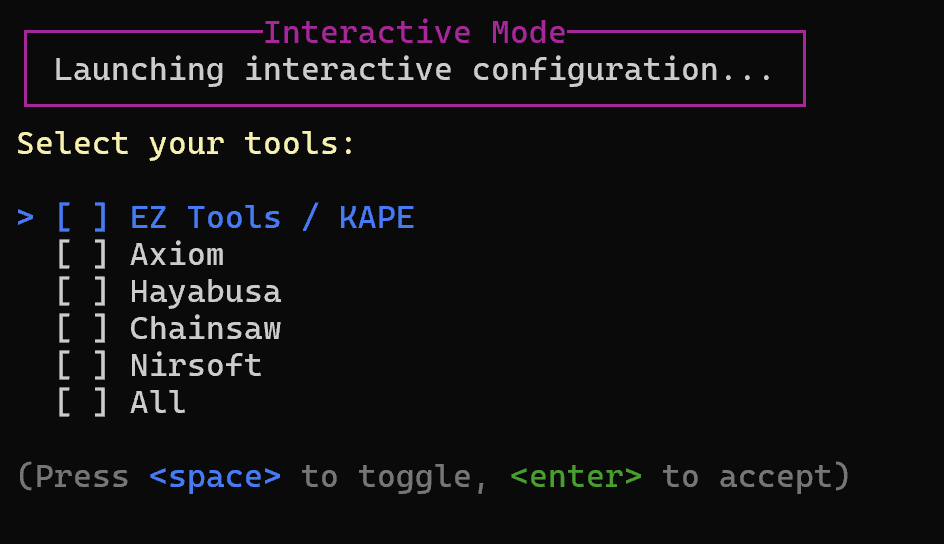
    Developed by Acquired Security, the tool’s core capability lies in its ability to discover and parse CSV artifacts generated by EZ Tools, KAPE, Axiom, Chainsaw, Hayabusa, and Nirsoft. Analysts simply point the tool at a base directory:

    Forensic-Timeliner
    Forensic-Timeliner

    Interactive Menu

    The engine applies YAML-driven filters defined in config/keywords/keywords.yaml, automatically detecting files by name, folder, or header patterns. New interactive enhancements in v2.2 include:

    • Silent mode (–Silent) to suppress prompts and banners, facilitating headless execution in automated workflows.
    • Filter previews rendered as Spectre.Console tables, allowing live validation of MFT timestamp filters, event-log channel/provider rules, and keyword tagger configurations.
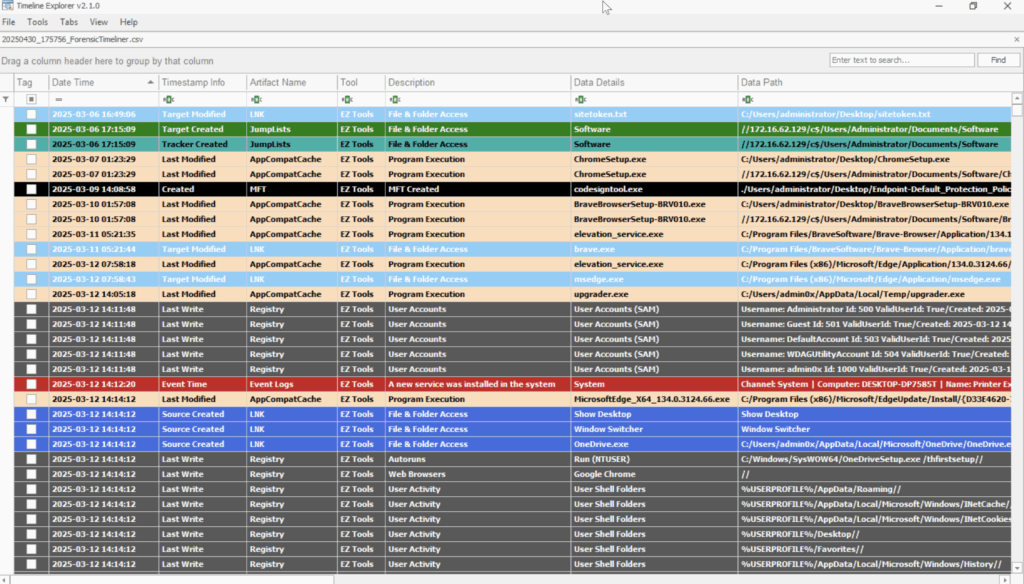
    • Keyword tagging support for Timeline Explorer (.tle_sess): tagged events are grouped by user-defined keyword sets, simplifying pivoting in downstream analysis.
    Timeline Explorer Support 
    Timeline Explorer Support 

    These tool features reduce manual effort and ensure repeatable, auditable processing across large-scale collections. Beyond basic timeline collation, Forensic-Timeliner offers advanced enrichment and export options.

    Date filtering (–StartDate, –EndDate) and deduplication (–Deduplicate) to tailor timelines to the incident’s window of interest.

    Raw data inclusion (–IncludeRawData) for forensic provenance, embedding original CSV rows in the output for forensic validation.

    Configurable parsers via YAML definitions, mapping artifact CSV fields to a standard timeline schema:

    DateTime | TimestampInfo | ArtifactName | Tool | Description | DataDetails | DataPath | FileExtension | EventId | User | Computer | FileSize | IPAddress | SHA1 | Count | EvidencePath.

    The tool’s RFC-4180-compliant CSV output ensures seamless compatibility with Excel, Timeline Explorer, and other forensic review platforms. Analysts can also export in JSON or JSONL formats for integration with SIEMs and log management systems.

    Customizable YAML parameters allow exclusion of undesired MFT extensions (default: .exe, .ps1, .zip, etc.) and path filters (default: Users), while built-in event-log filters restrict noise by channel and provider IDs.

    Forensic-Timeliner v2.2’s mix of interactive setup, automated discovery, and keyword-driven enrichment positions it as an indispensable tool for DFIR investigators seeking speed, precision, and consistency in constructing Windows forensic timelines.

    Follow us on Google News, LinkedIn, and X for daily cybersecurity updates. Contact us to feature your stories.

    The post Forensic-Timeliner – Windows Forensic Tool for DFIR Investigators appeared first on Cyber Security News.

    ¶¶¶¶¶

    ¶¶¶¶¶

    ¶¶¶¶¶

    ¶¶¶¶¶

    ¶¶¶¶¶

  • NCSC has issued an urgent warning regarding a critical zero-day flaw in Oracle E-Business Suite (EBS) that is currently being exploited in the wild. 

    Tracked as CVE-2025-61882, the vulnerability resides in the BI Publisher Integration component of Oracle Concurrent Processing and allows unauthenticated remote code execution. 

    Organisations running EBS versions 12.2.3 through 12.2.14—especially those exposed to the internet are at the highest risk.

    Oracle BI Publisher Flaw (CVE-2025-61882)

    Oracle’s security alert confirms that an attacker can send specially crafted HTTP requests to the BI Publisher Integration servlet without any prior authentication, achieving full system compromise. 

    No user interaction is required. A proof-of-concept HTTP request pattern resembles the following:

    NCSC Warns Oracle E-Business Suite 0-Day Vulnerability

    Successful exploitation could allow arbitrary command execution under the Oracle EBS application account, potentially leading to data exfiltration, system takeover, or lateral movement across the corporate network. 

    Indicators of compromise (IoCs) published in Oracle’s advisory include anomalous servlet URIs, unexpected child processes spawned by $XBPSRV, and suspicious outbound connections on non-standard ports.

    The NCSC is closely monitoring incident reports and has observed multiple exploitation attempts against UK organisations. 

    Exposed EBS instances on the public internet are the primary target, although internal networks lacking proper segmentation may also be vulnerable to threat actors who gain an initial foothold.

    Risk FactorsDetails
    Affected ProductsOracle E-Business Suite (EBS) 12.2.3 – 12.2.14; BI Publisher Integration component of Oracle Concurrent Processing
    ImpactRemote code execution (RCE)
    Exploit PrerequisitesNetwork access to exposed BI Publisher Integration endpoint; no authentication or user interaction required
    CVSS 3.1 Score9.8 (Critical)

    Mitigation 

    To address CVE-2025-61882, the NCSC urges UK organisations to adopt a defense-in-depth approach.

    Apply Oracle’s October 2023 Critical Patch Update followed by the dedicated EBS patch for CVE-2025-61882. Oracle’s advisory provides detailed installation instructions.

    NCSC Warns Oracle E-Business Suite 0-Day Vulnerability

    Leverage the published IoCs to scan logs, web access records, and process listings for signs of exploitation. Tools such as grep and SIEM rules can help identify:

    NCSC Warns Oracle E-Business Suite 0-Day Vulnerability

    Limit public exposure of Oracle EBS components. Where internet access is unavoidable, implement web application firewalls (WAFs), strict access control lists (ACLs), and network perimeter guidelines as outlined by the NCSC.

    Deploy EDR agents on application servers and conduct behavioral analysis to detect anomalous child processes or unusual outbound traffic.

    If compromise is suspected, contact Oracle PSIRT and report to the NCSC via its online portal. Early notification can help coordinate response and threat intelligence sharing.

    Additional free NCSC resources include guidance on vulnerability management, preventing lateral movement, and the Early Warning service for real-time alerts. 

    By taking these precautions, Oracle E-Business Suite resilience would be strengthened against present and upcoming vulnerabilities.

    Follow us on Google News, LinkedIn, and X for daily cybersecurity updates. Contact us to feature your stories.

    The post NCSC Warns of Oracle E-Business Suite 0-Day Vulnerability Actively Exploited in Attacks appeared first on Cyber Security News.

    ¶¶¶¶¶

    ¶¶¶¶¶

    ¶¶¶¶¶

    ¶¶¶¶¶

    ¶¶¶¶¶

  • Hosted at the repository “Huckel789/Android-RAT,” this fully undetectable (FUD) RAT is designed to evade antivirus detection permanently, maintain persistence in battery-optimized environments, and deliver a feature-rich command-and-control (C2C) experience entirely from a web interface. This Android RAT sets itself apart by eliminating the traditional requirement for a desktop or laptop in the attack chain. A […]

    The post New ‘Fully Undetectable’ Android RAT Discovered on GitHub appeared first on GBHackers Security | #1 Globally Trusted Cyber Security News Platform.

    ¶¶¶¶¶

    ¶¶¶¶¶

    ¶¶¶¶¶

    ¶¶¶¶¶

    ¶¶¶¶¶

  • Cybersecurity researchers are reporting an alleged security breach involving Chinese technology giant Huawei Technologies, with hackers claiming to have accessed and leaked sensitive source code and internal development tools. The incident, which surfaced through social media channels, represents a potentially significant security compromise of one of the world’s largest telecommunications equipment manufacturers. Hacker illustrating world’s biggest […]

    The post Hackers Allegedly Breach Huawei Technologies, Leak Source Code and Internal Tools appeared first on GBHackers Security | #1 Globally Trusted Cyber Security News Platform.

    ¶¶¶¶¶

    ¶¶¶¶¶

    ¶¶¶¶¶

    ¶¶¶¶¶

    ¶¶¶¶¶

  • A critical security vulnerability has been discovered in Zabbix Agent and Agent 2 for Windows that allows attackers with local system access to escalate their privileges through DLL injection attacks. 

    The flaw, tracked as CVE-2025-27237 with a CVSS score of 7.3 (High), affects multiple versions of the popular network monitoring solution and has prompted immediate security updates from Zabbix.

    The vulnerability stems from improper handling of OpenSSL configuration files in Windows environments, where the configuration file is loaded from a path that can be modified by low-privileged users. 

    This design flaw creates an attack vector for malicious actors who can inject dynamic link libraries (DLLs) to gain elevated system privileges.

    Zabbix Agent Windows Local Privilege Escalation

    The security flaw resides in how Zabbix Agent and Agent 2 process OpenSSL configuration files on Windows systems. 

    When these agents initialize, they load the OpenSSL configuration from a file path that has insufficient access controls, allowing users with limited privileges to modify the configuration content. 

    The attack requires local system access and involves modifying the OpenSSL configuration file to reference a malicious DLL that gets loaded during the agent’s startup or system restart process.

    The vulnerability affects a broad range of Zabbix versions, including 6.0.0 through 6.0.40, 7.0.0 through 7.0.17, 7.2.0 through 7.2.11, and 7.4.0 through 7.4.1. 

    The attack vector has specific prerequisites: attackers need existing access to the Windows system with Zabbix Agent installed, and the malicious configuration only takes effect after the Zabbix Agent service restarts or the system reboots.

    Security researcher himbeer discovered this vulnerability and reported it through Zabbix’s HackerOne bug bounty program

    The DLL injection technique exploits the trust relationship between the Zabbix Agent service and the OpenSSL library, allowing attackers to execute arbitrary code with the elevated privileges of the agent process.

    Risk FactorsDetails
    Affected Products– Zabbix Agent for Windows 6.0.0 – 6.0.40- Zabbix Agent for Windows 7.0.0 – 7.0.17- Zabbix Agent2 for Windows 7.2.0 – 7.2.11- Zabbix Agent2 for Windows 7.4.0 – 7.4.1
    ImpactLocal privilege escalation
    Exploit Prerequisites– Local Windows user account- Zabbix Agent or Agent 2 installed- Ability to modify OpenSSL configuration file path- Agent service or system restart to load malicious DLL
    CVSS 3.1 Score7.8 (High)

    Mitigations

    Zabbix has released security patches across all affected product lines to address this privilege escalation vulnerability. 

    The fixed versions include 6.0.41, 7.0.18, 7.2.12, and 7.4.2, which implement proper access controls for OpenSSL configuration file paths and validate configuration content before processing.

    System administrators should immediately update their Zabbix Agent installations to the corresponding patched versions. 

    The company has not provided specific workarounds for this vulnerability, making the security updates the primary mitigation strategy. 

    Organizations using Zabbix monitoring infrastructure should prioritize these updates, particularly in environments where multiple users have local system access or where the monitoring agents run with elevated privileges.

    Given the widespread deployment of Zabbix monitoring solutions in enterprise environments, this security flaw could potentially affect thousands of Windows-based monitoring installations globally.

    Follow us on Google News, LinkedIn, and X for daily cybersecurity updates. Contact us to feature your stories.

    The post Zabbix Agent and Agent 2 for Windows Vulnerability Let Attackers Escalate Privileges appeared first on Cyber Security News.

    ¶¶¶¶¶

    ¶¶¶¶¶

    ¶¶¶¶¶

    ¶¶¶¶¶

    ¶¶¶¶¶

  • A sophisticated malware campaign dubbed TamperedChef has successfully compromised European organizations by masquerading as a legitimate PDF editor application, according to new research from WithSecure’s Strategic Threat Intelligence & Research Group (STINGR). The campaign demonstrates how threat actors can leverage convincing advertising strategies and fully functional decoy applications to harvest sensitive credentials and establish persistent […]

    The post TamperedChef Malware Disguised as PDF Editor Hijacks Browser Credentials and Opens Backdoors appeared first on GBHackers Security | #1 Globally Trusted Cyber Security News Platform.

    ¶¶¶¶¶

    ¶¶¶¶¶

    ¶¶¶¶¶

    ¶¶¶¶¶

    ¶¶¶¶¶