A critical vulnerability has been discovered in DrayTek’s DrayOS routers, which could allow unauthenticated remote attackers to execute malicious code.
The flaw, tracked as CVE-2025-10547, affects a wide range of Vigor router models, prompting administrators to apply security updates urgently.
The vulnerability, detailed in security advisory DSA-2025-005 released on October 2, 2025, is classified as a “Use of Uninitialized Variable” weakness.
It can be triggered when an attacker sends specially crafted HTTP or HTTPS requests to the device’s Web User Interface (WebUI). A successful exploit can cause memory corruption, leading to a system crash.
DrayOS Routers Vulnerability
More critically, under certain conditions, this memory corruption could be leveraged by an attacker to achieve remote code execution (RCE) on the compromised device.
Since the attack vector is the WebUI, any router with this interface exposed to the internet is at high risk. The vulnerability was initially identified on July 22, and its public disclosure highlights the potential for widespread impact given the popularity of DrayTek routers in business environments.
DrayTek has outlined several mitigation strategies to protect against this threat. The most immediate defense against external attacks is to disable remote access to the WebUI and SSL VPN services from the WAN.
Properly configured Access Control Lists (ACLs) can also serve as a barrier to prevent unauthorized access from the internet.
However, these measures do not offer complete protection, as an attacker who has already gained access to the local network can still exploit the vulnerability through the LAN-side WebUI.
For some models, it is possible to further segment local access using VLANs and additional ACLs. Despite these temporary fixes, DrayTek strongly emphasizes that the only way to fully resolve the vulnerability and ensure complete protection is to upgrade the device firmware to the recommended patched version.
Affected Products and Mitigations
The vulnerability impacts an extensive list of DrayTek’s Vigor router series. Affected models include the Vigor1000B, Vigor2962, Vigor3910, Vigor3912, Vigor2135, and various models within the Vigor276x, Vigor286x, Vigor291x, Vigor292x, and Vigor295x series, among many others.
DrayTek has released specific firmware updates for each affected product line. For example, Vigor2962 users should upgrade to version 4.4.3.6 or 4.4.5.1, while Vigor2865 Series users need to install version 4.5.1 or later.
The company extended its appreciation to Pierre-Yves MAES from ChapsVision for responsibly disclosing the vulnerability.
All users of affected DrayTek products are urged to consult the official advisory for a complete list of models and their corresponding minimum firmware versions to apply the necessary patches immediately.
Passwork is positioned as an on-premises unified platform for both password and secrets management, aiming to address the increasing complexity of credential storage and sharing in modern organizations. The platform recently received a major update that reworks all the core mechanics.
Passwork 7 introduces significant changes to how credentials are organized, accessed, and managed, reflecting
On October 15, 2023, a threat actor using the handle GhostSocks published a sales post on the Russian cybercrime forum xss[.]is advertising a novel Malware-as-a-Service (MaaS) offering. The post introduced GhostSocks, a service designed to turn compromised Windows machines into residential SOCKS5 proxies, enabling cybercriminals to bypass anti-fraud defenses and monetize infected hosts. The initial […]
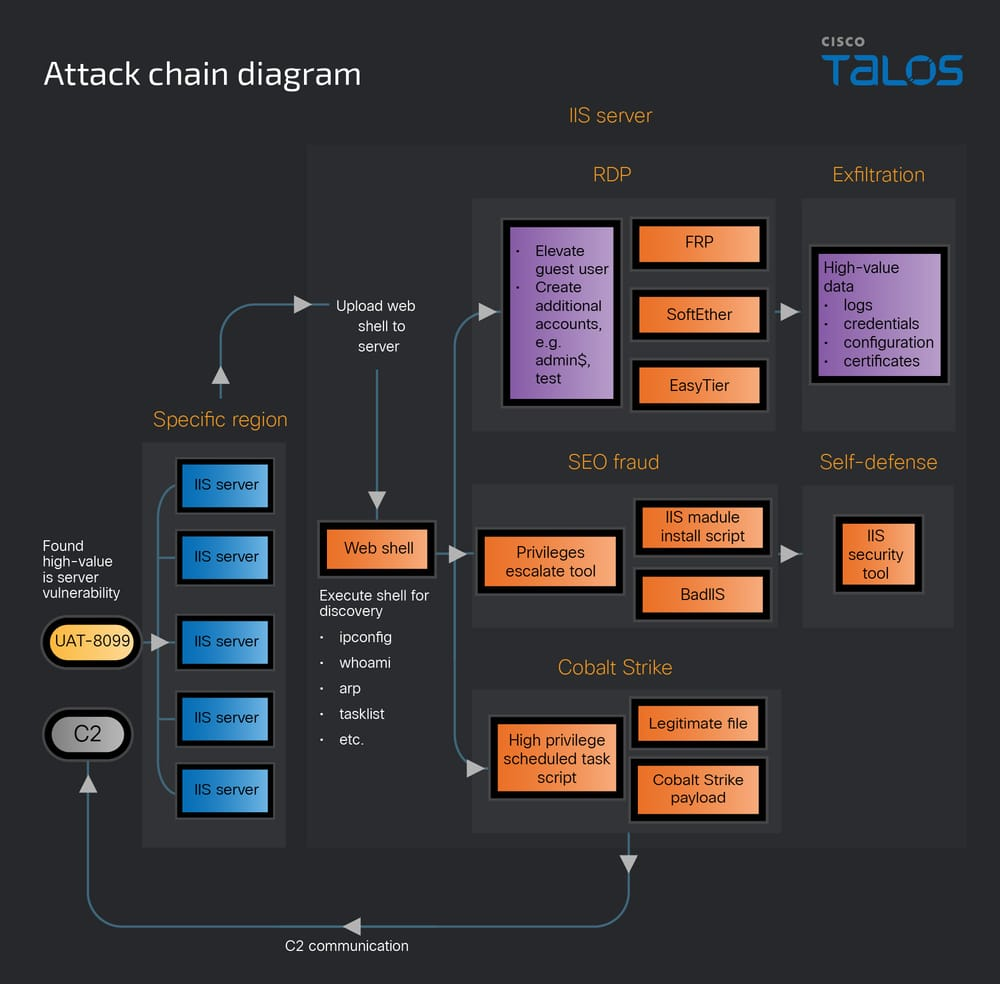
This campaign, which began surfacing in early 2025, leverages web shells, open-source hacking utilities, Cobalt Strike, and bespoke BadIIS malware to manipulate search rankings and harvest valuable credentials, certificate data, and configuration files.
UAT-8099’s Attack Chain
Analysis of DNS traffic and file census data reveals that UAT-8099 meticulously selects IIS servers with strong reputations, typically belonging to universities, technology firms, and telecom providers, to maximize the SEO impact.
IIS Servers Attack Chain
Cisco Talos reports that upon identifying a vulnerable server, the group exploits weak file upload configurations to plant an ASP.NET web shell (for example, server.ashx) under the /Html/hw/ directory. This initial foothold enables execution of reconnaissance commands such as:
Following reconnaissance, UAT-8099 automates user creation and privilege escalation via commands:
They then enable RDP access on a dynamically discovered listening port. For persistence, the group deploys SoftEther VPN, EasyTier decentralized VPN, and FRP reverse proxy tools, alongside a hidden “admin$” account for long-term remote access.
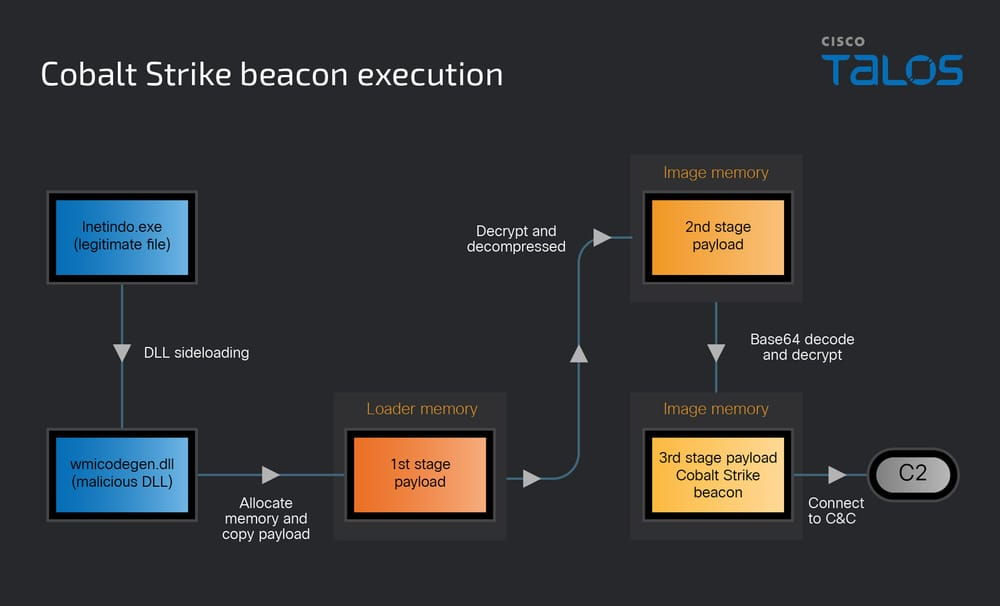
Cobalt Strike Execution
SEO Fraud Mechanisms
Once administrative access is secured, UAT-8099 installs BadIIS modules malware that hooks into CHttpModule::OnBeginRequest and CHttpModule::OnSendResponse handlers.
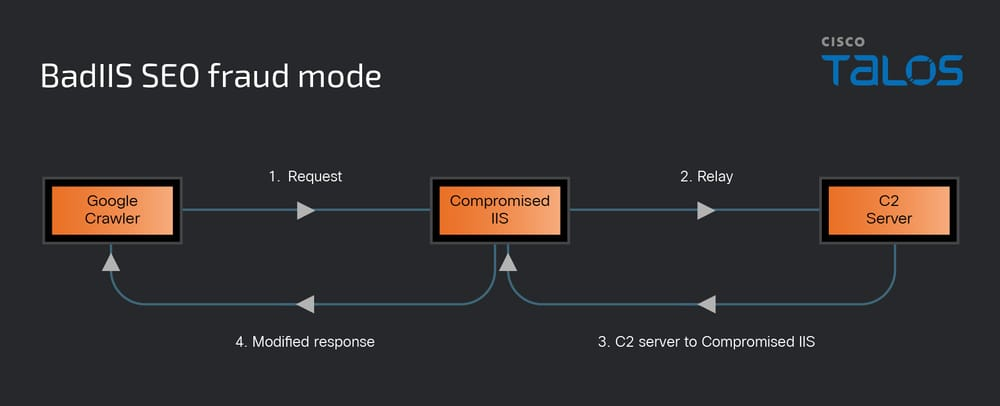
In proxy mode, the module decodes a hex-encoded C2 address and forwards requests to secondary C2 servers, using the native WriteEntityChunks API to craft valid HTTP responses.
In injector mode, BadIIS intercepts users’ browser requests from Google search results, retrieves JavaScript payloads like jump.html or pg888.js from C2, and embeds them into HTML responses to redirect victims to illegal gambling or advertisement sites.
The SEO fraud mode specifically targets requests where the User-Agent equals “Googlebot” and the Referer contains “google.com,” serving backlink-heavy HTML content to manipulate search ranking algorithms.
Bad IIS SEo Farud
Common URL path patterns include keywords such as casino, gambling, betting, and deposit. Talos has identified multiple BadIIS variants on VirusTotal, one with extremely low detection rates and another featuring simplified Chinese debug strings, underscoring the group’s continuous evolution.
Indicators of compromise, including web shell file paths, C2 URLs, and batch scripts (e.g., iis.bat, fuck.bat, 1.bat), have been cataloged for defenders.
Organizations running IIS should immediately audit file upload settings, enforce strict RDP policies, and deploy endpoint and network protections from Cisco Secure Endpoint, Secure Firewall, and Secure Analytics to detect and block BadIIS behaviors and related RDP misuse.
The cybersecurity landscape has witnessed a dramatic evolution in attack methodologies, with fileless malware emerging as one of the most sophisticated and dangerous threats facing organizations today.
Unlike traditional malware that relies on executable files stored on disk, fileless attacks operate exclusively in memory, leveraging legitimate system tools to achieve their malicious objectives while remaining virtually undetectable to conventional security solutions.
Key Differences Between Traditional Malware and Fileless Malware Attacks
According to the Ponemon Institute, fileless attacks are approximately ten times more likely to succeed than traditional file-based attacks.
This staggering success rate reflects a fundamental shift in how cybercriminals approach system compromise, moving away from easily detectable file-based methods toward memory-resident techniques that exploit the very tools administrators use daily.
Recent statistics reveal that fileless malware was involved in 52% of all system intrusion incidents globally in 2023, with over 60% of ransomware attacks incorporating some form of fileless component.
Understanding Traditional Malware Architecture
Traditional malware follows well-established attack patterns that have been refined over decades of cybercriminal evolution.
These threats typically involve executable files that must be written to and stored on the target system’s hard drive before they can be executed.
The attack lifecycle begins with initial delivery through vectors such as email attachments, malicious downloads, or infected removable media.
Once the malicious file reaches the target system, it requires execution permissions and often establishes persistence by modifying the registry, creating startup folder entries, or installing services.
The detection paradigm for traditional malware is relatively straightforward, relying heavily on signature-based identification methods.
Security solutions maintain extensive databases of known malware signatures, which are unique patterns or fingerprints that identify specific threats.
When files are scanned, their characteristics are compared against these signatures, triggering alerts when matches are found.
This approach has proven effective for identifying known threats and their variants, but struggles significantly with new or modified malware.
Traditional malware persistence mechanisms are well-documented and relatively easy to detect. Common techniques include registry Run keys that ensure automatic startup execution, Windows services that provide continuous operation, scheduled tasks that enable periodic execution, and boot sector infections that maintain deep system control.
These methods create detectable artifacts that security tools specifically monitor, making long-term persistence increasingly challenging for attackers.
The Fileless Malware Evolution
Fileless malware represents a fundamental departure from traditional attack methodologies, operating on principles that challenge every assumption underlying conventional cybersecurity defenses.
These attacks maintain several defining characteristics that distinguish them from file-based threats: they execute entirely within system memory without creating persistent files, utilize legitimate system utilities rather than custom executables, establish presence through registry modifications or process injection, and maintain communications through encrypted legitimate protocols.
The technical foundation of fileless attacks requires sophisticated capabilities that exploit the very architecture of modern operating systems.
Memory-resident execution allows dynamic code loading without touching the disk, while inter-process communication enables persistent presence across system boundaries.
System API manipulation provides access to legitimate functionality, and kernel-level operations can grant deep system control when properly executed.
Unlike traditional malware that announces its presence through file system artifacts, fileless attacks leverage what security researchers term “Living off the Land” (LotL) techniques.
These approaches exploit built-in system tools such as PowerShell, Windows Management Instrumentation (WMI), CertUtil, RegSvr32, and MSBuild to execute malicious operations while appearing as legitimate administrative activity.
The 2023 Global Threat Report from CrowdStrike revealed that 62% of detections were malware-free, instead leveraging legitimate credentials and built-in tools characteristic of living off the land attacks.
Memory-Based Execution Techniques
The cornerstone of fileless malware lies in its sophisticated memory manipulation techniques. Process injection represents one of the most critical methods, allowing malicious code to execute within the context of legitimate processes.
This technique encompasses several variations, including DLL injection, process hollowing, and reflective loading, each designed to evade different types of detection mechanisms.
DLL injection forces legitimate processes to load malicious dynamic link libraries directly into memory. The attack begins by identifying target processes using APIs such as CreateToolhelp32Snapshot, Process32First, and Process32Next.
Once a suitable target is identified, the malware uses VirtualAllocEx to allocate memory space within the target process, WriteProcessMemory to insert the malicious DLL path, and CreateRemoteThread to execute LoadLibrary, forcing the target to load the malicious library.
Process hollowing, also known as RunPE, represents an even more sophisticated approach. This technique creates a new process in suspended mode using CreateProcess with the CREATE_SUSPENDED flag.
The malware then unmaps the legitimate executable’s memory using ZwUnmapViewOfSection or NtUnmapViewOfSection, allocates new memory space with VirtualAllocEx, writes its malicious code using WriteProcessMemory, redirects the entry point with SetThreadContext, and finally resumes execution with ResumeThread.
Diagram illustrating the step-by-step workflow of a fileless attack using PowerShell exploitation and Flash vulnerabilities
Reflective DLL loading provides another layer of stealth by loading libraries directly into memory without relying on the Windows LoadLibrary function.
This technique requires custom loaders that manually perform the tasks typically handled by the operating system, including memory mapping, address resolution, and dependency loading.
The resulting execution occurs entirely in memory, leaving minimal forensic evidence.
Persistence Mechanisms In Fileless Attacks
Fileless malware employs sophisticated persistence mechanisms that differ fundamentally from traditional approaches.
Rather than relying on easily detectable file system modifications, these attacks leverage registry manipulation, WMI event subscriptions, and memory-resident techniques to maintain presence across system restarts.
Registry-based persistence represents one of the most common fileless techniques. Attackers modify autostart registry locations to enable persistent execution without creating files.
COM object hijacking redirects legitimate application execution to malicious code, while Image File Execution Options provide debugger-based persistence mechanisms.
Service configurations enable privileged execution, and registry value modifications create covert data storage capabilities.
WMI abuse provides particularly powerful persistence capabilities through permanent event subscriptions that survive system restarts automatically.
Conditional filters enable context-aware activation based on specific system events, while event consumer registration creates execution pathways that appear legitimate to most monitoring tools.
Complex event queries enable sophisticated trigger conditions, and encoded payloads obscure malicious intent from casual inspection.
The attackers stored heavily obfuscated PowerShell code across multiple registry keys within the HKCU\System directory, with each function stored as a separate registry key formatted as null-terminated strings.
Once the initial function established backdoor communications with the command and control server, it would call and execute additional keys, creating a sophisticated execution chain entirely within the registry.
Detection And Analysis Challenges
The detection paradigms for fileless attacks diverge significantly from traditional malware identification methods.
Conventional signature-based antivirus solutions prove largely ineffective against memory-resident threats, as there are no files to scan or known signatures to match.
File system monitoring overlooks entirely memory-resident operations, while static analysis capabilities prove ineffective against dynamic execution patterns.
Fileless attacks present considerably more complex detection challenges that require advanced behavioral analysis and memory forensics capabilities.
Security tools must distinguish malicious use of legitimate tools from normal administrative activities, a task that generates high false-positive rates without proper tuning.
Process injection detection demands real-time memory analysis, while persistence mechanisms often blend seamlessly with normal system operations.
Categorization of malware attack scenarios, distinguishing fileless attacks from traditional file-based attacks, including examples and memory injection characteristics (Source: Deepinstinct)
While EDR excels at monitoring endpoint activities and automated responses, it focuses exclusively on endpoints and may not be fast enough for today’s rapid attacks.
Detection-first approaches can allow malicious actors to access resources before threats are identified, limiting effectiveness against sophisticated attacks such as LockBit ransomware, which can encrypt 100,000 files in under six minutes.
Memory forensics requires specialized expertise and resources that many organizations lack. Volatile evidence disappears upon system restart, complicating investigation efforts.
Process injection makes artifact attribution exponentially complex, while legitimate tool usage obscures malicious intent.
Timeline reconstruction becomes difficult when attacks operate primarily in memory, and evidence preservation requires specialized procedures that go beyond traditional digital forensics.
Attack Lifecycle Comparison
The execution patterns of traditional and fileless threats follow distinctly different trajectories that reflect their underlying architectural differences.
Traditional malware attacks follow predictable phases, including initial delivery through email or downloads, file execution and installation, establishment of persistence through registry or startup folders, credential harvesting and lateral movement, and final data exfiltration or destructive actions.
Fileless campaigns execute through different stages that emphasize stealth and legitimate tool abuse. The attack lifecycle begins with memory-based payload delivery, often through malicious documents containing macros or scripts.
Legitimate tool exploitation follows, with attackers using PowerShell, WMI, or other built-in utilities to execute malicious commands.
In-memory persistence establishment occurs through techniques such as process injection or registry manipulation.
Living off the land enables lateral movement using trusted administrative tools, while covert data exfiltration occurs through legitimate channels that avoid detection.
The speed differential between these attack types is significant. According to CrowdStrike research, the intrusion breakout time—the period between initial compromise and lateral movement decreased from 84 minutes in 2022 to 62 minutes in 2023.
This acceleration reflects the increasing sophistication of attackers in deploying fileless techniques that bypass traditional detection mechanisms.
Real-world examples demonstrate these differences in practice. The 2021 attack on the Irish Health Service Executive exemplifies a fileless attack methodology.
The Conti ransomware group used a phishing email with a malicious Excel macro to penetrate an endpoint, then deployed a compromised version of Cobalt Strike to move laterally through the network for eight weeks before deploying ransomware.
This resulted in the exfiltration of 700GB of unencrypted data and the shutdown of an entire health service IT network serving over five million people.
Advanced Evasion Capabilities
Fileless malware achieves superior stealth through fundamentally different approaches to evasion.
While traditional malware employs established techniques such as packing and obfuscation to alter file signatures, polymorphic engines that generate unique instances, and anti-analysis measures to frustrate reverse engineering, fileless attacks achieve evasion through their very nature.
Living off the land techniques eliminate unusual process creation patterns that typically trigger security alerts. Memory-only execution avoids file system artifacts that forensic tools rely upon for evidence collection.
Legitimate tool abuse bypasses application whitelisting controls that many organizations implement. Minimal artifacts complicate forensic analysis efforts, while dynamic behavioral adaptation enables evasion of pattern recognition systems.
The environmental awareness capabilities of modern fileless malware represent another significant advancement. These threats can detect sandbox environments and alter their behavior accordingly, preventing security researchers from analyzing their true capabilities.
They can also assess system configurations and adapt their persistence mechanisms to match the specific environment, making detection even more challenging.
The resource profiles and operational impacts of fileless attacks differ significantly from traditional malware incidents.
Traditional malware typically requires moderate system resources, including disk space for executable storage, processing power for encryption and obfuscation operations, memory allocation for running processes, and network bandwidth for command and control communication.
These attacks often produce measurable performance impacts that monitoring tools can detect. Fileless attacks, conversely, demonstrate different resource consumption patterns.
They require minimal disk space since they operate primarily in memory, but demand more sophisticated system access and higher memory utilization.
Network traffic patterns may be more difficult to distinguish from legitimate administrative activity, while system performance impacts can be subtle and intermittent.
The forensic implications extend beyond the collection of simple evidence. Traditional malware leaves a clear trail, including file artifacts, registry modifications, network indicators, and system log entries that investigators can analyze.
Fileless attacks present several challenges, including the volatility of memory evidence, legitimate tool usage that can obscure malicious activity, minimal persistent artifacts, and difficulties in timeline reconstruction that complicate incident response efforts.
Future Implications and Mitigations
The evolution toward fileless attack methodologies represents more than a technical advancement – it signifies a fundamental shift in the cybersecurity threat landscape.
As attackers continue to refine these techniques, organizations must adapt their defensive strategies accordingly. The 1,400% year-over-year increase in fileless attacks reported in the 2023 research demonstrates the urgency of this challenge.
Organizations must move beyond detection-based security approaches toward preventive technologies that can stop threats without needing to identify them first.
Automated Moving Target Defense (AMTD) represents one such approach, randomly morphing the runtime memory environment to create unpredictable attack surfaces while leaving decoy traps where targets were previously located.
This deterministic, preventive approach proves effective against fileless attacks and other advanced threats. Network segmentation and strict access controls create barriers to the permissionless data flows within networks that fileless threats exploit.
Zero-trust strategies become particularly important when dealing with attacks that leverage legitimate administrative tools.
Advanced behavioral analytics capable of distinguishing malicious use of legitimate tools from normal administrative activity represent essential defensive capabilities.
The increasing sophistication of fileless malware techniques demands a corresponding evolution in cybersecurity defenses. Organizations must invest in advanced memory analysis capabilities, behavioral detection systems, and comprehensive incident response procedures specifically designed to address memory-resident threats.
As the threat landscape continues to evolve, the ability to detect, analyze, and respond to fileless attacks will become increasingly critical for maintaining an organizational security posture.
The fundamental differences between traditional and fileless malware attacks extend far beyond simple technical variations. They represent competing philosophies in cyberattack methodology, each with distinct advantages, challenges, and implications for organizational security.
Understanding these differences enables security professionals to develop more effective defensive strategies and prepare for the continuing evolution of cyber threats in an increasingly digital world.
The notorious SideWinder APT group has intensified its credential harvesting operations across South Asia, deploying sophisticated phishing campaigns that target government, defense, and critical infrastructure organizations through fake webmail portals. The campaign represents a significant escalation from the group’s August 2024 activities, which initially focused on 14 malicious webpages hosted on Netlify and pages.dev platforms. […]
A threat actor that’s known to share overlaps with a hacking group called YoroTrooper has been observed targeting the Russian public sector with malware families such as FoalShell and StallionRAT.
Cybersecurity vendor BI.ZONE is tracking the activity under the moniker Cavalry Werewolf. It’s also assessed to have commonalities with clusters tracked as SturgeonPhisher, Silent Lynx, Comrade Saiga,
Researchers at GreyNoise observed a sudden spike in attempts to exploit a well-known Grafana flaw. This vulnerability, tracked as CVE-2021-43798, allows attackers to traverse paths on a server and read any file they choose. Over the course of a single day, 110 unique IP addresses scanned GreyNoise’s Global Observation Grid for vulnerable Grafana instances. All […]
APT SideWinder, a state-sponsored threat actor long associated with espionage across South Asia, has recently launched a campaign deploying phishing portals that mimic legitimate Outlook and Zimbra webmail services.
Emerging in mid-2025, this operation uses free hosting platforms such as Netlify, pages.dev, and workers.dev to serve fake login pages tailored to government and military targets in Pakistan, Nepal, Sri Lanka, Bangladesh, and Myanmar.
By exploiting maritime and defense-themed lure documents, SideWinder not only harvests user credentials via direct POST requests but also stages malware in exposed directories for subsequent retrieval.
Beginning in August 2025, Hunt.io telemetry observed rapid domain churn—new phishing sites appeared every three to five days—underscoring a high operational tempo.
Many pages spoofed the Directorate General of Defense Purchases (DGDP) in Bangladesh, offering “Secured File” portals that prompted victims for email credentials under the guise of accessing Turkish defense equipment details.
Concurrently, Nepal’s Ministry of Finance staff received invitations to view PDF decoys titled “सम्माननीय प्रधानमन्त्रीज्यूको चीन भ्रमण सम्बन्धमा.pdf,” which redirected to a counterfeit Outlook login hosted on Netlify (98.84.224.111).
Fake Outlook webmail login page uncovered by Hunt.io, targeting Nepal’s Ministry of Finance and hosted on Netlify (Source – Hunt.io)
Hunt.io analysts noted the malware’s ability to blend social engineering with simple, effective credential collection.
In one SUPARCO-targeted site, JavaScript logic encodes the victim’s email in Base64 before redirecting to a secondary phishing page, then overlays a reload prompt to capture fresh inputs.
This staged redirection and obfuscation both tracks sessions and thwarts casual inspection.
JavaScript logic from the SUPARCO phishing kit showing Base64 encoding of the victim’s email and staged redirection (Source – Hunt.io)
The infection mechanism underpinning these fake portals relies on direct form submissions to attacker-controlled servers rather than client-side malware payloads.
A typical HTML form observed in the SUPARCO phishing kit posts captured credentials to the endpoint https://technologysupport.help/1pac.php:-
The hidden inbox field carries a Base64-encoded address to correlate stolen credentials with specific campaigns.
Once harvested, these credentials feed into broader espionage workflows, granting SideWinder access to restricted networks or facilitating follow-on malware deployment from open directories at IPs such as 47.236.177.123 and 31.14.142.50.
By hosting portals on widely used, trusted platforms, SideWinder evades simple domain-based blocks and leverages rapid redeployment once URLs are taken down.
Countermeasures should include continuous monitoring of free hosting domains, advanced filtering of form POST requests to unknown servers, and user training to recognize document-based lures tied to login prompts. 开心 with network segmentation and enforced multi-factor authentication, organizations can limit credential-based intrusions even when phishing attempts succeed.
Follow us on Google News, LinkedIn, and X to Get More Instant Updates, Set CSN as a Preferred Source in Google.
Enterprise networks worldwide are facing an aggressive, self-propagating malware campaign that exploits WhatsApp as its primary delivery mechanism.
First observed in early September 2025 targeting Brazilian organizations, SORVEPOTEL spreads through convincing phishing messages carrying malicious ZIP attachments.
Upon execution, the malware not only establishes a foothold on the host system but also hijacks active WhatsApp Web sessions to replicate itself across all contacts and groups associated with the compromised account.
This unprecedented blend of social engineering and automated propagation has elevated SORVEPOTEL into a significant threat for enterprises relying on messaging platforms for internal communication.
Initial reports traced the campaign to phishing messages bearing archive names such as RES-20250930112057.zip or ORCAMENTO114418.zip, masquerading as innocuous documents like receipts or budgets.
These messages prompt users to “baixa o zip no PC e abre” (download the ZIP on PC and open it), explicitly targeting desktop sessions to maximize enterprise impact.
Trend Micro analysts identified that an alternative infection vector involves phishing emails distributing similarly named ZIP attachments, often appearing to originate from trusted institutions with subjects like “ComprovanteSantander-75319981.682657420.zip.”
Once the ZIP is extracted, the victim encounters a deceptive Windows shortcut (.LNK) file designed to launch a hidden PowerShell script, which downloads and executes the primary payload from attacker-controlled domains.
Attack Chain
As the .LNK file executes, it invokes an encoded command that launches a batch script in a concealed window.
The SORVEPOTEL attack chain (Source – Trend Micro)
This attack chain illustrates the encrypted command line within the shortcut that leverages the PowerShell Invoke-Expression (IEX) function with the -enc parameter for payload obfuscation.
This script retrieves a secondary batch file payload and establishes persistence by copying itself into the Windows Startup folder.
Through a series of Base64-encoded PowerShell commands, the malware generates URLs pointing to command-and-control (C2) servers and uses Net.WebClient to fetch additional components, which are then executed in memory.
The decrypted command inside the batch file connects to the C2 infrastructure. By employing typo-squatted domains such as sorvetenopotel.com (a play on the Portuguese phrase “sorvete no pote”), the attackers blend malicious traffic with legitimate network flows, evading basic detection mechanisms.
Once persistence is in place, the malware scans for active WhatsApp Web sessions. Upon locating an authenticated session, SORVEPOTEL automatically propagates the same malicious ZIP across all contacts and groups.
This automated spam not only multiplies infection rates but often results in compromised accounts being banned for violating WhatsApp’s terms of service.
By combining social engineering, script-based execution, and rapid session hijacking, SORVEPOTEL demonstrates a novel escalation in messaging-platform attacks.
The malware’s focus on widespread distribution rather than immediate data theft underscores a shift toward maximizing reach and operational disruption.
Organizations should enforce strict endpoint policies to block unauthorized shortcuts, disable auto-download features in messaging applications, and conduct regular user awareness training to mitigate the evolving risk posed by self-propagating threats like SORVEPOTEL.
Follow us on Google News, LinkedIn, and X to Get More Instant Updates, Set CSN as a Preferred Source in Google.






.webp)
.webp)
.webp)